
Essential Commercial Fridge Maintenance Checklist for Unifrost Models
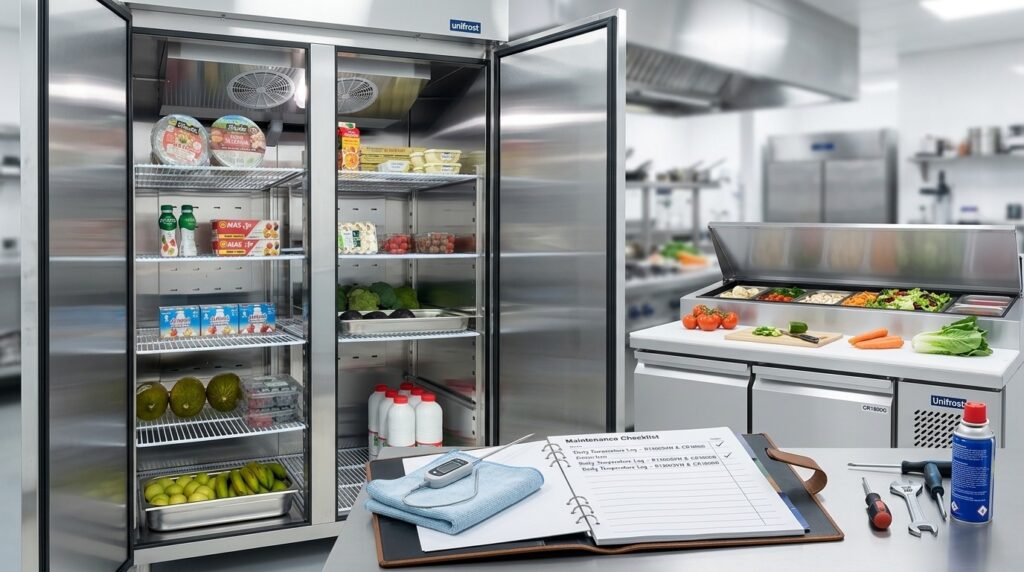
Practical Unifrost fridge maintenance for Irish businesses: daily, weekly, monthly checks to ensure efficiency and longevity.
Commercial Fridge Maintenance Checklist for Unifrost Models
If you run a busy kitchen, your commercial fridge is only as dependable as your maintenance routine. A simple, repeatable checklist helps you hold safe temperatures, cut running costs, reduce emergency callouts, and protect the lifespan of your Unifrost equipment.
This guide walks you through practical daily, weekly, monthly, and periodic checks you can safely do in house on common Unifrost types, including upright fridges, counter fridges, undercounter units, prep counters and saladettes, and display and cake display fridges. You will also see what changes by application, what to log for HACCP and EHO expectations, and the common mistakes that lead to poor airflow, icing, and temperature drift.
You will finish with clear decision points on when cleaning and loading fixes are enough, and when to stop and call a qualified refrigeration engineer, especially for electrical faults, refrigerant issues, persistent temperature problems, or anything that could impact warranty cover.
Why Regular Maintenance is Crucial
Commercial fridges rarely fail out of nowhere. They usually lose performance gradually first: temperatures drift, the compressor runs longer, and components take more wear. In hospitality, that is more than an equipment headache. It becomes a food safety and compliance risk if chilled food is not being held in the safe range.
The Food Safety Authority of Ireland (FSAI) advises keeping refrigerated food at 0 to 5°C. If a unit is struggling to hold that range, you need to treat it as an operational issue, not something to “keep an eye on”. The catch is that the same fridge can behave very differently depending on where it lives. A unit on a hot pass in a busy café will need more attention than one in a cool storeroom in a hotel. Your maintenance routine should match the heat, grease, dust, and door-opening it actually sees.
How maintenance protects food safety and your HACCP records
Your HACCP paperwork is only as strong as your cold holding. Clean airflow paths, intact door seals, sensible loading, and consistent temperature checks make it far easier to stay within the range the FSAI advises for refrigerated food (0 to 5°C).
It also makes EHO visits more straightforward. A simple routine and steady temperature logs speak for themselves. “We think it was fine” does not.
This matters most on high-touch equipment like saladettes and prep counters (constant lid opening), and on display and cake fridges where presentation can encourage overfilling. Maintenance will not fix poor habits, but it gives you a buffer when service is flat out and doors are opening all day.
Why a clean, well-set-up fridge costs less to run day to day
Most avoidable running-cost increases come from basics you can actually control: dirty condensers, poor ventilation, icing on internal coils, and door gaskets that are torn or not sealing. When heat cannot be rejected properly, the fridge has to run longer to recover, which increases electricity use and shortens the life of key parts.
In Irish kitchens, the usual offenders are grease and flour dust. An undercounter beside a fryer, a counter fridge on a busy line, or an upright squeezed into a tight alcove will nearly always need more frequent cleaning and checks than the same unit in a cleaner, cooler back-of-house space.
How routine checks prevent peak-time breakdowns (and when to stop and call an engineer)
Peak-time breakdowns are often predictable. Warning signs tend to show up first: higher cabinet temperatures than normal, slow pull-down after door openings, unusual noise, new icing patterns, or repeated alarms. A quick check as part of opening and closing duties is often the difference between fixing a simple loading or airflow issue and discovering at 7pm that your display fridge is running warm.
There is also a clear point where you stop and call a qualified refrigeration engineer. Use this as your hard line:
If the unit cannot hold a safe temperature after you have checked loading, cleared obvious airflow restrictions, and confirmed the door is closing and sealing properly.
If you see oil staining, repeated icing after defrost, burning smells, or tripping electrics, or anything that suggests an electrical or sealed-system fault.
If the fridge has just been repaired and performance is still unstable. Repeated “tweaks” by staff can mask the underlying issue and complicate fault-finding and warranty support.
Once the “why” is clear, the practical step is making the routine easy for staff to follow without guesswork. That is where a simple daily, weekly, and periodic checklist earns its place.
Unifrost Fridge Maintenance Checklist
Build your Unifrost fridge maintenance around four routines: daily hygiene and temperature checks, weekly cleaning and seal checks, monthly condenser and airflow checks, and a quarterly deeper inspection. Keep the steps consistent across uprights, counters, undercounters, saladettes, and display units. Then add a couple of format-specific checks for glass merchandisers and prep counters. Log what you do as part of HACCP so you can show control if an Environmental Health Officer asks.
If you see repeated temperature drift, heavy icing, burning smells, tripped electrics, or anything involving refrigerant or wiring, stop and call a qualified refrigeration engineer.
1. Set your “safe baseline” for how the unit should run
Before you can spot a fault, your team needs to know what “normal” looks like in your kitchen, not in a brochure.
Across common commercial formats, a healthy fridge should:
Pull back to temperature after routine door openings
Close and seal without forcing
Keep internal vents clear for airflow
Avoid fighting heat sources like grills, combi ovens, hot passes, or direct sun through a window
For food safety in Ireland, align your day-to-day target with your HACCP plan. As a practical reference point, the FSAI consumer guidance commonly used is 5°C or below for safe chilled storage: Food Safety Authority of Ireland guidance on fridge temperature.
2. Run the daily checks at opening and closing (fast, staff-safe)
Daily tasks should take minutes. Done consistently, they prevent the “it was fine this morning” problems that turn into an emergency call at 6pm on a Saturday.
At opening
Check the displayed cabinet temperature is stable and sensible for your HACCP target.
Check doors shut cleanly. If a door is “bouncing”, look at levelling and hinges before you assume it is a refrigeration fault.
Confirm airflow inside the cabinet. A very common cause of warm spots is stock packed tight to the back or blocking internal vents.
At close
Wipe spills immediately and clear debris from corners, rails and door frames.
Leave the cabinet tidy so it starts clean and circulating properly in the morning.
On prep counters and saladettes, treat the pan rail and worktop as hygiene-critical: empty pans correctly, wipe down, and do not leave acidic residues sitting overnight.
3. Printable checklist (daily, weekly, monthly, quarterly)
Use this as the core routine for a kitchen opening checklist, a closing checklist, and your HACCP folder. It suits typical commercial formats: uprights, counters, undercounters, saladettes and prep counters, and display units.
Daily (opening and closing)
Check the cabinet temperature display and record it in your HACCP log.
Confirm doors shut fully and are not catching or bouncing on uneven floors.
Wipe internal spills and visible debris, especially around door frames and drain channels.
Check airflow: keep internal vents clear and do not pack stock tight to the back.
For glass display units, clean glass with a non-abrasive cloth and keep air vents clear to reduce fogging and warm spots.
Weekly
Clean door gaskets with warm water and mild detergent, then dry them so they seal properly.
Inspect gaskets for splits, flattening, or areas pulling away from the frame.
Clean shelves, runners and corners where grease and crumbs build up.
Check positioning: if the unit is being hit by heat, steam, or fryer grease from the cookline, move it or shield it where possible.
Monthly
Check the condenser air path is clear and clean accessible dust build-up carefully with a soft brush or vacuum.
Inspect the drain area for slime or blockage and clean as needed to prevent odours and internal water.
Listen for changes: louder fan noise, rattles, or cycling that seems more frequent than usual.
Quarterly (or more often in hot, greasy kitchens)
Deep clean behind and beneath the unit and confirm it is level and stable.
Review your HACCP temperature records for drift, repeated high readings, or frequent “door left open” events.
If the unit is mission-critical, heavily loaded, or running in a hot or poorly ventilated space, plan a preventative maintenance visit.
4. Clean condenser coils and ventilation without causing damage
Condenser cleanliness affects running cost and reliability, especially in chipper-style grease, bakery flour dust, or tight back-bar cupboards.
Only clean what you can access safely without removing sealed covers or disturbing wiring. If you need to switch off for safe access, do so. Use a soft brush or vacuum and take care not to bend fins. Avoid pressure washing, soaking electrics, or using aggressive chemicals unless the manufacturer specifically allows it.
If the condenser is not accessible without dismantling panels, or it is impacted with grease and grime, book a professional clean. A rushed coil clean is an easy way to turn routine maintenance into a fan or electrical failure.
5. Keep door seals working, because seals are cheaper than compressors
A leaking gasket pulls warm air into the cabinet. The fridge runs longer, struggles at busy service, and is more likely to ice up or drift warm.
Help the unit by:
Training staff to close doors properly, not by slamming or leaning on them
Keeping gaskets clean (weekly)
Checking simple causes of poor sealing: unit out of level, loose hinges, or packaging trapped in the door
Warning signs that need action:
Persistent condensation around the door frame
Icing near the door area
A “paper test” fails: if you can pull a sheet of paper out easily with the door closed, the seal is likely not doing its job
Replacing worn gaskets is usually straightforward for a service technician and often cheaper than the knock-on cost of constant warm-air ingress.
6. Know when to stop and call a qualified refrigeration engineer
Your team can do cleaning, visual checks, correct loading, and temperature logging. They should not open electrical panels, interfere with refrigerant circuits, or chip ice with sharp tools.
Call an engineer promptly if you see:
Repeated high temperatures after you have corrected loading and checked seals
Heavy icing that returns quickly after a normal defrost cycle
Burning smells, unusual electrical noise, or the unit tripping the breaker
A compressor that is constantly running and very hot
Fans not running or obvious airflow failure
Any suspected refrigerant leak
For safety and warranty protection, anything involving gas, electrics, controller wiring, or component replacement should be handled by a qualified professional.
7. Recordkeeping that actually helps in Irish HACCP audits
A maintenance checklist is useful when it produces evidence, not paperwork for its own sake.
Keep one page per unit with:
Asset name/location (for example “Main kitchen upright” or “Back bar display”)
Daily temperature records
Dates of weekly and monthly tasks
Notes on issues spotted and corrective actions taken
Dates of engineer visits and any parts replaced
This mirrors what EHOs typically look for in practice: consistent monitoring, sensible corrective action when you go out of tolerance, and proof that the equipment protecting food safety is being maintained. It also makes it easier to separate genuine faults from airflow, loading, and cleaning issues when a unit starts struggling under real Irish service conditions.
Common Maintenance Mistakes
Most “sudden” breakdowns start with small, repeated issues: poor ventilation, dirty heat-exchange surfaces, and doors that do not seal properly. The knock-on effect is longer run times, temperature drift and, in a busy kitchen, a cabinet that struggles to recover after door openings and deliveries. You might not see the damage straight away, but over a few weeks it usually shows up as higher electricity use, more icing, slower pull-down and a higher chance of an out-of-hours callout.
These patterns apply across Unifrost upright fridges (including CR and R series), counters and undercounters, saladettes and prep counters, and glass display and cake display units. As a rule: if it involves electrics, refrigerant, controls, or a fault that keeps returning, stop “having a go” and put it to an engineer.
Blocking ventilation or squeezing the unit in too tight: If air cannot move around the grille and condenser, heat cannot escape. The cabinet will run hotter during service, the compressor will run longer, and wear and energy use go up.
Turning the stat down to mask warm temperatures: This often creates icing and poor internal airflow without fixing the real cause (loading, ventilation, a dirty condenser, or a failing seal). You can end up with cold air at the front and warm product where it matters.
Overloading shelves or packing product tight to the back wall: Air needs space to circulate. When you block it, you get warm spots, slow recovery after door openings, and inconsistent conditions that make HACCP checks harder than they need to be.
Skipping condenser cleaning in floury, greasy, or lint-heavy kitchens: A dirty condenser cannot reject heat properly. Head pressure rises, performance drops, and the compressor is put under unnecessary stress.
Treating door gaskets as “cosmetic”: Split, loose, or dirty seals pull warm, moist air into the cabinet. That drives icing and condensation and forces longer run times.
Using harsh chemicals or abrasive pads on trims and seals: Aggressive cleaners can haze plastics, damage finishes and shorten gasket life. On display and cake units, clarity and seals matter for both holding temperature and presenting product properly.
Power-washing, soaking electrics, or chipping ice out with sharp tools: You risk electrical faults and puncturing internal surfaces. Any time saved is quickly lost when the unit is down.
Ignoring repeat alarms, nuisance tripping, burning smells, or oily residue: Treat these as warning signs, not background noise. Isolate the unit where appropriate and escalate, as they can indicate electrical or refrigerant-related problems.
Two Ireland-specific points worth building into staff training. First, your target is the food temperature, not just the cabinet display. The FSAI advises chilled food should be maintained at 0 to 5°C as part of maintaining the cold chain in food businesses (FSAI advice on maintaining food temperatures). Second, work that needs technical competence to prevent danger, including work on electrical parts and anything involving a risk from refrigerant release, should be done by a competent person under Irish workplace safety requirements (S.I. No. 299/2007).
If you want this to stick, tie each mistake to one safe action a staff member can take on shift (clear vents, check the door closes cleanly, report alarms early). That is what a day-by-day fridge maintenance checklist is for: catching the small things before they become downtime.
Integrating Maintenance into Daily Operations
Integrate fridge care into the routines you already run: opening checks, service checks, close-down cleaning, plus a weekly inspection in a quieter slot. Assign clear ownership per unit type (upright, counter, undercounter, saladette, display) and keep a simple log. It helps you prove checks were done, and it highlights patterns before they turn into a breakdown.
Train staff on the small number of tasks they can safely do. Draw a hard line around anything electrical, refrigerant-related, or requiring panels to be removed. When in doubt, check performance using food temperatures, not just the cabinet display. Heavy loading, frequent door openings and warm items going in can all make the display look “fine” while food temperature tells a different story.
1. Map each fridge to a real routine (opening, service, close)
Start by listing what you actually have on site, because the workflow changes by format:
Upright fridges (bulk storage): quick opening temperature check; close-down tidy and wipe.
Counter fridges and undercounters: take more knocks during service, so add quick “is airflow blocked?” checks.
Saladettes and prep counters: disciplined end-of-day clean around pans, lids and the top area.
Glass display and cake display fridges: gentler cleaning to avoid scratching or clouding.
If a unit sits on the hot line, near fryers, or in a tight servery, expect more frequent cleaning and more temperature drift during peak bursts. That is not automatically a fault. It is usually a ventilation and workload issue you can manage with better loading, door discipline and condenser cleaning.
2. Standardise what “good” looks like for temperature control and logging
A checklist only works when everyone is aiming at the same target. For chilled storage, set expectations around keeping food at safe temperatures. In practice that often means setting the fridge to around 3°C to 4°C so food stays between 0°C and 5°C, in line with the FSAI temperature control guidance for caterers.
Keep logging inside your existing HACCP routine instead of creating a new admin job. If you use the Safe Catering Pack, FSAI Recording Form 2 (Refrigeration) is designed for logging fridge and freezer temperatures and recording corrective actions. That is exactly what Environmental Health will look for if there is ever a query.
3. Make ownership obvious, not assumed
In a busy kitchen, “everyone” quickly becomes “no one”. Put names beside tasks and tie checks to roles that are already in the building at the right times:
Opener: verifies temperatures and obvious door seal issues.
Section lead during service: keeps vents clear and stock organised.
Closer: cleans, resets and confirms doors are shutting properly.
Manager/head chef: does the weekly deeper check and reviews the log for trends.
A short routine that fits on opening and close-down sheets usually works best:
Opening: check and record temperature; quick visual check for blocked vents and poor door closure
During service: keep stock off the back wall and away from air vents; avoid holding doors open
Close-down: wipe spills; clean door gaskets; confirm doors shut cleanly; remove anything that will block airflow overnight
Weekly: deeper clean of shelves and accessible drains; inspect gaskets for splits; confirm the unit is level and doors self-close properly
Monthly/quarterly: schedule condenser cleaning if it is user-accessible, otherwise book a qualified engineer to do it safely
4. Set clear “stop and call an engineer” rules
Your checklist should also tell staff what not to do. Do not let untrained staff remove panels, interfere with electrics, or attempt refrigerant or compressor work.
Call a qualified refrigeration engineer if you see:
Persistent temperature failure or poor recovery after normal door openings
Repeated tripping or electrical smells
Oil residue, unusual compressor noise, or rapid ice build-up returning after defrost
This is how you avoid the classic emergency callout at the worst time. If your log shows performance drifting over days, you can plan a repair for a quieter morning instead of losing stock on a Friday night.
5. Add a post-repair reset so the same fault does not return
After any repair, treat the next 48 hours as a controlled reset:
Confirm the unit has adequate ventilation and is positioned correctly.
Load it properly and stick to the agreed temperature target.
Increase check frequency briefly so you catch early warning signs.
If the team adopted workarounds during the fault, like propping doors, overloading, or putting warm food straight in, call those out and remove them. Those “temporary” habits are often what triggers the next issue.
Once this is embedded, you can turn it into a simple printable maintenance checklist covering daily, weekly, monthly and quarterly tasks across upright, counter, undercounter, saladette and display units.
Connecting to Unifrost Support Ecosystem
How you respond depends on what you are dealing with: routine care, HACCP records, or a fault that could turn into downtime mid-service. In Ireland, it helps to keep your maintenance approach aligned with your HACCP controls. The FSAI guidance on HACCP-based food safety management procedures is a solid reference for what an EHO will typically look for in terms of evidence and routine checks.
The main line to hold is this: many checks are safe for trained staff, but once you get into electrics, refrigerant, or sealed-system work, it becomes specialist repair and compliance work.
Where Unifrost resources help most (without slowing you down on shift)
If you are running a mix of refrigeration formats across kitchen and front-of-house, the simplest win is having the right document beside the right unit. That typically means a user manual, basic cleaning guidance, and a clear “stop and call” note for anything that should not be handled in-house.
Even when models differ, the support pattern is the same. Keep one consistent place where staff can find:
the manual for that specific unit
your site notes (how you load it, when you clean it, who checks temps)
what to do when temperatures drift or alarms appear
A small “fridge file” per unit, paper or digital, also speeds up callouts. If you can tell an engineer what changed, when it started, and what you have already checked, you cut out most of the back-and-forth.
What staff can do safely vs what should go straight to an engineer
In most Irish operations, staff can cover hygiene, airflow and basic temperature checks. Qualified technicians should handle anything that carries electrical or refrigerant risk. Under EU and Irish enforcement of F-gas rules, any work involving refrigerant handling must be done by appropriately certified personnel. The EPA’s overview of fluorinated greenhouse gas obligations in Ireland is a clear reference for where that line sits.
A practical split to use on site:
Staff tasks: clean internal surfaces, keep vents and grilles clear, check doors and seals are closing properly, confirm the controller reading looks sensible, and log temperatures and issues as part of your HACCP routine.
Engineer tasks: anything involving refrigerant, electrics, controller replacement, persistent temperature alarms, repeated icing that returns after correct defrost and loading, unusual compressor cycling, burning smells, or tripping at the socket.
That approach protects uptime and reduces the risk of a well-meant fix turning into a bigger failure or a warranty issue.
Getting faster, more accurate support when something goes wrong
When you contact Caterboss or an Unifrost-approved engineer, the first message matters. You will get a quicker answer if you share operational facts rather than guesses, for example:
where the unit sits (hot line, tight alcove, beside a fryer)
whether it has just been reloaded with warm stock
whether it is being overfilled or packed against the back panel
how often doors are opened during service
whether the issue is constant or only shows up during peak periods
If performance is marginal rather than a full failure, try to separate loading and airflow from a mechanical fault before escalating. A counter fridge on a busy pass can look like it is failing when it is really short of ventilation at the grille or being opened continuously during a rush. A simple log of when temperatures drift is often more useful than one reading, especially for saladettes and prep counters where open-top use is part of normal service.
Care considerations for glass display and cake displays
Front-of-house display units are where cleaning and presentation pressure collide. With glass display fridges and cake displays, stick to gentle, non-abrasive cleaning and a dry finish. Keep drainage areas and door tracks clean so doors close properly and condensation does not build up. Avoid harsh chemicals on plastics, seals and printed trims. Do not use sharp tools on ice. Cosmetic damage and punctures are an expensive way to save five minutes.
If a display unit is misting up, it is often a mix of door opening, ambient humidity and airflow. Better housekeeping and loading can help, but persistent condensation or icing that returns quickly is a good point to stop experimenting and get it assessed properly.
When you pull these habits together, checks are easier to train, easier to audit and more consistent. That is exactly what you want before you pin a simple checklist beside the fridge.
Commercial Fridge Maintenance Checklist FAQs
How often should I service or maintain my commercial fridge?
For most Irish kitchens, use a tiered routine:
Daily: quick hygiene, temperature and airflow checks by staff.
Weekly: deeper cleaning (including seals) and a visual inspection of components.
Monthly: a more thorough clean and performance review, including cleaning any accessible air intakes and checking for dust build-up.
Every 6 to 12 months: schedule a professional preventative maintenance visit (more often in hot, greasy or high-traffic kitchens).
If the unit is struggling to hold temperature, icing up, running constantly, or making unusual noises, treat that as repair needed now, not “next service.” Refrigerant, electrical and sealed-system work should always be done by a qualified refrigeration engineer.
What basic daily or weekly checks should staff do on a commercial fridge?
A simple commercial fridge maintenance checklist that staff can safely follow:
Daily (opening or shift start)
Check and record the cabinet temperature (use the unit display plus a probe check where your HACCP requires it).
Confirm doors close fully and nothing is blocking them.
Keep air vents clear inside the cabinet and avoid overloading shelves.
Wipe up spills and keep packaging from obstructing airflow.
Daily (end of service)
Clean food-contact and touch points (handles, door edges, prep-top areas on saladettes).
Ensure the unit is left on and stable unless you have a planned shutdown procedure.
Weekly
Clean and dry door seals/gaskets and check for splits, gaps or hardened areas.
Inspect hinges, door alignment and self-closing action.
Check the drain area (if accessible) for blockages and odours.
Lightly clean any accessible air intakes/grilles and remove dust build-up.
If you see repeated alarms, heavy icing, water pooling inside, or burning smells, stop troubleshooting and call an engineer.
What is the correct operating temperature for a commercial fridge?
As a practical target for food-safe chilled storage, most businesses run commercial fridges at +1°C to +5°C, aiming for a steady ~+3°C where suitable for the product.
Key points:
Judge performance by product temperature, not just the air temperature on the display.
Allow for door openings, loading and hot kitchen ambient conditions.
If you cannot keep chilled food within your required limits even after improving loading and airflow, book a professional check.
What records or logs should I keep for HACCP compliance?
Keep records that prove the fridge is controlled, monitored and maintained:
Temperature logs: at least daily (or as your HACCP plan states), including corrective actions when out of range.
Cleaning records: who cleaned, what was cleaned (interior, seals, handles, prep-top surfaces), and when.
Maintenance and service history: dates, what was done, parts replaced, and the engineer/company details.
Breakdown/corrective action log: what went wrong, product disposition (discarded/moved), and verification that temperature control was restored.
Calibration/verification records: probe thermometer checks and any adjustments.
This paperwork turns your commercial fridge maintenance checklist into evidence for inspections and helps spot recurring issues before they become failures.
How can regular maintenance extend the lifespan of my fridge?
Regular maintenance reduces the main causes of early failure: overheating, poor airflow, moisture/ice issues and door leakage.
In practical terms it helps by:
Keeping condenser/airflow paths clean, so the refrigeration system runs cooler and with less strain.
Maintaining tight door seals, so the unit cycles normally instead of running constantly.
Preventing ice build-up and blocked drains, which can cause temperature swings and water damage.
Catching small issues early (loose hinges, damaged gaskets, abnormal noise) before they become compressor or control faults.
The biggest “lifespan win” is consistency: assign ownership, schedule tasks, and escalate quickly to a qualified engineer when performance doesn’t recover after basic checks.
Need a fridge that fits how your kitchen actually runs?
If you’re building a maintenance routine and still seeing temperature swings, icing, or heavy wear from busy service, it may be a sign the unit type or layout is not matched to the job. Unifrost covers upright, counter, undercounter, saladette/prep and display fridges, so you can choose a format that suits your workflow and helps keep your commercial fridge maintenance checklist realistic.
Browse the Unifrost Commercial Fridge Range or contact Unifrost for guidance on selecting the right model for your menu, space and operating pattern.
View Unifrost fridges at Caterboss
For current product options, pricing and availability, continue to Caterboss.