
Unifrost Frost-Free Undercounter Freezer: Is It Right for Your Business?
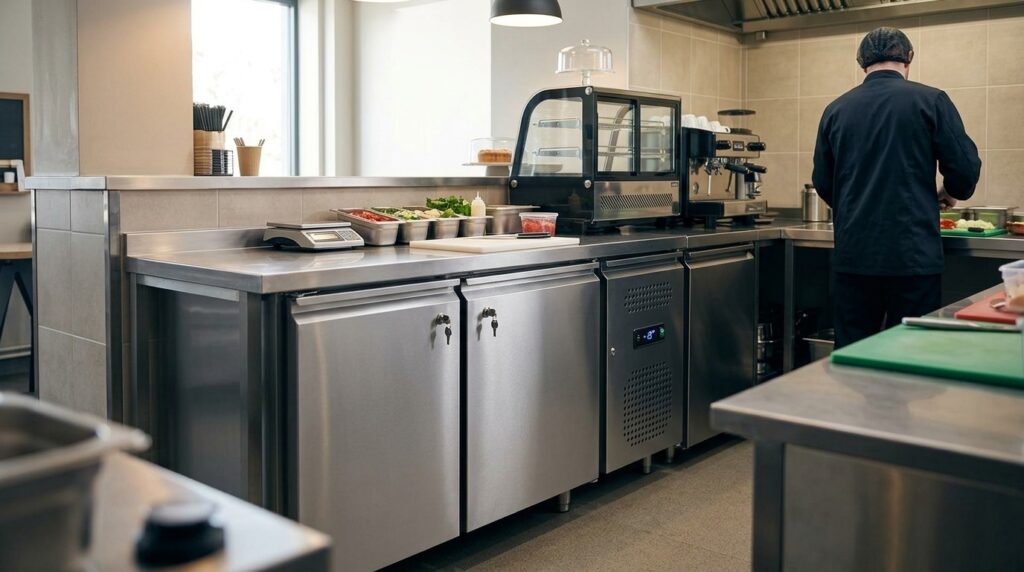
Explore the benefits and considerations of Unifrost frost-free undercounter freezers for commercial kitchens.
Unifrost Frost‑Free Undercounter Freezer: What to Check Before You Buy
If you are choosing an undercounter freezer for a café, bar, or restaurant, the frost‑free question matters because it affects staff time, day‑to‑day temperature stability, and running costs in a small footprint.
On this page you compare what you gain from frost‑free (fan‑assisted) operation versus a more traditional static undercounter setup, and where Unifrost’s current undercounter freezer options, including the F200SN and F200SNOG, fit in that decision. You will work through the practical checks that drive a good purchase: how much time you can realistically spend on manual defrosting and cleaning, how often the door is opened during service, what ventilation space you have under the counter, and whether your storage needs suit GN use or a shelving layout.
You also weigh the tradeoffs that change the true cost of ownership, such as energy use, noise for front of house locations, and maintenance points like fans, air paths, and drain lines, so you can specify the right undercounter freezer for your site and workload.
What problem this equipment solves
Frost-free undercounter freezers tackle two common pressures in Irish kitchens: you need frozen storage right beside the prep run, and you cannot be taking a unit out of service for manual defrost when the place is busy. From a food safety point of view, the baseline is clear. Frozen food should be stored at -18°C or colder, as set out in the Food Safety Authority of Ireland guidance on freezing and frozen storage. The challenge is keeping that temperature consistent when doors are opened repeatedly and ice build-up starts restricting airflow.
Frost-free (fan-assisted) designs are intended to reduce frost accumulation and the knock-on effects on usable space and temperature stability. The trade-off is complexity: fan systems have more components and move more air, so how you load, wrap and maintain the unit matters more than with a basic static freezer.
Why “undercounter” matters in real kitchens
In cafés, takeaways and hotel prep areas, the most valuable square metres are usually the ones beside the pass, the sandwich station, or the main prep run. An undercounter freezer puts frozen storage where staff actually work, so they are not walking to an upright freezer during peak service.
It also avoids sacrificing wall space that may be better used for shelving, a sink, or a combi landing area. In tighter back-of-house layouts, undercounter can be the safer, cleaner option too, simply because you are not dealing with an upright door swing clashing with people, trolleys, or checks during service.
Why frost-free is really about labour and downtime
The issue is not the sight of ice, it’s the operational hassle it creates. Frost build-up reduces internal space, makes doors or drawers harder to close properly, and eventually forces a defrost that takes the freezer out of action. In a busy bar kitchen or high-volume deli line, that usually means moving stock, finding temporary freezer space, then cleaning and waiting for the unit to pull temperature again.
A frost-free system is designed to minimise that build-up so you are not planning your week around defrosting. You still need sensible habits though: keep door-open time tight, avoid overfilling, and don’t block air paths with boxes that sit hard against the back or vents.
Why placement and loading matter more than people expect
A lot of “this freezer can’t hold temperature” complaints come down to installation and use, not the badge on the door. If you squeeze an undercounter freezer into a hot line, restrict ventilation to the condenser, or load warm product during service, you will see temperature swings and slower recovery whether the unit is frost-free or static.
Fan-assisted airflow helps even out cabinet temperature, but it can also dry unwrapped product more quickly. Good packaging, clear labelling, and steady stock rotation are not just good practice for HACCP. They also protect food quality and help the freezer stay stable during a busy shift.
This is where the benefits become noticeable day to day: less disruption, smoother service flow, and a freezer that behaves more predictably under pressure.
Which benefits show up in daily operation
If you move from a static undercounter freezer (for example, Unifrost’s F200SN / F200SNOG) to a frost-free (fan-assisted/NoFrost) undercounter unit, the day-to-day change is simple: you get far less ice build-up on shelves and around the evaporator area. Drawers and door seals stay easier to work with, usable space doesn’t get slowly eaten by frost, and the cabinet generally holds temperature more steadily through repeated openings in service.
That matters because frozen storage is judged on whether it stays properly frozen. The Food Safety Authority of Ireland uses -18°C as the key reference point when advising food businesses on whether frozen food can remain frozen after disruption, such as a power outage. See: FSAI guidance on power outages in food businesses. In practice, fewer temperature swings means fewer awkward notes in the HACCP file when you are already flat out.
Frost-free vs static in an Irish kitchen: where you actually feel it
Frost-free is mainly a labour and downtime win. In a café or takeaway where the freezer sits under the prep bench, a static cabinet can become a slow nuisance. Frost builds, packaging sticks, and eventually someone has to empty it, defrost it, clean it, and reload it, usually at the worst possible time.
A frost-free cabinet reduces that cycle. The trade-off is a bit more mechanical complexity, but for most busy kitchens the saved labour and reduced disruption are worth more than any small differences you might see on a meter.
The nuance is food quality. Fan-assisted freezers can dry out unwrapped or loosely wrapped items faster. If your team seals and labels properly, you will rarely notice. If it’s “open bag back into the freezer” and constant door openings, you will still benefit from better recovery, but you may need to tighten packaging to avoid freezer burn.
Temperature consistency and HACCP logging
The practical benefit is not a fancy control panel. It’s fewer temperature excursions that you need to explain later.
Whether a freezer is static or frost-free, your operating target for frozen storage is below -18°C. Frost-free systems tend to help in real service conditions, especially when:
stock is left a little spaced for airflow (where the design relies on it)
warm deliveries are not loaded straight in
internal air paths are not blocked
Do that consistently and your week-to-week temperature logs are usually calmer, which is exactly what you want when you are juggling staff, service pressure and compliance.
Maintenance and reliability: fewer defrost jobs, different checks
Static undercounter freezers are straightforward, but they often need periodic manual defrosting. If ice builds up, cleaning becomes more involved and you can end up fighting doors that don’t seal cleanly.
Frost-free reduces the “empty it and defrost it” jobs, but you still need routine checks:
keep vents and internal air paths clear (if fitted)
clean the condenser area to maintain efficiency
watch for drainage issues on designs that use a drain route
One important point on expectations: the Unifrost undercounter freezer models referenced here are the F200SN / F200SNOG. If you are pricing a unit specifically because you want frost-free behaviour, confirm the defrost system on the exact model you are buying. It avoids paying for the wrong specification, and it keeps the day-to-day workload aligned with what you think you are getting.
What tradeoffs still matter
Choosing a frost-free (fan-assisted/NoFrost) undercounter freezer instead of a static model such as Unifrost’s F200SN / F200SNOG usually means two practical tradeoffs: a higher upfront cost and slightly higher day-to-day electricity use. The reason is simple. Fan-assisted cabinets run evaporator fans and periodic defrost cycles to stop ice building up.
What you get back is time and consistency in a busy Irish kitchen. Frost-free units reduce the usual problems with static freezers: iced-up doors, stuck drawers, reduced usable space, and the slow creep towards “we’ll defrost it next week”.
The compromise is complexity. Fan-assisted cabinets have more parts and more air paths to keep clear. Over time, fans, drains and airflow channels can be affected by crumbs, flour dust and packaging, especially in undercounter spots that double as a prep landing area.
This matters most when the unit is squeezed into a tight run with poor ventilation, or placed beside heat. When airflow around the cabinet is marginal, any extra load from fans and defrost tends to show up first as slower pull-down and higher running costs during service. If your kitchen is busy enough that manual defrosting keeps getting kicked down the road, frost-free often earns its keep. If the freezer is lightly used and you can stick to planned defrosting, static can still be the simpler, lower-running-cost option.
When the upgrade is worth it
Paying extra for a frost-free undercounter freezer can make sense over a static-freeze unit like the Unifrost F200SN / F200SNOG, but only when it saves you time or protects service. The simplest way to decide is to look at how hard the freezer is worked, what frost is costing you in labour and disruption, and whether your stock is packaged well enough for fan-driven airflow.
1. Audit your service pattern and where frost causes real pain
Base this on real door-opening behaviour over a week or two, not a “normal day” guess. Frost-free tends to earn its keep when the freezer is opened constantly during busy periods, for example cafés pulling frozen pastry stock, pubs running frozen chips and appetisers, or kitchens doing frequent portion top-ups.
If the freezer is mainly a back-up store opened a handful of times per shift, a static unit is often the more economical choice, as long as you can plan manual defrosting without interrupting trading.
2. Put a cost on defrosting, cleaning, and stock disruption
Frost is an operating cost. It eats usable space, slows staff down when drawers or baskets stick, and forces defrosting that usually lands at the worst possible time.
Frost-free is easier to justify when defrosting creates a genuine labour or food cost, such as moving stock into other freezers, re-labelling, and risking temperature abuse while you shuffle product around.
A quick “worth it” checklist:
Defrosting is frequent enough to hit prep time, close-down, or overtime.
Frost build-up is reducing usable capacity, so you are carrying less stock than the footprint should allow.
Ice is affecting seals, drawers, or closing, leading to temperature drift and avoidable call-outs.
The freezer sits on the line, where any downtime immediately slows service.
3. Check food quality risk: frost-free is less forgiving of poor packaging
Most frost-free designs rely on fan-driven airflow to reduce ice build-up. That airflow can dry exposed food faster than a still-air cabinet. In practical terms, frost-free suits sealed, boxed, or well-wrapped stock far better than open trays, loose portions, or part-used packs left unprotected.
You can still run frost-free in a kitchen that uses part packs, but it only works if wrapping, lidding, and rotation are tight. If not, you are more likely to see dehydration and freezer burn, which becomes a real food cost even when temperatures are technically in spec.
4. Make temperature performance non-negotiable, then match the freezer to the job
Whatever technology you choose, the baseline is safe frozen storage. Plan to hold frozen food at -18°C or colder, in line with FSAI guidance on temperature control and frozen storage: https://www.fsai.ie/en/business-advice/food-safety-controls/temperature-control
Where frost-free can help is on high-traffic sections: steadier performance after repeated door openings can reduce the “soft stock” problem during a rush. Where it will not help is poor practice, like overloading, putting warm product in, blocking airflow, or leaving the door ajar during prep.
5. Validate fit and maintenance reality before you pay for the upgrade
Before you commit, check the constraints that decide whether you will actually feel the benefit.
Placement and ventilation: Undercounter freezers struggle when boxed in beside hot kit or with restricted airflow. Frost-free systems still need clear air paths to do their job.
Maintenance access: Frost-free adds fans, air channels, and drains that need periodic checking and cleaning. If the unit is hard to access, it is less likely to be maintained properly.
Usability and layout: If your workflow depends on GN storage, drawers, or shelving, confirm the internal layout at model level rather than assuming. The wrong format costs time every shift, long after the purchase is forgotten.
If those basics stack up, a frost-free upgrade is usually worth considering for high-turnover stations. If they do not, a well-managed static freezer can be the more sensible commercial decision.
Unifrost ecosystem considerations
A frost free undercounter freezer makes the most sense when it’s part of a planned refrigeration set-up, not a once-off add-on. The real payback is operational: less time lost to ice build-up, fewer door-closing issues during service, and fewer awkward temperature queries in your HACCP records. Standardising how your undercounter units behave also helps staff spot problems faster and record checks more consistently.
The key point is that frost free (fan-assisted/NoFrost) changes airflow and moisture inside the cabinet. That can be a benefit, but it also means your loading and food handling habits need to suit the technology.
How does a matched Unifrost undercounter set-up reduce day-to-day friction?
If you’re already running Unifrost undercounter refrigeration such as the R200SN / R200SVN, adding an undercounter freezer in the same work zone is mainly about workflow discipline. Staff get used to one set of door swings, seals, loading height, control layout, and cleaning access. That matters in cafés, hotel kitchens, and busy bar food passes where people rotate in and out of sections.
Standardisation also helps your HACCP routine because checks become habitual and easier to verify. Monitoring only works if it’s actually done, and if the corrective action is clear when temperatures drift. The FSAI’s HACCP guidance emphasises practical monitoring and corrective actions as part of keeping refrigeration under control (see the FSAI HACCP principles on monitoring and corrective action/principles-of-haccp)).
When is “frost free” a good fit alongside Unifrost’s standard undercounter freezers?
Within the Unifrost undercounter freezer range, the F200SN / F200SNOG sit under Undercounter Freezers. They’re typically chosen because they protect premium floor space by fitting under a counter or prep run.
A frost free undercounter freezer is worth considering when:
The freezer gets opened constantly (service and prep are both dipping in).
Ice build-up is already costing you time or causing drawers/shelves to snag.
You need reliable door closing and recovery during peak trading.
The trade-off is food quality control. Fan-driven air movement can dry out unwrapped product faster. In practice, frost free rewards tighter portioning, lidded containers where suitable, and consistent labelling and rotation. If you mostly store sealed packs, boxed stock, or properly wrapped portions, the convenience tends to show up more clearly.
What changes in maintenance and placement when you add frost free into the mix?
Frost free undercounter units typically have more airflow paths that need to stay clear. Build your routine around keeping vents unobstructed and cleaning access realistic for your team. In tight Irish back-of-house layouts, undercounter units often get boxed in by joinery or turned into a “storage shelf” for trays and dry goods. That’s where temperature stability usually starts to suffer.
The goal is a fleet your staff can keep clean and running without heroics. You’re not buying a spec-sheet win. You’re buying fewer interruptions, fewer service headaches, and fewer temperature exceptions to explain when you’re already under pressure.
Unifrost frost-free undercounter freezer FAQs
Does the Unifrost F200SN undercounter freezer come with a stainless-steel exterior and digital temperature display?
In the current Unifrost undercounter freezer range (F200SN and F200SNOG), the exact exterior finish and controller/display details can vary by model suffix and batch. Because those are model-level features, the safest approach is to confirm on the live product spec sheet/listing for the exact code you are buying and, if needed, request a photo of the control panel and cabinet exterior before ordering.
If you tell us whether you are looking at F200SN or F200SNOG, we can help you verify what is supplied with that specific model.
Is the Unifrost undercounter freezer suitable for GN pans or is it a shelving-only layout?
For Unifrost undercounter freezers like the F200SN / F200SNOG, treat the standard configuration as a shelving-based layout unless the listing specifically states GN compatibility.
If you need GN use in day-to-day service (for example, sliding GN pans in and out under a prep counter), check two things before you buy:
Internal dimensions and shelf supports in the spec sheet, to confirm a GN size will physically fit.
Whether there is a GN shelf support kit or compatible runner system available for that model.
If GN fit is critical, get written confirmation from the seller on which GN size(s) are supported rather than assuming GN 1/1 compatibility.
How does a frost-free undercounter freezer affect food quality in day-to-day catering use?
A frost-free (fan-assisted/NoFrost) undercounter freezer helps food quality in one big way: it reduces ice build-up, so drawers/shelves don’t get clogged with frost and door seals tend to close more consistently in busy service.
The trade-off is that constant air circulation can dry exposed food faster, increasing the risk of freezer burn if items are unwrapped. In catering use, you minimise that by:
Freezing product well wrapped (tight cling film plus an outer bag, or sealed containers).
Avoiding storing uncovered trays near the fan outlets.
Letting hot food cool safely before loading, to reduce moisture and temperature spikes.
Using first-in, first-out labelling so items are not left too long.
If your menu includes lots of open or loosely covered items, frost-free is still workable, but packaging discipline becomes more important than with static-freeze units.
Are undercounter freezers ‘plug‑in and go’ or do they require professional installation or ventilation clearances?
Most commercial undercounter freezers are effectively plug-in and go, but they are not “fit anywhere” units. Plan for:
A suitable power point and circuit (avoid shared extensions in a commercial kitchen).
Ventilation clearances so the refrigeration system can reject heat. Do not box the unit tightly into a joinery void unless the manufacturer says it is designed for that.
Ambient conditions: placing an undercounter freezer beside cooking equipment, in a tight alcove, or in direct heat can reduce performance and increase running costs.
You usually won’t need a refrigeration engineer just to install a plug-in cabinet, but a competent fitter/electrician is recommended to ensure safe electrical supply, airflow, and access for servicing and cleaning.
Next step: compare frost-free undercounter options
If you are ready to shortlist a Unifrost frost free under counter freezer for your kitchen layout, the quickest way is to compare available sizes and formats side by side, then match them to your service workflow and clearance space.
Browse Caterboss’s Frozen Storage category to see current frozen storage options and narrow down the best fit for your site.
Compare Unifrost freezer options on Caterboss
For current product options, pricing and availability, continue to Caterboss.