
Unifrost Ice Machine and Storage Bin: Cleaning and Maintenance Schedule
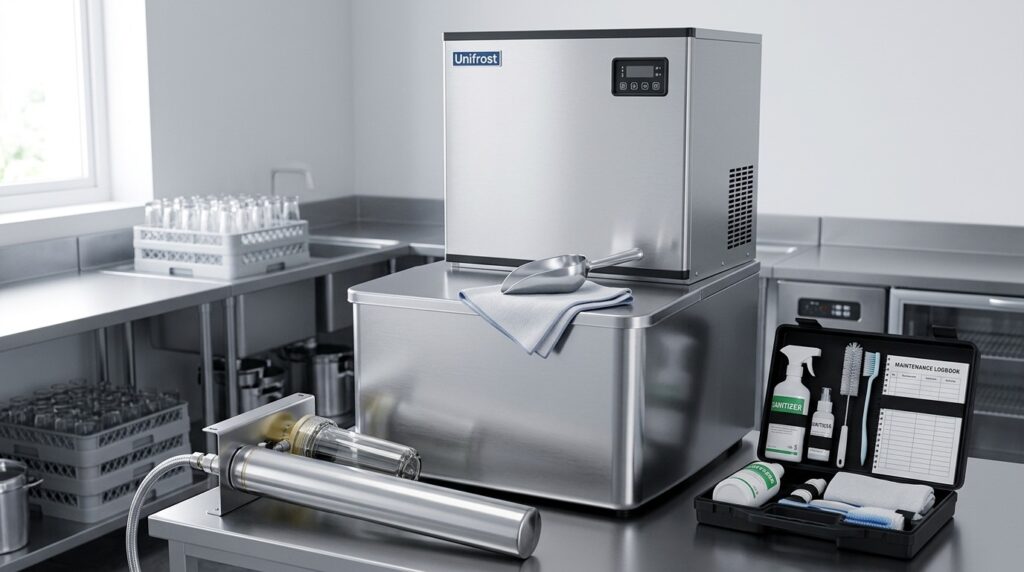
Ensure cleanliness and optimal performance of Unifrost ice machines with our practical cleaning schedule for Irish hospitality.
Need more detail? For model comparisons, setup steps and troubleshooting, see the related guides below.
Unifrost ice machine cleaning schedule: routine maintenance for ice makers and storage bins
If you run a bar, café, hotel, or restaurant, your ice is a food product, and your Unifrost ice machine and storage bin can quickly become a risk point if cleaning slips. A consistent Unifrost ice machine cleaning schedule protects drink quality, reduces breakdowns and call-outs, and helps you show inspectors that ice handling and equipment hygiene are under control.
On this page you get a practical routine you can actually run during service and quieter prep time. You will learn what to clean daily, weekly, monthly, and quarterly across both the head unit and the bin, what to log for HACCP style records, and where operators commonly go wrong (for example, sanitising the bin but ignoring the scoop, seals, or filter maintenance). You also get guidance on the tradeoffs that affect frequency, including high-throughput sites, warm plant rooms, and hard water, plus how water filtration changes your descaling and internal cleaning intervals.
Where model names matter, we reference common Unifrost cube maker head units and sets used in Ireland, including U165-125 and U230-175 and paired options like U165-125+B175 and U230-175+B175, as well as bin deep-clean considerations for B175 and B375. You also learn the signs that routine cleaning is no longer enough and it is time to book professional service.
Importance of a Cleaning Routine
A strict cleaning routine matters because ice is food. Any limescale, slime, or handling contamination in the machine or storage bin can end up in customers’ drinks and in your inspection notes. In Ireland, food businesses are expected to maintain effective hygiene controls under the requirements summarised by the FSAI for Regulation (EC) 852/2004.
How often you need to clean is not one-size-fits-all. Water hardness, service volume, and how the bin is used all affect the right frequency. A busy pub over a weekend will expose weaknesses much faster than a quiet café.
Why cleaning is about more than hygiene (performance and running cost)
Cleaning is not just about keeping the unit presentable. Scale and biofilm reduce heat transfer and restrict water flow inside an ice maker. That typically shows up as:
slower production and longer run times
inconsistent cube shape or incomplete cubes
more waste during harvest
higher electricity use for the same amount of ice
Operationally, this becomes “we’re always chasing ice” and “the machine never seems to stop”. That is a service problem, a labour problem, and a cost problem.
What slips when the routine slips (taste, odour, and service pressure)
The early warning signs usually appear before anyone opens the unit for a proper look. Watch for:
ice picking up off-tastes or a damp smell in the glass
cubes clumping in the bin or breaking up easily under the scoop
production feeling patchy across the week even when demand is steady
staff topping up with bought-in ice, adding cost and introducing extra handling and traceability steps
In pubs and cocktail bars, taste and odour are the quickest way to lose confidence. Customers will not blame the ice machine, but they will blame the venue.
Why documentation matters in Ireland (HACCP reality, not paperwork for its own sake)
If the routine is not written down, it is hard to keep consistent across shifts and staff changes, and hard to stand over during an inspection. The practical approach is to build ice machine and bin cleaning into your normal HACCP records, using the same signed-and-dated discipline you already use for fridges, freezers, and hot holding.
The FSAI’s Safe Catering Pack record books are a good benchmark for the level of routine record-keeping inspectors expect, even if you use your own log sheet.
Treat ice as food and the machine and bin as food-contact equipment. Then the job is straightforward: define the tasks, set a frequency that matches your water and service load, and make it easy for staff to complete and prove. That is what the Unifrost ice machine and storage bin cleaning checklist is there to support.
Unifrost Ice Machine and Storage Bin Cleaning Checklist
Set a routine your team can actually follow: daily hygiene checks to stop contamination, a proper weekly clean of the bin and food-contact areas, and a monthly deep clean and descale that matches your water conditions. Keep records as part of your HACCP file. In Ireland, ice is treated as food, so your ice machine and bin should sit inside your HACCP-based food safety management system (see the FSAI HACCP guidance)).
If you spot slime, black specks, musty odour, slow production or recurring faults, treat it as both a hygiene and reliability issue. Stop serving ice if there is any contamination risk and escalate beyond routine cleaning.
1. Set up your cleaning kit and HACCP record (once, then keep it topped up)
You need two things: a repeatable method and a record that proves it happened.
Keep an “ice hygiene kit” beside the unit so staff do not reach for the wrong cloths or chemicals during service. At minimum:
Disposable gloves
Clean cloths or single-use blue roll
Food-safe sanitiser suitable for food-contact surfaces
A dedicated ice scoop
A clean, date-labelled container or holder to store the scoop off the ice
For Unifrost head units (including U165-125 and U230-175) paired with storage bins like B175 or B375, keep a simple log with:
Date and time
Frequency (daily, weekly, monthly)
What was cleaned and how
Chemicals used
Initials
Notes (odour, scale, blocked drain, damaged seals, anything unusual)
2. Daily tasks (end of night shift, or start of day for daytime venues)
Daily tasks are about preventing contamination entering the bin and catching issues early. This matters most where multiple staff handle ice, such as pubs, late bars and busy cafés.
Two habits that prevent most headaches:
Do not top up old ice after a contamination concern. Empty, clean, then restart properly.
Never use a glass to scoop ice. A chipped glass turns into a physical contamination incident and a service slowdown you do not need.
3. Weekly tasks (book a quiet hour, not a five-minute gap)
Weekly cleaning is where you stay ahead of biofilm and keep airflow and drainage working as they should. In hotels and busy bar operations, midweek is often the most realistic slot.
Empty the storage bin fully.
Clean and sanitise the bin interior, lid underside, and the bin door or flap. Focus on corners and the bin opening where hands and scoops are closest.
Check access while you are there. If the unit is boxed in, staff will avoid the awkward bits and mould finds the “dark corner”. If you cannot comfortably reach the bin drain, remove panels, and clean the lid underside, the install needs adjustment so the weekly clean is achievable.
Check the air intake area for dust build-up and make sure the drain line is clear and flowing.
Poor airflow and poor drainage are two of the quickest routes to weak performance and unpleasant odours.
4. Monthly tasks (deep clean, descale planning, filter discipline)
Monthly is where you deal with scale, taste and odour. In many Irish premises, limescale is a regular reality, so your “monthly” plan may need to be more frequent on hard water.
Run the machine’s cleaning routine if your unit has a built-in cleaning cycle, following the Unifrost instructions for your specific head unit. If you are unsure whether a U165-125 or U230-175 has an automated clean mode, do not guess. Check the documentation or your site operating notes, as steps vary by control type.
Descale and sanitise using chemicals intended for ice machines and suitable for food-contact surfaces. Avoid generic acids, bleach mixes, or improvised chemicals. The wrong chemistry can damage components, leave odours, or create residues that show up in the drink.
If your Unifrost setup includes a water purifier kit (for example references such as SA30007, I40002-CN, or SA950750), use the monthly check to confirm cartridge change intervals and any pre-filter cleaning or replacement. Filtration can help with scale and taste, but it does not replace internal cleaning. A neglected cartridge can become a hygiene issue in its own right.
Review your log for missed tasks and repeat patterns. If scale, odour or slow recovery keeps returning even after cleaning, you are likely looking at a water, ventilation, drainage or service issue that needs proper diagnosis.
Common Cleaning Mistakes and Their Impact
If cleaning slips into a “quick rinse” or you only clean what you can see in the bin, you risk contaminated ice, off-tastes in drinks, and extra strain on the machine as scale and biofilm build up. That is why the FSAI stresses the importance of a proper cleaning schedule and keeping records as part of good food safety management and HACCP control. In a busy operation, the knock-on effects are usually obvious: slower ice production, clumping in the bin, repeat call-outs, and awkward questions in an EHO visit if there is no paper trail.
“We clean the bin, so the machine must be clean”
The bin is the part staff handle, but it is not the whole system. If you do not clean and descale the ice-making path as well, you can still end up with tainted odours, cloudy cubes, and a steady drop in performance, even when the bin looks spotless.
Topping up ice instead of emptying and sanitising
If you keep adding fresh ice onto old ice, the bin never really gets a proper reset. In pubs and busy bars, this is a common cause of a low-level taste or smell issue in spirits, mixers, and soft drinks that is hard to pin down until you fully empty the bin, wash, sanitise, and let it dry.
Using the wrong chemical, or using the right one incorrectly
Ice machine internals are not the place for general kitchen degreaser or “guesswork” chlorine dosing. The usual problems are chemical residue affecting taste and odour, and seals and plastics degrading faster. That damage creates more edges and surfaces for grime to hold, which makes every future clean slower and less effective.
Skipping the basic pre-clean and dry-out steps
A lot of cleans fail because sanitiser is sprayed onto wet, dirty surfaces and everyone assumes it will sort itself out. The sequence matters: remove loose debris, wash with detergent, rinse, disinfect or sanitise to the product instructions, then allow parts and the bin to air dry. Leaving the bin damp is an open invitation for regrowth.
Forgetting the “small” hygiene points that inspectors notice
The scoop, scoop holder, door gasket, and bin lid area are where hands and splash-back do the most damage day to day. Common slip-ups include storing the scoop in the ice, putting it on an unclean surface between uses, and ignoring damaged gaskets that trap dirt and are hard to sanitise properly. Even if the machine is making ice, those points can undermine your HACCP controls.
Ignoring water quality and filtration warning signs
Hard water and poorly maintained filtration usually mean more frequent descaling and more nuisance faults. The practical warning sign is a gradual drop in output and poorer cube quality, which tends to show up at the worst possible time, mid-service.
A simple routine that splits daily, weekly, and periodic tasks reduces these mistakes and gives you a record you can stand over if you are asked.
Integrating Cleaning into Routine Operations
Set a fixed routine with short, non-negotiable daily tasks, then book deeper cleans into quieter trading windows so you are not stripping the machine down mid-rush. Assign ownership by role (not by “whoever is free”), keep the right chemicals and tools beside the machine, and require a quick sign-off each time the job is done. If a clean is missed, treat it as a service risk. It tends to show up later as slower ice production, off tastes, or a bin that is not inspection-friendly.
1. Build the cleaning plan around your service pattern, not your best intentions
Your schedule has to fit how venues actually run: morning prep, lunch spikes, after-work trade, late service, then close. For Unifrost head units such as U165-125 and U230-175, and setups paired with bins like B175 or B375, the workable approach is simple: keep daily tasks short and external, and ringfence a deeper clean when you can afford downtime.
Pubs and bars: if Friday and Saturday are your pressure points, plan the deeper clean early in the week when you can empty the bin fully and let it air dry properly.
Hotels and high-volume cafés: if you cannot easily go without ice, plan the deeper clean just after a delivery day or when you have backup ice capacity on site. Trying to “squeeze it in” during service nearly always ends with a half-job and a compromised bin.
2. Assign responsibility by station and make the handover clear
Ice hygiene usually falls apart at handover. The machine becomes “someone else’s job”, the scoop goes missing, or nobody knows when the last deep clean happened. Put the ice machine and bin under one station owner (often the bar lead, KP lead, or duty manager depending on where the bin sits), and name a back-up for days off.
Keep instructions where the work happens, not in a folder in the office. FSAI guidance supports having a cleaning schedule and keeping records so staff can see what needs doing and when, and so you can show control during an inspection (FSAI guidance on cleaning schedules and records).
3. Make “quick clean” the default and “deep clean” a planned shutdown
You are running two rhythms in parallel.
Quick clean (during trading):
Wipe down high-touch external surfaces.
Keep the scoop and holder clean and off worktops.
Keep the bin lid and gasket area free of sticky residues.
Keep hands and glassware out of stored ice.
This is what stops the bin becoming a contamination point even when the machine is still producing ice.
Deep clean (planned downtime):
This is where you protect taste, odour, reliability, and output: internal clean, descale where needed, then empty, clean, and sanitise the bin. Because it often means pausing production and discarding old ice, it needs to be booked like any other job that affects service. If you do not schedule downtime, downtime will find you, usually on a busy weekend.
4. Standardise what “clean” means: chemicals, contact time, and drying
Most problems come from the wrong chemical (or the right one at the wrong concentration), and from rushed rinsing and drying. In practical terms, standardising means:
One approved cleaner and one approved sanitiser (or a combined product used exactly as per the label).
A measured dosing method, not guesswork.
A rule that food-contact surfaces are allowed to air dry, rather than being wiped with a cloth that has already done a lap of the bar.
Standardise where the cleaning kit lives too. If staff have to hunt for gloves, a brush, or a bucket, they will improvise. That is how you end up with scented sprays, abrasive pads on plastics, or cloth fibres left behind. Keep a labelled box beside the machine, and keep a spare scoop so nobody is tempted to use a glass as a shovel when it gets busy.
5. Embed logging into your HACCP routine so it survives staff turnover
If it is not written down, it did not happen, especially when the person who “always does it” is on holidays. The simplest system that works on shift is a one-page log sheet clipped beside the unit:
Tick-and-sign for daily tasks
Separate sign-off for weekly/monthly tasks
Notes line for anything unusual (smell, slime, slow fill, unusual noise, filter change)
In most small operations, the duty manager or owner should own the record, but the person doing the clean signs the action. That split keeps it honest and makes inspections easier, particularly because ice is served directly to customers and taste issues will be noticed long before scale build-up becomes obvious.
Done properly, this structure also makes it straightforward to turn your routine into a printable Unifrost ice machine and storage bin cleaning checklist that staff will actually follow on shift.
Connecting the Routine to the Unifrost Ecosystem
A cleaning schedule for a commercial ice machine is not just “good practice”. It is part of how you show control under HACCP and keep output reliable through busy service. The FSAI is clear that a cleaning schedule and cleaning records matter in day-to-day food safety management, and that keeping them visible helps staff follow them consistently (FSAI guidance on cleaning schedules and records).
In Irish venues, the right frequency depends on water hardness, trading volume, and how ice is handled at the bin during peak periods. You will get better results if you treat cleaning as a documented routine, not an occasional deep clean when something looks off.
Why Unifrost advice treats the ice machine and bin as one hygiene system
If you are running a Unifrost head unit such as the U165-125 or U230-175, the ice-making side can be clean while the storage side becomes the weak point. Most day-to-day contamination risk comes from the bin: hands, scoops, splashback, and lids that stay damp, especially behind a bar where ice is moved quickly.
If you are pairing a head unit with a storage bin like the B175 (or larger options such as the B375), plan and clean them as one workflow. What happens at the bin opening affects the food-contact quality of every cube served.
Unifrost’s own FAQs flag maintenance scheduling as a common support need. Operationally, you should always be able to answer three questions without guessing: when it was last cleaned and sanitised, what was done, and who signed it off.
Where routine maintenance intersects with selection, install, and running costs
Cleaning is also a running-cost issue. Scale and build-up do not just increase hygiene risk, they typically reduce performance and lead to nuisance faults. That is when an ice machine starts costing you in staff time, missed sales, and call-outs during peak trade.
When you are choosing and installing an ice machine and bin setup, the practical links to maintenance are:
Capacity that matches your service pattern: steady pub trade is different to hotel banqueting peaks.
Access for cleaning: leave space to remove panels and properly reach the bin interior. If it is awkward, it gets skipped.
Water treatment decisions made early: filtration can help with scale and taste issues in harder-water areas, but it does not replace cleaning and sanitising. It often shifts the problem from constant limescale to more predictable routine hygiene control.
How to use Unifrost support resources without “winging it” in service
People skip steps that are not built into the routine. The most reliable approach is to tie ice machine cleaning into what you already run: closing checks, a weekly deep-clean slot, and your HACCP folder. If staff change, the process stays put.
If you operate Unifrost ice makers through Caterboss, treat support and spares as part of the plan. When you are unsure whether your unit has a built-in cleaning cycle, which chemicals are suitable, or what “normal” looks like after sanitising, stick to the documentation for that machine family and keep your log consistent with it. It also helps you avoid common mistakes that cause damage or re-contamination, like over-strong chemicals, abrasive cleaning on sensitive surfaces, or putting a dirty scoop back into a clean bin.
When the cleaning schedule is no longer enough and you likely need a service visit
If the schedule is being followed and you still see slow production, off taste or odour, scale returning quickly, or repeated alarms after cleaning, treat it as a maintenance escalation rather than “clean it again”.
In practice, consistency is the clue. If the machine swings between fine and unusable across the week, the issue is often something underlying: water supply, drainage, airflow around the unit, or a component that is no longer performing correctly.
With that in mind, the aim is a routine staff can actually follow and a supervisor can verify on paper, covering both the ice machine and the storage bin.
FAQs: Unifrost ice machine cleaning schedule
What maintenance schedule should I follow for a commercial ice machine?
Use a layered schedule so nothing gets missed:
Every day (end of shift): empty and wipe the bin lid and surrounding surfaces, wash and sanitise the scoop, check ice looks and smells normal, and keep the bin closed.
Weekly: clean high-touch parts (scoop holder, bin door/handle, splash areas), check the drain is flowing freely, and clean any accessible air intake vents.
Monthly: remove and clean washable air filters (if fitted), check water supply fittings for leaks, and inspect door seals and bin liner for damage.
Quarterly (or more often in hard-water areas): run a full descale and sanitise of the ice-making system following the manufacturer procedure, then deep-clean the storage bin.
Annually: schedule a professional service to confirm water system, refrigeration and safety checks, especially for high-volume sites.
If you notice slow production, small/soft cubes, off-odours, scale build-up, or slime in the bin, bring the deep-clean forward rather than waiting for the next planned interval.
How often should I clean and sanitise my ice machine and storage bin?
For most Irish hospitality sites, a practical baseline is:
Bin and scoop hygiene: daily (wash and sanitise the scoop and scoop holder, wipe down bin contact surfaces).
Deep clean and sanitise the bin: monthly (more often if the bin is opened frequently or ice is handled a lot).
Descale and sanitise the ice-making circuit: every 3 to 6 months depending on water hardness, usage, and whether filtration is installed.
Increase frequency if you have hard water, a busy bar service, visible limescale, or any taste/odour complaints. If your site uses filtration, you may still need regular descaling, but scale usually builds up more slowly if filtration is correctly specified and maintained.
What chemicals or cleaners are safe to use in an ice machine?
Stick to products intended for ice machines and food-contact areas:
Use a dedicated ice machine descaler for limescale.
Use a food-safe sanitiser suitable for food-contact surfaces for the bin, scoop and internal surfaces.
Avoid:
Bleach/chlorine in the ice-making circuit unless the manufacturer explicitly allows it for your model.
Abrasive pads, strong acids, caustic cleaners or unapproved chemicals that can damage surfaces, seals and coatings.
Always follow the chemical label (dilution and contact time), wear PPE, and flush/rinse as instructed before returning the machine to service. If you are unsure what is approved for your specific unit, use the cleaning products and method recommended in the Unifrost documentation or contact support before proceeding.
How do I set up a cleaning log or checklist to satisfy food safety inspections?
Build a simple log that proves what was cleaned, when, how, and by whom. A good inspection-ready cleaning record includes:
Asset details: location, equipment type, and the model/serial (e.g., ice head and bin).
Task list by frequency: daily, weekly, monthly, quarterly (descale + sanitise), plus “as needed” triggers (taste/odour, visible scale, slow production).
Method and chemicals: product name, dilution, contact time, and rinse/flush step.
Sign-off fields: date, time, staff initials, and a supervisor verification checkbox.
Corrective actions: a section to record issues found (slime, scale, blocked drain, damaged seal) and what was done (extra clean, filter change, service call).
Attachments: keep invoices for filter cartridge changes and any service visits alongside the log.
Keep the log where the work happens (near the ice machine) and make completion part of close-down. Inspectors generally want to see that cleaning is planned, consistent, and documented, not just done occasionally.
What is a model-specific cleaning schedule for Unifrost U165-125 and U230-175 ice machines?
For Unifrost head units such as U165-125 and U230-175 (including when paired with storage bins like B175), you can use this model-specific, operator-friendly schedule without relying on any unverified technical assumptions:
Daily (end of shift):
Wash and sanitise the ice scoop and scoop holder.
Wipe and sanitise bin lid/door contact areas and any splash zones.
Quick visual check: ice clarity, any unusual smell, and that the bin closes properly.
Weekly:
Empty any loose ice that has been heavily handled and clean the top of the bin interior where hands/glassware may contact.
Check the bin drain is clear and flowing.
Clean external vents and keep clear space around the unit for airflow.
Monthly:
Deep-clean and sanitise the storage bin: empty the bin, wash interior surfaces with a suitable food-safe cleaner, rinse, sanitise to label contact time, and air-dry.
Inspect door seals/gaskets and the bin liner for splits or mould staining.
Every 3 to 6 months (water-quality dependent):
Run a full descale + sanitise of the ice-making system using an ice-machine-approved descaler and sanitiser, following the Unifrost procedure for the unit.
If you use a water filter system, check whether the cartridge change interval has been reached and record it.
After any of the following, clean immediately:
Ice taste/odour complaints, visible slime or scale, a long shutdown, nearby construction dust, or a contamination incident.
If you want a truly model-specific interval (based on your water hardness, usage pattern and any installed filtration), the fastest approach is to match this schedule to your on-site conditions and then adjust the 3 to 6 month deep-clean frequency up or down based on what you see in the water circuit and bin.
Next step: keep your Unifrost ice setup inspection-ready
If you are planning a refresh, adding filtration, or replacing worn hygiene accessories (like scoops or bin items), it helps to match your purchases to your unifrost ice machine cleaning schedule and service routine.
Browse the range here: Explore Unifrost ice machines and accessories.