
Unifrost CF500HS, CF501 & CF601 Chest Freezers: Model Buying & Setup Guide for Irish Kitchens
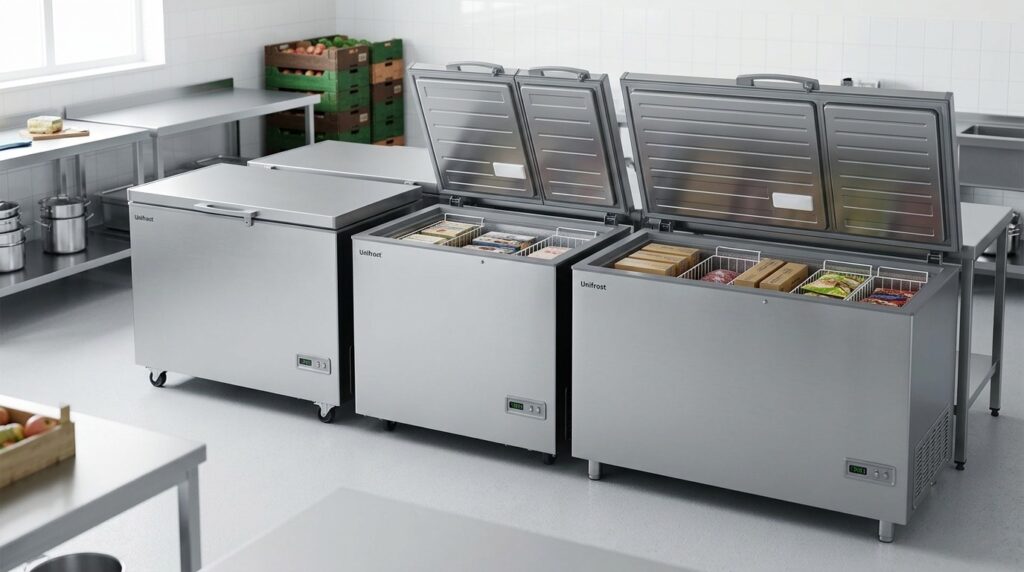
Explore Unifrost CF500HS, CF501 & CF601 chest freezers for commercial kitchens. Learn about setup, features, and fit for your business.
Unifrost CF500HS, CF501 & CF601 Chest Freezers: Buying, Setup and Daily Use Guide for Irish Kitchens
If you are choosing between the Unifrost CF500HS, CF501 and CF601 chest freezers, the real question is not just “how many litres”. You are balancing footprint vs usable storage, how fast staff can access stock during service, and whether the unit will actually fit and run properly in your back-of-house space.
This guide walks you through the practical checks that matter before you order: which model suits your volume and workflow, when a split stainless-steel lid is worth it for organisation and faster picks, and what rollers or feet mean for moving the freezer versus keeping it stable on a busy floor. You will also get a clear setup plan for Irish premises, including access and clearance planning, ventilation positioning, and first-week loading habits.
Finally, it covers the ownership side: what to watch for on running costs, a maintenance and defrost routine you can actually schedule, and quick troubleshooting steps for common issues like poor pull-down, heavy ice build-up, and lid seal problems before you call an engineer.
Introduction to Unifrost Chest Freezers
CF500HS, CF501 and CF601 are Unifrost commercial chest freezers, specified with stainless steel lids for hard-wearing back-of-house use. For Irish food businesses, your freezer should be run at -18°C or colder, in line with the Food Safety Authority of Ireland guidance on freezer temperatures.
The real difference between these models is not whether they can freeze. It’s how much frozen stock you can hold, how quickly staff can get at it during service, and whether the footprint works with your store layout and access routes.
What the CF500HS, CF501 and CF601 are designed for (in real kitchens)
Chest freezers suit the kind of work a domestic unit struggles with: heavier loading, frequent access, and being kept in a tight prep area or storeroom where people are moving at pace. In Irish pubs, cafés, takeaways and smaller hotel kitchens, a chest freezer often becomes the bulk store for chips, frozen proteins, pastry, ice, and prepped items that don’t stack neatly in uprights.
A stainless steel lid is a practical choice here. It tends to shrug off knocks, tray contact and routine wipe-downs better than painted finishes, which matters when the freezer is used all day and “gentle handling” is not really on the rota.
How CF500HS vs CF501 vs CF601 typically suits different venue types
If you’re choosing between these three, it usually comes down to throughput and how many frozen lines you need to carry at once.
Lower-volume sites often prioritise a tighter frozen range that turns quickly, with easier access in a small back-of-house.
Higher-volume kitchens usually need more headroom to take deliveries, hold buffer stock, and stay covered through weekends, bank holidays and match days.
You’ll often see CF501 and CF601 positioned for professional kitchen, bar and bakery use, with attention given to handling details such as split lids and roller/feet setups. Those features can make day-to-day use easier, but you still want the model that suits your stock profile and your floor plan.
Stainless lids, split lids, and rollers: why these details affect workflow
On the CF601, a split stainless-steel lid is mainly about control and speed. Opening one side reduces the amount of warm air getting into the cabinet, and it lets you set up a “fast movers” side so staff are not lifting a full lid and rummaging through stock during a busy service.
Rollers and feet are a trade-off between cleaning access and stability. If you need to move the freezer for regular floor washes, deliveries, or to clear spills in a tight store, mobility helps. If it’s staying put and being leaned on during loading, you’ll care more about a solid sit and consistent lid closure.
For most buyers, capacity is still the first decision, because it determines how many lines you can carry and how often you end up juggling overflow stock when trade spikes.
Choosing the Right Capacity for Your Business
Chest freezer capacity should match your menu, delivery pattern, and how well your team can rotate stock, not just how many covers you do. The Food Safety Authority of Ireland (FSAI) HACCP guidance is clear on one thing: controls have to work in the real routine of your kitchen. Storage capacity is one of those controls. Get it wrong and rotation becomes difficult, packs get buried, and you end up either over-ordering “just in case” or running short at the wrong time.
If you are comparing models like the Unifrost CF500HS, CF501 and CF601, focus the decision on two practical questions:
How much frozen stock do you genuinely need to hold between deliveries?
How often do staff need to access it during service?
Start with what you’re actually freezing (and how often you need to get into it)
Capacity choices get easier when you separate bulk storage from service stock.
Bulk storage (chips, frozen proteins, pastry, ice): a larger chest freezer can work well because you are restocking prep stations or undercounter units, not opening it constantly.
Service picking (staff grabbing product during a rush): a slightly smaller freezer that stays organised will usually beat a bigger one that turns into a frozen heap. Bigger looks like better value until it costs time on every pick.
A quick sizing method that works in real Irish kitchens
Use a simple calculation, then sanity-check it against space and workflow:
List your frozen lines by category (chips, veg, proteins, desserts, bread items, ice) and your typical weekly usage in cases or kg.
Flag anything that needs separation for your operation (for example allergens, raw items vs ready-to-eat). That tells you how many “zones” you need.
Set your delivery cadence (daily, 2 to 3 times weekly, weekly, fortnightly) and allow capacity for at least one delayed delivery day. It happens.
Add headroom for the peaks you actually see (bank holiday weekends, communion and confirmation season, summer trade, Christmas parties), not a generic percentage.
Then choose the unit size. If you are forced into over-stacking, you will lose the benefit of the extra litres quickly.
Footprint matters as much as capacity in pubs, cafés and takeaways
Chest freezers take up width and need clear space above the lid. A “right-sized” freezer is still the wrong choice if it blocks a gangway, interferes with prep flow, or creates a daily obstacle around deliveries.
In tight back-of-house areas, a slightly smaller unit positioned properly often works better than a larger one squeezed into a bad spot. Also think about access on delivery day: narrow corridors, steps, tight turns and small door openings can rule out certain sizes before you even get to capacity.
Lid format and access style change the usable capacity
Two freezers with similar quoted capacity can behave very differently once you try to keep them organised.
If a model you are considering has split lids, it can reduce heat gain during service because you only open the section you need. It also helps with basic zoning. The trade-off is that the most workable “capacity” is often the one that supports tidy separation and quick picking, not the biggest single open cavity.
Plan capacity around HACCP routines, not just storage volume
If your team already struggles to label, date and rotate frozen stock, a bigger chest freezer can make it harder by encouraging deeper burying and forgotten packs.
A size that keeps stock visible and reachable supports safer handling and aligns with the FSAI’s approach to practical food safety controls. In plain terms: choose the freezer your team can keep in order at 10pm on a Saturday, not the one that only looks organised after a reset.
When to size up, and when to add a second freezer instead
Size up when you genuinely need to hold more inventory because you have fewer deliveries, limited dry store, or a menu that leans heavily on frozen lines.
Add a second freezer when separation matters (allergens, vegetarian lines, raw proteins) or when one location cannot sensibly cover both bulk storage and frequent service access without causing congestion.
If you are torn between CF500HS, CF501 and CF601, decide first whether this unit is mainly for bulk holding, service picking, or a mix. That one decision usually dictates the most workable capacity and day-to-day layout.
Key Features and Daily Workflow
The day-to-day usefulness of the Unifrost CF500HS, CF501 and CF601 is less about “it freezes” and more about whether the lid style, finish and mobility suit how you load, rotate and retrieve stock when service is busy. Irish food businesses are expected to manage frozen food through documented controls, including stock rotation and separation, as part of a HACCP-based system, as set out in FSAI guidance on food safety management systems. Chest freezers are excellent for bulk storage, but they can become a “black hole” unless you organise them for access frequency, baskets and clear labelling.
Split stainless-steel lids: access, temperature recovery, and stock control
Where a split lid is available (often listed on CF501 and CF601 by Irish resellers), it can make a noticeable difference in day-to-day use. You are only opening part of the cabinet, which reduces how much warm air you let in and cuts down on the “lid left open” moments during prep.
It also supports better zoning. Many kitchens find it easier to keep one side for high-turnover items (chips, portions, pastry) and the other for slower-moving backup.
The trade-off is that a split lid does not fix organisation on its own. If you do not set simple rules (what lives left vs right, and what never goes on the bottom), older stock can still end up buried.
Rollers and feet: moving it without ending up out of level
If your CF501 or CF601 is supplied with rollers and feet, it makes cleaning behind the unit and shifting it in a tight store more realistic. That matters in plenty of Irish premises where storage is a converted room with awkward corners, and the freezer ends up pushed against shelving that blocks proper cleaning and stock takes.
Don’t assume “on wheels” means easy to move when it is full, or stable on an uneven floor. The practical question is whether you need the freezer to be routinely movable, or effectively parked:
If you plan to move it for washdowns/inspections, allow a clear route, a parking position where the lid opens fully, and a way to stop it creeping.
If you want maximum stability, level it properly on the feet and treat any rollers as occasional-use, not a daily habit.
If you need the exact roller/foot configuration for a risk assessment or cleaning SOP, confirm it from the unit documentation and the rating plate on delivery rather than relying on reseller listings.
Stainless steel lid: durable surface, but not a worktop by default
A stainless lid makes sense in a busy kitchen because it takes knocks better than painted finishes and is straightforward to wipe down. In practice, it often becomes a handy landing spot during deliveries, portioning, or moving stock to an upright freezer.
The caution is letting it become permanent bench space. That increases lid-open time and raises the chance of dents, scratches and seal damage from trays dragged across the edges. Treat it as occasional staging space, not your main prep area. Keep it dry, wipe it down, and don’t block the lid line so it closes cleanly every time.
Stock organisation in a chest freezer: making it searchable at 6pm on a Saturday
Chest freezers reward a “layers and zones” approach. Keep the top layer for fast-moving stock and the bottom for clearly labelled backup. The big win in pubs, takeaways and cafés is reducing rummaging time so the lid stays shut.
A simple structure that tends to work well day-to-day on CF500HS, CF501 and CF601 is:
Keep high-turnover items in baskets or crates at the top.
Zone left vs right (or lid A vs lid B if split).
Label with product, date frozen and use-by.
Use the bottom layer for sealed, dated backup cartons you only touch during prep or stock counts.
That supports stock rotation, reduces time with the lid open, and helps keep raw and ready-to-eat items separated in a way that aligns with HACCP controls.
What these features mean for Irish venue types
Cafés and bakeries: Split-lid zoning helps keep pastry, desserts and pre-portioned items from turning into mixed stock after deliveries.
Pubs and casual restaurants: Mobility matters most for cleaning behind the freezer and keeping access routes clear in small stores where kegs, soft drinks and dry goods compete for space.
Bars: The stainless lid is mainly about durability and quick wipe-downs, but avoid using it as a permanent dumping ground for wet trays or glass racks.
Once you are clear on how you will load, zone and access the freezer under real service pressure, the remaining choice is usually capacity and footprint. “A bit bigger” can solve a stock problem, or it can just give you a bigger place to lose stock if the organisation isn’t there.
Setup and Installation for Irish Kitchens
Plan the delivery route, confirm the final location, and make sure you have a suitable power point before the unit arrives. Position the chest freezer so the lid can open fully without clashing with walls, shelving, or staff routes, then leave enough space around it for airflow and cleaning access. Switch it on empty and let it pull down to temperature before loading stock. For the first few days, keep an eye on temperature stability, lid sealing and icing. That is when poor positioning or ventilation issues usually show up.
1. Confirm the delivery route (doors, turns, steps, lifts)
In Irish pubs, cafés and takeaways, the failure point is often the back corridor, a tight turn near the keg room, or a step at the yard door.
Measure the narrowest points on the route, including door widths, any tight turns, and height under low pipes or door closers. If there are steps, gravel, or a steep ramp, plan how you will control the unit safely. Castors and rollers help with final positioning on a flat floor. They are not a safe solution for obstacles.
If you are relying on staff to help move it, do a quick manual-handling risk check first. The HSA is clear that employers should organise tasks to avoid or reduce manual handling where possible, which in practice means proper handling equipment rather than “four lads and a prayer” for a heavy freezer (HSA manual handling guidance).
2. Choose the location around workflow, not just spare floor space
A chest freezer works best when it is near the section that uses it, but not in the main traffic lane. In a small prep kitchen or busy bar back-of-house, you want it close enough that staff are not trekking across the floor mid-service, and far enough away that the lid is not opening into someone carrying a hot tray, a rack, or a keg.
Allow lid-opening space for real use, not just “it fits on paper”. You need clear overhead and rear space so the lid opens fully and stays open safely. Also plan where staff will stand while loading and picking, so they are not stepping back into a walkway.
3. Leave ventilation space and avoid heat and moisture traps
Chest freezers are more forgiving than some upright units, but they still need airflow to shed heat. Avoid boxing the unit into an alcove or pushing it hard against a wall to gain a few centimetres. Keep it away from obvious heat sources like fryer areas, dishwasher exhausts, or radiator pipework.
Irish back-of-house spaces can also be damp or poorly ventilated. Higher heat and humidity generally mean longer run time and faster ice build-up, even if the freezer still appears to be “working”. If the area is routinely warm, consider whether the location is suitable before you start blaming the unit.
4. Get the electrics right (and keep it accessible)
Use a proper fixed socket that you can reach easily, so you can isolate power quickly for a fault, cleaning issue, or flood event. Avoid adaptors and daisy chains, and do not bury the plug behind other equipment where nobody can access it safely.
The HSA flags that socket outlets should not be overloaded by the use of adaptors, and that extension cables and flexible leads should be checked and maintained because they are prone to damage at plugs and connections (HSA electricity in the workplace).
5. Commission it before loading (first-week setup that prevents headaches)
Once the freezer is in position, let it stand for a while before switching on if it has been tilted during transport. Then power it up empty and confirm it is cooling normally. When it reaches temperature, introduce stock in stages rather than loading it heavily with warm product in one go.
For HACCP routines, frozen storage is typically managed at or below -18°C. Confirm this with your own calibrated probe and recording process, not just the cabinet readout (FSAI guidance referencing -18°C for frozen food). If it is slow to pull down or cannot hold temperature, pause loading and fix the cause first. In practice, it is usually restricted airflow, a power issue, or the lid not sealing correctly.
6. Set up “day one” access and labelling habits
Decide where you will stand to load and pick, and keep that area clear so the lid can open without staff stepping back into traffic. If your unit is supplied with castors or feet, treat castors as a positioning and cleaning-access aid, not as something you want to roll around the kitchen every day.
Build in a small buffer around the freezer for wipe-downs and for checking the lid seal and hinges. If you cannot comfortably access the perimeter, cleaning gets skipped, and that tends to show up later as icing, odours and damaged seals.
Once installation is sorted, the buying decision usually comes down to a simple trade-off: the floor space you can afford for a chest freezer footprint versus the frozen stock volume you need for your menu and peak trading pattern.
Running Costs and Maintenance Schedules
To keep running costs under control on Unifrost chest freezers like the CF500HS, CF501 and CF601, focus on the basics that drive energy use in real kitchens: placement, lid discipline, frost control, and routine checks. Keep lid openings short, keep stock organised so you are not rummaging, and deal with ice early. Log temperatures as part of HACCP so changes show up before you lose stock. If frost suddenly increases, the lid stops closing cleanly, or the unit seems to run non-stop, treat it as a maintenance issue first rather than assuming the freezer is the problem.
1. Reduce running costs before you touch the control
With chest freezers, the biggest cost driver is how hard the system has to work in your room, not the number on the dial. In Irish hospitality kitchens that usually means warm back-of-house areas, tight corners, and frequent openings during service.
Start with positioning:
Keep it away from heat you control: fryers, ovens, dishwashers, hot passes, and direct sun through a door or window.
Do not box it in with dry-store, kegs, or stacked packaging. Restricted ventilation makes the compressor run longer.
Then think about traffic flow. If the freezer sits in a pinch point, it will be opened more often, held open longer, and bumped out of line more easily. That is just service reality.
2. Cut “lid open time” with a chest-freezer workflow
Chest freezers are efficient when they stay shut. They get expensive when they become a rummage box. Aim for fewer openings, shorter openings, and faster grabs.
Practical setup that usually pays off:
Use baskets and clear grouping for your highest-turn lines (chips, veg, pastry, desserts, allergen-safe stock) so they are reachable from the top.
Keep slower-moving, heavier stock lower down as reserve, not service stock.
If you are using split lids on a busy line, make “open one side only” the standard. It reduces warm air ingress and speeds recovery.
3. Defrost before it becomes downtime
Even well-run chest freezers build ice over time. Once it creeps up the liner, you lose usable space and service gets slower because stock stops fitting properly.
Set a sensible trigger for your site, for example:
The lid starts to drag.
Baskets stop sitting properly.
Ice consistently forms around the top edge.
When you do defrost:
Move stock to another freezer or insulated boxes.
Switch off and let it melt naturally where possible.
Avoid sharp tools on the liner. A puncture or gouge is a long-term problem, not a one-off inconvenience.
Clean with mild detergent and warm water, then dry fully before restart to reduce immediate frosting.
4. Put maintenance on a rota (this is where most savings come from)
A lot of “mystery” running costs come down to seals, frost, and poor heat rejection. SEAI notes that poor maintenance can increase refrigeration energy use by up to 10%, which is reason enough to make checks part of your normal schedule rather than an occasional rescue job.
Source: https://www.seai.ie/sites/default/files/publications/SME-Guide-to-Energy-Efficiency.pdf
A simple schedule most kitchens can keep:
Weekly: wipe and inspect the lid gasket (splits, flattening, residue); clean spills before they freeze solid; confirm the lid closes cleanly without needing a slam; check HACCP temperatures for stability (look for drift).
Monthly: deep clean the interior and baskets; watch for persistent ice patterns (often linked to gasket leakage or repeated propping open); check the unit is level and not rocking after cleaning.
Quarterly to annually (depends on dust and flour): clean accessible ventilation and heat-exchange areas; call a competent refrigeration engineer if you suspect refrigerant loss, unusual noise, or long run times without pulling down.
If you are in a bakery or flour-heavy prep area, shorten the cleaning interval. Fine dust builds up quickly and typically shows up first as longer run times.
5. Measure what it costs on your tariff, then act on the results
Without your tariff, ambient temperature, and opening pattern, any “expected” euro figure is guesswork. If you want a useful number, measure consumption on-site using a suitable plug-in energy meter (where compatible with your supply and plug type) or your building monitoring, then compare before and after you fix the obvious issues: placement, seals, and ice.
If the freezer is running constantly, struggling after deliveries, or frosting heavily, do not compensate by turning the control colder. Fix the cause first. Overcooling usually increases energy use and can make frosting and lid sticking worse, which then increases lid-open time and knocks you back again.
This is also why capacity and organisation matter commercially. A chest that is “just barely big enough” tends to get overfilled and disorganised, which increases openings, slows service, and raises the risk of waste.
Troubleshooting Common Issues
Before you call an engineer for temperature drift, heavy ice, or lid-seal trouble on a Unifrost CF500HS, CF501 or CF601 chest freezer, confirm the food temperature first, then work through the basics: lid closure, loading, airflow, ice, and finally the gasket and hinges. If you think stock has warmed, deal with that as a HACCP issue first. The display can lag behind what’s happening in the food.
1. Confirm it’s a real temperature problem (not just a misleading reading)
Separate “the cabinet looks warm” from “the food is warming”.
In a busy kitchen, frequent openings, warm deliveries being dropped in, or a lid not fully shut can spike the air temperature without the core of the product moving much.
Use a calibrated probe thermometer and record the result. The FSAI expects temperature monitoring as part of HACCP and advises using a calibrated probe rather than relying on cabinet air temperature alone (FSAI Temperature Control guidance).
If you can’t probe the product (vac-packed or boxed stock), take a reading between packs and don’t assume the top layer represents the whole load.
If product is above your safe limit, treat it as a food safety incident first: move stock to another freezer, isolate anything suspect, and document your corrective action.
2. Check the day-to-day causes that stop a chest freezer reaching temperature
Chest freezers are straightforward, but small habits make a big difference.
Start with the lid:
Check nothing is stopping full closure: carton flaps, bag corners, baskets sitting high, or a liner of packaging caught at the edge.
Then check loading:
After a delivery, avoid burying a lot of warmer product at the bottom and expecting quick pull-down.
Split loads where you can, leave gaps between cartons, and prioritise getting already-frozen stock stable again.
If staff are constantly “digging” during service, keep fast-moving items near the top so the lid isn’t held open.
Finally, check placement and heat around the unit:
A chest freezer still needs space around it to get rid of heat and allow the compressor to cycle normally. If it’s boxed into a corner, tight to other equipment, or sitting beside hot kit (range, dishwasher, hot holding), you’ll see slower recovery and higher running costs.
3. Deal with excessive ice build-up before it creates bigger problems
Ice build-up is not just untidy. It reduces usable space, slows access for staff, and can stop the lid seating properly, which then makes temperature control worse.
If you’re seeing thick ice, assume moisture ingress first:
frequent openings
lid propped during prep
damp outer packaging going into the freezer
Plan a controlled defrost when stock is lowest:
Move food to another freezer.
Switch off and let ice melt naturally.
Don’t chip with sharp tools. A punctured liner turns a basic maintenance job into a serious repair.
Clean with mild detergent, rinse, and dry fully.
Restart and let it pull down to temperature before reloading.
If ice returns quickly after a proper defrost, move on to lid seal checks. Fast re-icing is often warm, wet air leaking in rather than a refrigeration fault.
4. Inspect the lid seal, hinges, and contact points (especially on split-lid units)
A poor lid seal is one of the quickest ways to lose performance on a chest freezer.
Do a simple paper test:
Close the lid on a strip of paper at several points around the perimeter. It should drag consistently. If it slips out easily at one corner, you’ve likely got a gasket contact issue or hinge alignment problem at that point.
On split-lid units, check both sections close evenly. In real service conditions it’s easy for one half to be “nearly shut”, especially when staff are grabbing product one-handed. A small gap is enough to drive frost and gradual temperature drift, often showing first as heavier frost along the leaking edge.
Also clean the gasket and lid mating surface. Flour dust, sticky spills and grease film can all stop a gasket sealing properly. If the gasket is torn, deformed, or no longer springy, it’s typically a parts and service job rather than an on-site workaround.
5. If the unit has rollers or feet, stabilise it first, then re-test
Chest freezers that can be moved easily can also be knocked out of position easily.
If the freezer is twisted slightly on an uneven floor, the lid may not align perfectly. That can present as a “temperature issue” when it’s really a closure issue.
Put it back in its normal working position.
Make sure it’s stable and not rocking.
Check it’s not being nudged by crates, kegs, or trolley traffic.
Once corrected, give it time. After moving, heavy loading, or lots of openings, a chest freezer needs a proper recovery window before you decide it has failed.
6. Treat power cuts and suspected thawing as a food safety issue first
After any outage, assume nothing until you’ve checked product and temperatures.
The FSAI advises checking fridge/freezer temperatures after an outage and discarding food that has fully defrosted, keeping only food that is still frozen and within safe limits (FSAI guidance on power outages in food businesses).
Operationally:
Keep lids closed during the outage.
Record what happened.
When power returns, confirm temperature recovery before resuming normal use.
If the freezer won’t pull down after power returns and you’ve already confirmed the plug, isolator, and breaker are sound, stop experimenting and move to a service call. Running it while warm risks stock and can put the compressor under unnecessary strain.
Many of these problems are easier to avoid when you’re not overfilling the chest or stacking awkward cartons just to make everything fit. If that’s a constant battle, it’s usually a sign you need more capacity or a different freezer format for how you trade.
Integrating Unifrost Freezers in Your Kitchen Layout
The cleanest way to use a Unifrost chest freezer (for example CF500HS, CF501 or CF601) is as bulk storage that feeds faster-access refrigeration at the pass, prep bench, or bar. Most kitchens work better when the chest is the “backing store”, and daily working stock lives in an upright or undercounter unit.
In Ireland, layout decisions also need to line up with your HACCP routine, particularly keeping raw and ready-to-eat foods properly segregated as set out in FSAI guidance on HACCP-based food safety management. What works in a tight café can be a poor fit in a high-volume takeaway where the lid is opening all day. Your best layout depends on service pressure, access frequency, and whether the lid becomes a help or a bottleneck at peak.
Where a chest freezer earns its space in a small Irish kitchen
A chest freezer usually performs best just out of the main prep run. Keep it close enough that staff will actually use it, but not where it becomes a collision point when people are turning with hot trays, dish racks, or deliveries.
In practice, most small Irish kitchens end up with one of these placements:
Back-of-house store or dry-store edge: best if you mainly pull stock once or twice a day (pub food, hotel prep, bakery production).
Just off the prep line: suits frequent portioning and replenishment (takeaway, busy café), but only if you can keep a clear “lid open” zone so it is not competing with people moving behind.
Pairing CF500HS/CF501/CF601 with upright and undercounter refrigeration
Chest freezers are good for bulk holding, but they are slower to work from than an upright freezer or an undercounter. A practical setup is often “bulk in the chest, working stock in the upright/undercounter” so your team is not digging for product during service.
Common workflows where that combination pays off:
Pubs and restaurants: chest holds backup proteins, chips, desserts; an upright or undercounter near the line holds today’s pars.
Cafés: chest for frozen bakery lines and backup ice; undercounter for quick-access items that move all day.
Bars: chest for bagged ice or backup frozen garnish stock, with a separate unit for anything needing frequent access.
If a chest freezer is your only freezer at a high-open station, you will feel it at peak. Lid-open time is a real cost in labour and in temperature recovery.
Keeping workflow clean: loading, labelling, and “no rummaging”
Chest freezers encourage rummaging. That is exactly what you are trying to avoid when you are busy, gloved up, and trying to keep doors and lids closed.
Make it easy on staff by setting it up as a simple crate/basket system so the top layer is not a mixed pile. In most kitchens, zoning by function works better than zoning by supplier:
A defined area for raw items.
A defined area for cooked or ready-to-eat items.
A clearly labelled, sealed area for allergens (kept separate from open product).
This helps stock rotation without pulling product out onto the floor, and it prevents the chest becoming a mixed-category “dump box” that nobody wants to own.
Ventilation, heat, and where not to put it
Chest freezers are fairly forgiving, but they still need to reject heat. A common mistake in small kitchens is boxing a freezer into a corner beside cooking equipment, then stacking packaging around it “for the weekend” and forgetting about it.
Avoid placing a chest freezer:
Beside fryers, ovens, combis, or a hot wash-up area.
In direct sun through a back door or front-of-house window.
Where staff will lean delivery boxes against the sides and restrict airflow.
If your kitchen runs hot and tight, placement becomes a running-cost and reliability decision, not just a convenience one.
Split lid and mobility: what changes day to day
Some CF501/CF601 variants are commonly listed by resellers with features such as split lids and castors/feet. The operational impact can be significant in tight spaces.
A split lid can reduce cold loss when you are only accessing one side, and it reduces how much clearance you need for a full lid swing. Castors make it easier to clean behind the unit, but they also make it easier for the freezer to drift into the wrong place. Mark a parking position and keep it level so it does not end up blocking a store-room door or an exit route.
Decide early whether the freezer is:
A fixed asset (most kitchens), or
A movable cleaning asset (sites with tight access and strict cleaning schedules)
That decision drives where you run the cable, how you manage access, and how you keep the unit safely positioned.
Using the stainless lid as workspace without creating a service hazard
A stainless lid is tempting as extra landing space, especially in small cafés and takeaways. The safe version is using it briefly for sealed, dry items while loading, counting, or organising stock.
The risky version is treating it as a permanent prep surface. Spills work their way into lid seals, the lid becomes a grime magnet, and staff end up leaning on it while someone else needs to open it. If the freezer sits in a narrow run, keep the lid clear so opening it does not become a two-person job during service.
Once the layout is right, the decision that makes the system work is sizing. Capacity affects how often you need access, how quickly stock gets buried, and whether the chest is supporting service or slowing it down.
Connect with the Unifrost Ecosystem
You will get the best day-to-day value from a CF500HS, CF501 or CF601 when it is your bulk frozen storage layer, not the unit everyone raids during service. In Irish food businesses, frozen food should be held at -18°C or colder, as set out in the Food Safety Authority of Ireland temperature control guidance. The practical question is how you design the workflow so lids stay shut and temperatures stay stable, even when the kitchen is under pressure.
That depends on your menu, delivery pattern, and how far staff have to walk for stock. In most sites, a chest freezer works best alongside one or two faster-access freezers closer to the line.
Where a stainless-lid chest freezer fits best in a working kitchen
CF500HS, CF501 and CF601 typically suit a store room, prep area, or back corridor where you want dependable frozen holding and you can control access. A stainless lid stands up well to day-to-day contact compared with painted tops, but it is still a chest format. You want a setup that reduces open time and rummaging.
In practice, many operators use a chest freezer for slower-moving bulk lines (portioned proteins, frozen bakery, back-up chips, seasonal stock), then keep high-turnover items in a nearer, quicker unit. Fewer lid openings during peak periods means more stable temperatures and less opportunity for frost and ice to build up.
Pairing CF500HS/CF501/CF601 with other Unifrost formats (so service is faster)
A chest freezer is strong on volume, but it is rarely the quickest option when chefs are calling for product mid-rush. The simplest approach is to split roles:
Keep “grab-and-go” frozen items near the pass in an upright or undercounter freezer.
Use the CF500HS/CF501/CF601 for back-up stock that is topped up once or twice per shift, rather than constantly accessed.
A typical layout looks like:
CF500HS/CF501/CF601 in the back store for bulk holding, organised with baskets or clear zones to support rotation.
An upright freezer nearer the kitchen line for fast picking, replenished from the chest at quieter times.
If you do a lot of batch prep, a blast chiller feeding into frozen storage, so you are not loading warm product into your main freezer and dragging cabinet temperatures up.
Bottle coolers and display refrigeration positioned for bar or front-of-house use, so staff are not opening food storage units to serve drinks.
Using the lid and mobility options as a workflow tool, not a feature list
Some resellers specify split lids on CF601. The operational benefit is straightforward: open one side, take what you need, and leave the rest closed. In a busy pub kitchen or bakery prep room, that can reduce warm air ingress and makes “open time” easier to control when multiple staff are in and out.
If your CF501/CF601 is supplied with rollers or feet options, treat mobility as a cleaning and maintenance advantage, not something you do daily. Being able to pull the freezer forward occasionally helps you keep floors hygienic and avoid dust build-up around ventilation areas. It still needs to sit level and stable, both for safe lid operation and to protect door seals.
Building HACCP-friendly stock control around the chest freezer
Chest freezers encourage deep storage, which is exactly where labelling and rotation can slip when the kitchen is busy. For HACCP routines, the most reliable approach is to make the chest freezer your bulk, dated, organised store:
Clear date labelling on outer packs
Separate zones for raw and ready-to-eat items
A restocking routine that moves older stock forward rather than burying it
It also helps to standardise how you check temperatures. Even if the cabinet has a display, you still need a simple habit for verifying temperatures and recording them where your plan requires it. A chest freezer can look fine from the outside, but a lid left slightly open after a delivery can turn into a compliance problem very quickly.
A CF500HS/CF501/CF601 decision usually starts with the unglamorous bit: how much you genuinely need to hold, and how often you want staff digging through it during service.
FAQs: Unifrost CF500HS, CF501 & CF601 Chest Freezers
How do I choose the right capacity chest freezer for my business?
Choose capacity based on what you need to hold at your busiest point, not your average week.
List your “frozen core lines” (chips, protein, pastry, ice, veg) and estimate peak holdings in full cases, not loose items.
Work backwards from deliveries: fewer deliveries usually means you need more capacity and better stock segmentation (baskets, dividers, labelled zones).
Match capacity to workflow: if staff are in and out all service, a slightly larger chest freezer can reduce “digging” and product handling time, but only if you can organise it (zones for allergens, raw vs cooked, back-up stock).
Don’t ignore footprint and lid clearance: measure the spot it will live, confirm you can open the lid fully, and plan space for safe access in a busy kitchen.
If you are comparing within the Unifrost stainless-lid chest freezer family (including CF500HS, CF501 and CF601), the “right” model is usually the one that lets you store your peak stock and keep the items you grab daily closest to the top with minimal lid-open time.
Does the Unifrost CF601 chest freezer’s split stainless-steel lid change how I load and organise stock?
Yes. A split lid changes day-to-day use more than people expect because you can open only the side you need.
Practical ways to organise around a split lid:
Create left and right “zones” (for example: daily picks on one side, reserve stock on the other). Staff quickly learn where items live, which cuts search time.
Reduce temperature swings: opening half the freezer generally means less cold air loss during service, which helps with consistency when the lid is opened frequently.
Use baskets as “top drawers”: keep high-turn items in baskets near the top, and bulk or long-hold items stacked below. Label baskets by product family and date.
Keep compliance simple: dedicate a zone for allergens or ready-to-eat items, and avoid mixing raw and cooked products in the same stack.
If you currently struggle with overfilling or “stock archaeology” in a single-lid chest freezer, a split-lid layout is often a straightforward upgrade in organisation and speed.
What running costs and energy efficiency should I expect from a commercial chest freezer?
Running cost depends less on the badge and more on how it is used and where it sits.
To estimate and control costs:
Check the product energy data (where provided) and use it to calculate: kWh per day × your electricity rate × 365. If only annual consumption is listed, use that directly.
Site it correctly: avoid placing it beside cooklines, dishwashers, or in direct sun. Higher ambient heat makes the compressor run longer.
Loading habits matter: letting hot food cool first, keeping stock in sealed packaging, and avoiding “lid open while deciding” all reduce runtime.
Defrosting and seals are big hitters: excess ice build-up and damaged lid seals both increase energy use. A simple routine defrost and a quick gasket wipe can pay back fast.
If you want a like-for-like comparison between CF500HS, CF501 and CF601, use the published energy consumption figure (when available) rather than capacity alone. Bigger freezers can cost more to run, but they can also reduce waste and emergency top-up deliveries when they are properly organised.
Next step: narrow down the right Unifrost chest freezer
If you are at the shortlisting stage, make a quick note of your peak frozen stock, your available footprint, and whether you would benefit from split-lid access for faster service.
Explore our range of Unifrost chest freezers to find the perfect fit for your commercial kitchen needs.
Related Unifrost guides
Compare models, maintenance advice and support information related to this topic.
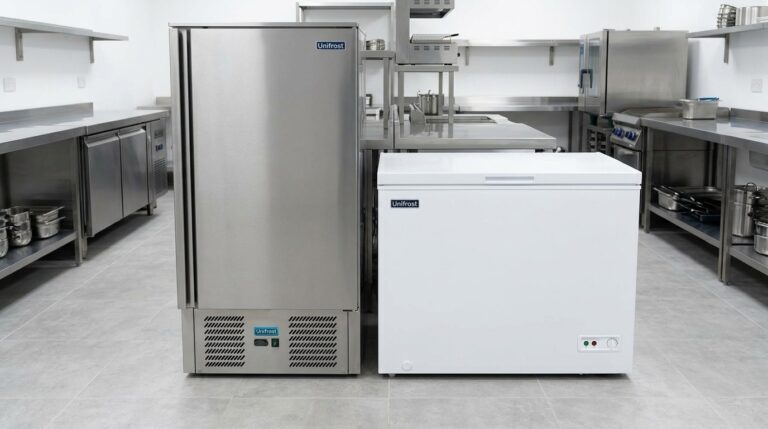
Unifrost F410SS vs CF500HS: First-Time Buying Layout Guide for Irish Kitchens
Discover the right Unifrost freezer for Irish kitchens. Compare the F410SS upright and CF500HS chest models for layout and efficiency options.
Read guideCompare Unifrost freezer options on Caterboss
For current product options, pricing and availability, continue to Caterboss.