
Unifrost Cold Topper vs SA136G Saladette Compact Pizza Line Buying Guide
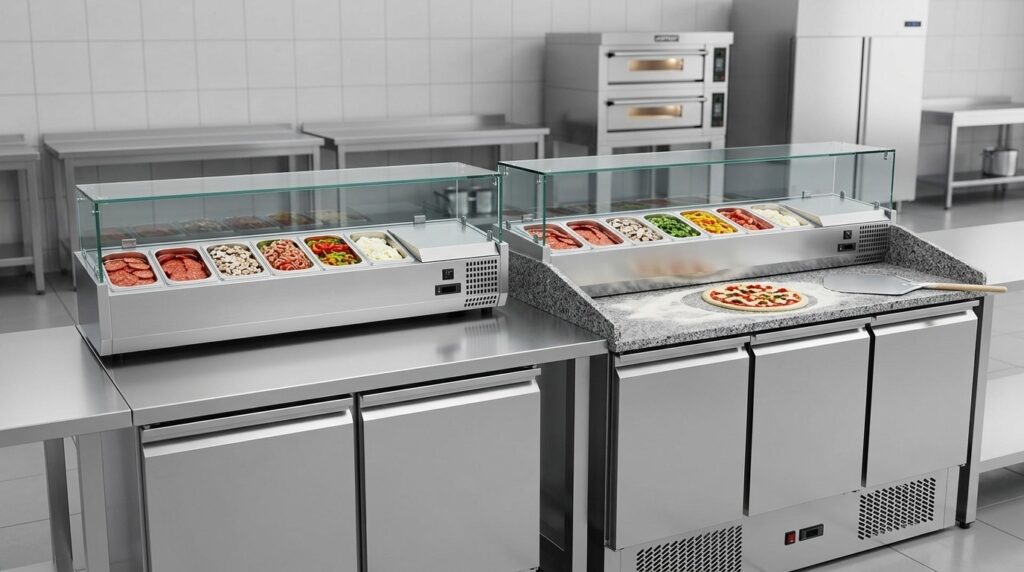
Compare Unifrost cold toppers with SA136G saladettes for optimal pizza prep in Irish commercial kitchens.
Unifrost Cold Topper (CTG/CTS) vs SA136G Saladette: Compact Pizza Line Buying Guide
You are deciding between a Unifrost CTG/CTS cold topper (a countertop GN topping unit that sits on an existing counter or base fridge) and the Unifrost SA136G saladette (a 3 door prep counter with an integrated refrigerated GN well plus undercounter storage). The right choice affects how fast you build pizzas in service, how reliably you hold toppings at safe temperatures, and how much space and spend you commit to your make line.
This guide walks you through the practical checks that matter in a tight Irish kitchen: the GN pan space you actually need for your menu, whether a modular setup (topper plus separate fridge) or an all in one saladette suits your workflow, and the tradeoffs around footprint, access speed, food protection, cleaning, and maintenance in a flour heavy environment. You also get venue based recommendations and how each option fits into a wider Unifrost prep line if you want to expand later.
Core Difference Explained
Unifrost CTG/CTS units are countertop refrigerated cold toppers that take GN pans for service ingredients. They are designed to sit on a separate base, such as an existing counter or an undercounter fridge, so your bulk storage and your working height are handled elsewhere.
The Unifrost SA136G saladette is a combined prep counter. It gives you a refrigerated GN top well and undercounter chilled storage in one footprint.
In both cases, the job is the same: keep high-risk toppings safely chilled during service. The Food Safety Authority of Ireland’s guidance is clear that chilled food should be controlled at 5°C or below for safe cold holding (see the FSAI’s temperature control advice). Your decision is really between:
a modular “top only” ingredient rail (CTG/CTS), and
an all-in-one compact make-line station (SA136G)
Your layout, service volume, and how you restock during a rush will decide which is easier to run and easier to keep compliant day to day.
CTG/CTS cold topper: chilled ingredient access on a counter you already use
A cold topper is built for speed at the point of assembly. It keeps pre-portioned GN pans within arm’s reach for pizza, deli, and sandwich work, without forcing you to replace the counter or fridge you already have.
This suits you if:
you already have reliable undercounter or nearby chilled storage for backup stock
you want to upgrade the prep surface first, then address base refrigeration later
you need a flexible layout that can change with the menu
The operational watch-outs are practical ones: where the reserve stock lives, how often staff are topping up pans, and how you’ll keep the open-top area clean in a busy kitchen (especially where flour, crumbs, and sauces are constant).
SA136G saladette: top well plus undercounter storage in one unit
The SA136G format is aimed at being the main compact prep station. You get the GN top well for service pans, plus refrigerated storage underneath for reserve tubs and backup ingredients. That reduces walking and door-opening elsewhere in the kitchen, which often helps consistency during peak periods.
This suits you if:
you need one compact station to do most of the prep work
space is tight and you want ingredients and backup stock in the same place
you’re trying to reduce bottlenecks on a small pizza or sandwich line
The trade-off is commitment. An integrated prep counter is harder to “move around the plan” later, so you need to think about placement, ventilation clearance, and whether the door swing and loading space work in your actual service lane.
What this means on a real pizza line
If you want a modular build, for example adding chilled pans to an existing counter now and dealing with the base fridge later, CTG/CTS is usually the cleaner fit.
If you want one unit to act as the core of the make line, with pans on top and reserve stock underneath, the SA136G-style layout is often simpler to run during a rush.
From there, the sensible next checks are temperature hold during busy service, how quickly it recovers after repeated lid opening, and how easy it is to clean and maintain in your kitchen.
Performance Comparison
A Unifrost CTG/CTS cold topper and the Unifrost SA136G saladette both keep toppings chilled at the make line, but they solve different problems once service gets busy.
CTG/CTS: a countertop GN topping unit. It gives fast access to pans, but it depends on separate refrigerated storage for backup stock.
SA136G: a combined prep counter with a refrigerated top well and three-door undercounter storage in one footprint.
In practice, a cold topper can feel quicker for pure assembly because everything is right in front of you. The trade-off is that your team will do more turning, restocking, and fridge-opening as the rush goes on. SA136G usually holds the line together better because toppings and backup stock live in the same station, so you are less likely to run short mid-service.
Whichever route you take, performance still comes down to how well you can keep food within safe temperatures. The FSAI guidance is that refrigerated food should be maintained at 0 to 5°C (source). The “best performer” is the unit you can keep correctly loaded, covered, and stocked without shortcuts.
How do Unifrost cold toppers and the SA136G compare overall?
Cold toppers (CTG/CTS) suit a modular line where you already have reliable chilled storage within arm’s reach, and you just need chilled GN access at the point of build.
SA136G suits a compact pizza, deli, or sandwich line where the prep station also needs to be the storage station. It reduces steps per order and makes restocking less disruptive.
Where you will feel the difference is during a busy spike. With a cold topper, the topping surface can stay tidy, but the weak point is how often someone has to open the separate fridge to replenish. With a saladette, the undercounter doors get opened too, but the stock is part of the station, so you are not crossing the kitchen or reaching around other staff to keep the line moving.
Unifrost CTG/CTS cold toppers (CTG1400/1500/1800 and CTS1200)
For speed, CTG/CTS is a straightforward way to add chilled topping capacity on an existing bench without rebuilding your line.
The key limitation is not the GN pans on top. It is that the topper does not solve bulk chilled storage. You still need a clear plan for where backup tubs, cheese, meats, and sauces sit, and how often they are replenished during service.
CTG/CTS fits best in tight takeaways where the make space is fixed, but you can position an undercounter or upright fridge immediately beside or behind the station. In flour-heavy kitchens, the risk is housekeeping: more joins and edges can mean more places for debris to build up, so cleaning needs to be built into the shift routine.
Unifrost SA136G 3-door saladette / compact pizza line prep counter
SA136G generally suits higher topping variety, more prep done in advance, or a line where more than one person is feeding the oven. The station acts as both the topping rail and the local stock room.
The undercounter storage is the main advantage. It lets you keep reserve pans and backup containers close, reducing restock interruptions and avoiding the temptation to overfill the top well “just in case”.
It is also easier to manage day-to-day because one unit owns the job. That can simplify cleaning routines and responsibility, although you still need to stay on top of basics like door seals and condenser hygiene.
Which is best for you?
Choose CTG/CTS if the bottleneck is topping access and you already have reliable chilled storage immediately adjacent to the prep position. Choose SA136G if the bottleneck is running out of prepped ingredients and losing time on restocking runs during service.
A quick sanity check before you buy:
If you cannot restock toppings in under 30 seconds without leaving your station, the integrated SA136G-style workflow usually works better in real service.
Get the layout right and either approach can work. The better choice is the one that matches your service rhythm, staff movement, and how much chilled backup you need within arm’s reach.
Operational Considerations
Day-to-day cleaning, maintenance, and HACCP checks are often what separates a tidy, predictable pizza line from one that is constantly fighting temperatures, odours, and service delays. The main operational risk is simple: toppings spend a lot of time exposed during service. Every lid opening, every hand in the well, and every blast of heat from the oven side pushes ingredients towards unsafe temperatures.
In Ireland, your HACCP controls need chilled food kept out of the danger zone. The FSAI guidance is clear that fridges and chill cabinets should be set so food is held between 0°C and 5°C (FSAI temperature control guidance). Both a CTG/CTS cold topper and an SA136G-style saladette can support that, but they place the operational workload in different places.
Cold topper (CTG/CTS): faster access, more exposure to heat and handling
A cold topper suits fast assembly. You are working directly from the pans, with frequent opening and closing. The trade-off is exposure: pans sit closer to warm hands, flour dust, and heat rising off the line. In a busy takeaway, the unit is mainly holding cold product. If the lid is left open for long periods, it will struggle to pull temperatures back quickly.
Cleaning is usually quicker because the footprint is smaller, but it is also easier to do a “quick wipe” and miss the corners. That tends to show up later as smells, sticky tracks, and hygiene headaches. The practical way to run a topper well is to lift out GN pans, clean and sanitise the well properly, and swap in a spare set of pans during quieter moments.
Saladette/prep counter (SA136G): better containment, more surfaces to stay on top of
A saladette combines a refrigerated top well with undercounter refrigerated storage, which reduces back-and-forth to a separate base fridge. In day-to-day use, that can help temperature control because you are less likely to leave “backup” ingredients sitting out for convenience, and you are opening fewer separate doors during service.
The trade-off is cleaning time and access. You have more stainless surfaces, more corners, and more door edges and gaskets to keep clean. Spills around the well area are harder to ignore, and if they build up you will feel it at the worst time, mid-service. The upside for a compact pizza line is consistency: one unit to check as part of HACCP routines, one controller to monitor, and a simpler flow for staff.
Flour-heavy pizza kitchens: maintenance habits that prevent nuisance faults
Flour dust and greasy vapour are tough on any refrigeration. They show up first as higher running costs, temperature drift during busy periods, and annoying callouts. Whether you choose a topper or a saladette, the same basics apply: keep airflow areas clear, keep seals clean, and stop warm air leaking in all day.
During service: top up little and often rather than overfilling pans, keep lids closed when you are not actively dressing pizzas, and use probe checks on the food (not just the cabinet display) as part of HACCP.
At close: remove pans, wash and sanitise the well and lid tracks, wipe door gaskets, and keep ventilation space around the unit clear.
Weekly: do a deeper clean on edges and corners where flour paste forms, then check doors are closing cleanly without forcing.
These differences matter most when the line is opened every few seconds and the kitchen is running hot. Choose the format that matches how your team actually works, not how you want it to work on a quiet Tuesday.
Best Fit for Venue Types
Choose between a Unifrost CTG/CTS cold topper and the Unifrost SA136G saladette by matching the unit to your service style and space. A CTG/CTS is a modular topping rail that sits on an existing counter, so it makes sense when your base storage is already sorted. An SA136G-style saladette is an all-in-one prep counter with a chilled top well and refrigerated storage underneath, so it suits stations where you want topping access and backup stock in the one place.
Whichever way you go, make sure your HACCP routine can keep chilled toppings within safe limits, particularly during peak service and refilling. The FSAI’s HACCP guidance is the right reference point for what you should be monitoring and recording: https://www.fsai.ie/business-advice/running-a-food-business/haccp
1. Match the unit to how your venue actually serves food
If you run a small takeaway or compact pizzeria with short, intense bursts, the decision is usually speed versus consolidation. A CTG/CTS cold topper works well where you already have undercounter refrigerated storage within reach and you want toppings directly in front of the operator. That reduces steps and helps when one person is stretching, topping, and loading.
If you are a café, deli, hotel kitchen, or multi-menu operation, a saladette format often fits better. You get a chilled top well for service and refrigerated storage underneath for backup pans and prepped ingredients. In day-to-day use, that cuts down on walking to a separate fridge and makes restocking simpler during a rush.
2. Decide whether “modular” or “integrated” suits your space and budget
Pick a CTG/CTS cold topper if your existing counter and base fridge are doing the job and your bottleneck is topping access. It is a common route in tight Irish kitchens where upgrades need to be phased without taking a full station out of service.
Choose an SA136G-style saladette when the prep counter itself needs to be the station, not an add-on. It can be a good fit for a tight menu where your topping range is controlled and you have sensible backup storage nearby. If you carry a long list of toppings or do a lot of custom builds, modular can still win because you can increase topping capacity without changing your undercounter storage setup.
3. Pick the best fit by venue type (what tends to work in Irish kitchens)
Single-site takeaway with one main pizza station: CTG/CTS is often the cleanest option if you need a fast topping rail and you already have refrigerated drawers or a base fridge within arm’s reach. It keeps the make area lean, but it relies on disciplined refilling and keeping the well covered when you can, especially in warm kitchens.
Café, deli, sandwich bar that also does pizza/flatbreads: SA136G tends to work better day to day because the undercounter storage supports all-day prep and restocking without turning service into a juggling act. It is also easier to standardise for staff because one unit carries the workflow.
Pub kitchen or hotel with unpredictable spikes: favour the option that reduces trips and reduces the chance of toppings sitting exposed during a rush. In practice, that often points to an integrated saladette, unless the pass is so tight that only a countertop topper will fit without obstructing movement.
4. Check the practicalities that bite in real kitchens: ergonomics, heat, and cleaning
In flour-heavy pizza kitchens, cleaning and airflow matter as much as layout. A countertop cold topper can be quicker to strip and wipe down, but you are relying on the cleanliness and ventilation around the surface and base unit it sits on. Plan for flour and ingredient debris around seals and vents and build that into close-down.
Ambient heat will make or break performance. If your line sits beside pizza ovens or fryers, avoid forcing the unit to pull in hot air all shift. Leave the ventilation clearance the unit needs and do not box it in. Also think about working height: a raised topper can speed topping placement for one person, while a full prep counter can be more comfortable for longer prep runs, depending on your counter height and how tall your staff are.
Once the venue fit is clear, it becomes easier to compare how each option behaves under pressure, including recovery during service, consistency across the top well, and what that means for day-to-day temperature checks.
Unifrost Ecosystem Context
The practical choice here comes down to what slows you down on shift: access to ingredients on the bench, or chilled storage underneath it. You also need to decide whether you want one self-contained station or a modular line you can change over time.
On a busy pizza line, the weak point is nearly always the topping pans. They are opened constantly, they sit closest to the heat, and they are the hardest part of the line to keep consistent when staff are moving fast. That is why it helps to anchor the decision to day-to-day compliance, not just layout. The FSAI’s consumer guidance is that refrigerated food should be kept properly chilled, with a typical target of 0–5°C for refrigerated storage, and your make-line setup should make that achievable in real service conditions, not only at prep time.
Source: FSAI advice on maintaining food temperature (0–5°C)
A cold topper (CTG/CTS) and an integrated saladette (SA136G) can both suit Irish takeaways and restaurants, but they behave differently once the kitchen is hot, lids are lifting every minute, and you are trying to keep HACCP checks straightforward.
How CTG/CTS cold toppers fit into a modular Unifrost prep line
CTG/CTS cold toppers are the “access layer” of a prep line. They sit on an existing counter or base fridge and focus on one job: keeping GN pans chilled and within easy reach without changing your whole setup.
They make most sense when:
You already have solid undercounter storage and just need fast access to toppings.
You want to build the line in stages, rather than committing to one large unit.
Space is tight and you need flexibility around door swings, delivery routes, and what can physically be moved into the unit.
A common real-world setup is a topper on a suitable base fridge or counter, with an upright fridge elsewhere holding backup stock. That keeps the make line quick, while bulk product stays shut and more temperature-stable.
How SA136G fits as the “core” of a compact pizza make line
SA136G (a 3-door saladette format with an integrated GN top well and undercounter storage) is usually the better fit when you want one predictable station for both mise en place and replenishment stock.
Operationally, that tends to mean:
Fewer steps to restock during a rush.
Fewer separate pieces of kit to manage day to day.
Less confusion for new staff because toppings and chilled backup are in the same place.
It also simplifies routines. With one main station, temperature logging and daily checks are more straightforward than managing a topper and a separate base with different loading and opening patterns.
Compatibility planning: plugs, ventilation space, and service access in Irish kitchens
Most failures in prep refrigeration are installation and positioning problems, not “bad units”. Before you choose between a topper setup and a saladette-style core station, plan for the issues that regularly catch Irish takeaways out: limited sockets, high ambient heat (especially near pizza ovens), and flour dust.
Power: confirm where your sockets are and avoid relying on extension leads in wet prep areas.
Ventilation and heat: leave practical airflow space and keep the unit out of direct oven blast. Hot kitchens slow recovery and increase running time.
Cleaning: build condenser cleaning into your routine, particularly in flour-heavy kitchens. Blocked airflow is a common cause of nuisance alarms and soft ingredients.
If you want maximum flexibility, a CTG/CTS topper lets you change the base fridge later without replacing the whole station. If you want fewer variables and one “known” make line, SA136G is the cleaner anchor point, with the trade-off that more of your footprint is committed to one unit.
FAQs for compact pizza prep lines
How much chilled GN pan capacity do I need for a compact pizza line?
Start by mapping your busiest 60 to 90 minutes and the number of toppings you actually keep on the line.
Core pizza menu (most small takeaways): plan space for your daily staples first: cheese, pepperoni, ham, mushrooms, onions, peppers, plus one or two “wet” items (fresh mozzarella, pineapple, tuna). That usually means 8 to 12 pans’ worth of chilled ingredients on the rail, with backup stock below.
If you run a wider menu (salads, wraps, kebabs): add pans for salad components and sauces. In practice this pushes many compact lines toward a wider GN top well or a second rail.
Rule that avoids waste: only keep what you can turn over in 60 to 120 minutes on the top well. Put bulk backup in the undercounter fridge or a separate upright. This keeps temperature recovery faster and reduces topping spoilage.
If you are choosing between a countertop cold topper (CTG/CTS) and an integrated saladette prep counter (SA136G), decide whether you need undercounter backup storage built-in (saladette) or you already have reliable cold storage directly underneath (cold topper on an existing counter/base fridge).
Will a saladette keep toppings safe during busy service?
Yes, a commercial saladette is designed to keep toppings chilled in a refrigerated GN well, but busy service habits matter as much as the unit.
Practical ways to keep the rail safe and consistent on a rush:
Pre-chill ingredients and GN pans before loading the top well. Warm refills are the most common reason rails struggle during peaks.
Do smaller, more frequent top-ups from the undercounter storage rather than overfilling the well.
Keep lids/cover closed when you can (where fitted). Open access is fast, but it increases heat gain from the kitchen.
Avoid blocking airflow in the well with over-deep pans or mounded product.
Daily cleaning and weekly condenser care are non-negotiable in flour-heavy pizza kitchens. Flour and grease buildup reduces cooling performance and makes temperature recovery slower.
If your service is very high-velocity with long periods of constant open access, a modular setup (cold topper over a strong base fridge) can also work well, but you still need the same disciplined refill routine.
Which Unifrost option suits a small Irish pizzeria?
A simple way to choose:
Choose a Unifrost CTG/CTS cold topper if you already have a solid undercounter fridge or prep counter, and you want a low-cost, modular upgrade to add a chilled topping rail on top. This is often the easiest option when you are fitting out a tight counter run or replacing only the “rail” part of the line.
Choose the Unifrost SA136G 3-door saladette prep counter if you want one integrated station that combines a refrigerated GN top well with built-in undercounter storage. It is typically the cleaner choice when you are building a compact pizza make line from scratch or you want less dependency on separate fridges.
Operational tip for Irish takeaways: if your kitchen runs warm (small space, ovens close by), prioritise better layout and ventilation space around the unit and keep bulk backup cold storage nearby. That often matters more than chasing extra top-well capacity on paper.
Explore Unifrost prep options for your pizza line
If you are planning a compact pizza make line, it helps to compare the workflow differences side-by-side: a CTG/CTS cold topper for modular topping storage on an existing counter versus an integrated SA136G saladette prep counter with undercounter backup built in.
Browse the current Unifrost prep and refrigeration options here: Browse Unifrost Refrigeration Options.
Related Unifrost guides
Compare models, maintenance advice and support information related to this topic.
Unifrost Counter Fridge Prep Counter Saladette Manuals and Installation Support
Manuals, controller guidance, setup checks and troubleshooting help for Unifrost counter fridges, prep counters and saladettes.
Read guideView Unifrost fridges at Caterboss
For current product options, pricing and availability, continue to Caterboss.