
Unifrost Small Ice Machine Model Comparison for Irish Bars & Cafes
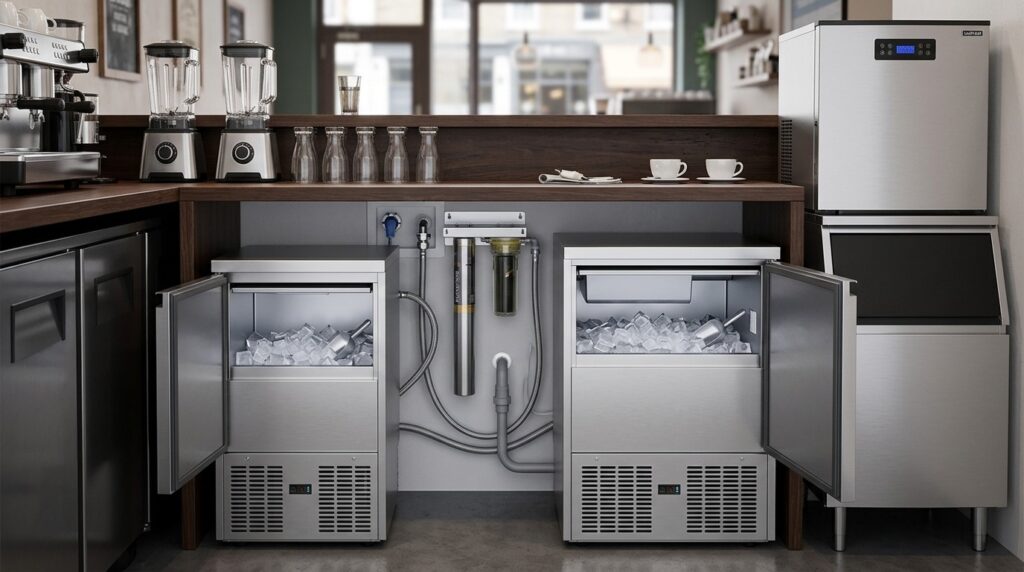
Compare compact Unifrost ice machines for Irish bars & cafes. Evaluate model size, output, and energy efficiency.
Unifrost Small Ice Machine Comparison: UB25-15 vs U40-15 and Compact Head-and-Bin Setups
You are usually buying a small ice machine because you need reliable ice every shift, but you do not have spare room behind the bar. This guide compares Unifrost’s compact options for Irish bars and cafés, including UB25-15 and U40-15, plus small head and bin combinations such as U165‑125 or U230‑175 paired with bins like B175 or B375.
You will work through the practical tradeoffs that actually decide the right unit:
Output vs footprint vs onboard storage: when a tighter undercounter unit makes sense, and when you outgrow it.
Self-contained undercounter vs head-and-bin: flexibility, expansion options, and what it means for service patterns.
Installation checks for cramped back bars: ventilation space, water feed, drainage and when a pump becomes necessary.
Running reality: noise expectations in café front-of-house, cleaning access, and how maintenance affects consistency.
Water quality protection: when to fit Unifrost filter kits such as SA30007 and cartridges like I40002‑CN to improve ice clarity and reduce scale risk.
By the end, you can shortlist the model and configuration that matches your busiest hour, your counter layout, and the level of ongoing upkeep your team can realistically deliver.
What the Core Difference Is
Unifrost’s small ice machine range breaks into two practical formats: self-contained undercounter units (UB25‑15, U40‑15) and modular head-and-bin setups (U165‑125, U230‑175). In day-to-day use, the differences that matter are footprint, how quickly you can recover during a rush, and how much ice you can hold ready to go.
From a compliance point of view, treat ice like food. Under EU food hygiene rules that apply in Ireland, ice that comes into contact with food must be made from potable water, so water quality and filtration are not optional extras if you want consistent output and fewer issues on service (EU Regulation (EC) No 852/2004, Annex II). Also worth keeping in mind: “kg per day” is a test figure. Your reality is peak-hour demand, storage, and whether the machine has enough ventilation in the space you are putting it.
Compact self-contained vs head-and-bin: what changes in a tight Irish bar
UB25‑15 and U40‑15 are the straightforward choice when you need one unit that both makes and stores ice. They suit undercounter installs and back bars where space is already spoken for, and where adding a separate bin (and the clearance to clean around it) is just not realistic.
U165‑125 and U230‑175 come into their own when drinks volume is both steady and spiky, and running short of ice mid-rush is regularly slowing the bar down. The modular format lets you separate production from storage, but it needs a bit more planning: space for the bin, access for cleaning, and a sensible route for drainage.
Output vs storage: why “kg/day” is only half the story
For cafés and smaller bars, compact cube makers in the broad 20 to 40 kg/day class can be plenty if demand is steady and the machine can keep ticking over through the day. The usual failure point is not the average day. It’s the hour when orders pile up and you need full scoops and buckets immediately.
That is why storage tends to decide whether a setup feels comfortable in service. If you are mainly doing spirit-and-mixer with the odd cocktail, recovery rate can matter as much as storage. If you are hitting rounds of cocktails, jugs, and iced coffees at the same time, having more ice sitting ready often beats chasing a slightly higher headline daily output.
Utility differences: ice type, water filtration, and fit with your workflow
Across this compact Unifrost range, you are generally choosing cube ice either in a self-contained body or produced by a modular head into a separate bin. Cubes are the safe, workable default for mixed drinks and general bar use because they are easy to portion and behave predictably for dilution.
Water filtration is the practical factor many sites only take seriously after scale or taste issues start causing hassle. In hard-water areas, budgeting for a proper filter setup such as the SA30007 kit with an I40002‑CN cartridge is typically about protecting internals and keeping output stable, not just making nicer-looking ice. That stability matters even more when staffing is tight and routine cleaning slips.
Matching bins: B175 vs B375 is a service decision, not a spec-sheet decision
With modular heads like U165‑125 or U230‑175, choosing between B175 and B375 is really choosing how long you can run without waiting for the next harvest cycle to catch up. B175 can be the sensible pick where space is genuinely tight and you can live with topping up more often. B375 makes more sense where demand comes in bursts and you want to reduce the risk of running dry mid-service.
In practice, the best setup is the one that keeps ice within easy reach of the busiest station without blocking access for cleaning and maintenance. That is what decides whether the system feels smooth on a Saturday night, or like another thing you are fighting.
Where Each Option Performs Better
Choosing between Unifrost’s UB25-15 and U40-15 is mostly about matching ice production and bin storage to your busiest hour, not your quiet days. UB25-15 tends to suit lower, steadier demand where space is tight. U40-15 is usually the safer option when service spikes and the bin gets emptied quickly.
If you are running modest mixed-drink volume in a small bar, or iced coffees that come and go with the weather, UB25-15 can be easier to justify because you are less likely to pay for capacity you rarely use. If you are in a wet-led pub, a cocktail-focused corner, or a café that regularly gets hit with group orders, U40-15 gives you more breathing room before you start rationing ice mid-service.
Both are compact, self-contained undercounter machines in the “small commercial” bracket. The right choice depends on peak drinks per hour, how often staff can top up, and whether you can keep the unit properly ventilated under the counter.
How UB25-15 and U40-15 compare overall
On paper, daily output figures look tidy. In practice, what decides performance is recovery during rush periods and how quickly the machine can replace what you take out of the bin.
If your service regularly hits heavy bursts, the key question is simple: can you get through the gaps between scoops while the machine catches up? That links directly to day-to-day habits like keeping the scoop clean, not leaving the bin open, and not letting ice get crushed and melt into a slushy base.
In older Irish pubs and cafés with boxed-in counters, either machine will underperform if airflow is restricted or if it is installed beside a heat source (for example, near a glasswasher exhaust). Often, the “better” machine is the one you can install correctly.
UB25-15
UB25-15 tends to perform best where demand is predictable and you want a compact machine that does not feel oversized for the job. It suits:
small cafés
quieter lounge bars
takeaways that only need ice occasionally
a secondary machine backing up a larger setup
Where it can fall down is the busy hour. If you empty the bin faster than it can recover, staff end up chasing ice, opening the bin constantly, and improvising with bagged ice in already busy freezer space. That is usually when service slows and standards slip.
U40-15
U40-15 performs better when your “normal” includes peaks: a round of spirits and mixers, a cocktail burst, or a sunny-day café rush where every second order is iced. The extra capacity is also useful if nobody can mind the bin because the same person is pouring pints, making coffees, and taking payments.
The trade-off is that higher-output compact units are typically less forgiving of poor ventilation and poor cleaning routines. You will want to be confident you can keep condenser airflow clear and manage limescale in hard-water areas. Irish Water publishes county-level hardness guidance in its water quality information, which is worth checking before you decide on filtration and descaling intervals.
Which is best for you?
Pick UB25-15 if your ice use is steady, your busiest hour is manageable with occasional top-ups, and you are trying to fit a proper ice machine into a tight undercounter space without oversizing.
Pick U40-15 if you regularly get bursts of demand, you want more protection against running out mid-service, or you are building a small bar station where speed matters more than shaving every last centimetre of footprint.
Consider a head-and-bin setup if your real problem is storage and service flow rather than pure daily output. A separate bin can keep you serving through peaks even when production is catching up.
If you are still torn, measure your actual peak-hour draw, then sanity-check the install points that usually decide real-world performance in Irish counters: airflow, a reliable drain route, and whether filtration and cleaning access are genuinely achievable in your layout.
What Matters for Day-to-Day Operation
Running a small ice machine in a busy Irish bar or café is mostly about two controllables: keeping airflow clear and keeping scale out of the water system. The routine you set should also reflect the format you are using, whether that is a self-contained undercounter unit (UB25‑15, U40‑15) or a modular head-and-bin setup (U165‑125 or U230‑175 with B175 or B375). Before you finalise any schedule, confirm two install basics that cause most “mystery” faults: how the unit drains and where the condenser is pulling air from.
1. Use a cleaning schedule staff can actually stick to mid-service
Ice is treated as food, and in real-world back bars it sits beside glasswashers, coffee stations, fruit prep, and plenty of airborne dust. You need a written, tick-box routine, not a vague “we’ll do it monthly” plan.
A workable baseline is:
Daily: wipe external surfaces and the ice access area.
Planned deep clean and sanitise: set the frequency based on water hardness and ice volume, then keep records for HACCP.
The Food Safety Authority of Ireland is clear on the value of a proper schedule and defined cleaning stages, including record-keeping, rather than ad hoc wiping. Their guidance on cleaning schedules and the six stages of effective cleaning is a good reference point for building your internal routine:
https://www.fsai.ie/Business-Advice/Running-a-Food-Business/Butchers/Safe-Food-Handling
What changes between formats
UB25‑15 / U40‑15 (self-contained undercounter): one cabinet to manage. Day-to-day hygiene work is mostly the accessible food-contact areas and keeping the condenser air path clear (often behind or beside the unit).
U165‑125 / U230‑175 with B175 or B375 (head + bin): you gain storage and flexibility, but you also add a second hygiene zone that gets missed: bin interior, bin door, chute area, and splash zones.
2. Manage scale and taste with filtration, then keep cartridge changes on a calendar
Water quality varies across Ireland, and hard water will scale up an ice machine quickly. In practice that shows up as reduced output, odd cube shape, and more downtime. If ice matters to service, it is usually cheaper to plan filtration from day one than to react after the first breakdown.
For Unifrost small ice machines, the relevant parts are:
SA30007 water filter kit
I40002‑CN replacement cartridge
Filtration shifts the workload from frequent descaling to predictable cartridge changes, and it helps protect valves and water paths that are awkward to clean once scaled.
How it plays out in use
UB25‑15 / U40‑15: you tend to feel water issues faster because production and storage are in one unit. A bit of scale can quickly become “we’ve no ice”.
U165‑125 / U230‑175 with B175 or B375: the storage buffer can hide falling production for longer. That is why cartridge changes should be calendar-driven, not “when the ice looks cloudy”.
3. Plan deep cleaning around access (especially in older premises)
Most day-to-day issues are not exotic faults. They are blocked airflow, dusty condensers, poor drainage, and missed sanitation because the machine is wedged into a counter with no proper clearance. The aim is not just cleanliness, it is access you can maintain.
Practical realities by setup
UB25‑15 / U40‑15: undercounter installs beside glasswashers or dishwashers often mean more heat and steam. Expect more condenser cleaning and a tighter deep-clean cycle to maintain output. If the unit is customer-facing in a café, you will also be cleaning the exterior more often to keep it presentable and to stop vents clogging with dust.
U165‑125 / U230‑175 with B175 or B375: more storage can reduce pressure on production, but the bin adds corners and surfaces where residue builds up if it is not emptied, cleaned, and dried properly. Moving from B175 to B375 is not just “more ice”, it is a larger internal area that needs a proper empty-and-clean routine.
4. Keep running costs in check using what you can measure on site
If you do not have model-specific energy figures to hand, manage running cost by focusing on the main drivers you can control: ventilation, condenser cleanliness, ambient heat, and water treatment.
A practical approach:
Measure actual consumption for a week.
For undercounter self-contained units like UB25‑15 / U40‑15, use a plug-in energy monitor.
For modular installs, talk to your electrician about a suitable metering option.
Multiply kWh by your tariff, then add water and filter consumables.
Schedule deep cleans for quieter periods so you are not dumping large volumes of ice during service.
In buying terms, these formats tend to suit different priorities: undercounter units when you need compact ice with simpler ownership, and head-and-bin setups when you are paying for storage and service resilience rather than the lowest possible monthly utilities.
Once you know the maintenance load and what your team will realistically follow, the choice becomes straightforward: pick the format that fits your layout, your peak demand, and the level of downtime you can tolerate.
venue-choice-support
Which Choice Makes More Sense for Different Venue Types
Your “best” small ice machine choice changes by venue because ice demand is rarely steady. It comes in service bursts, it depends on how close the machine is to the bar or pass, and it depends on who actually owns cleaning and checks. Ice is a food product, so it needs to be produced, stored and handled hygienically under your HACCP controls. In practice, the easiest setup to keep clean and consistent often beats a machine that looks better on a “kg per day” line. The FSAI’s Guide to Good Hygiene Practice is a solid reference point for hygiene controls in food businesses, including handling practices that apply to ice in day-to-day operations: https://www.fsai.ie/getattachment/f3efa69d-8010-4a7c-b093-7b53700bfb81/guide-to-good-hygiene-practice-cml-final-2014.pdf?lang=en-IE
Older Irish bars and cafés add another layer. Tight counters, limited airflow, awkward drainage falls, noisy undercounter cavities and hard water can steer you towards a different format than you would pick from capacity alone.
Café counter, deli-style service, iced coffees and soft drinks
If your ice is mainly for iced coffees and soft drinks, a compact self-contained cube machine is usually the most straightforward fit. UB25‑15 generally suits smaller counters and lighter peaks. U40‑15 tends to suit busier daytime trade where you cannot afford staff running to the back for bagged ice mid-rush.
Pay attention to noise and heat rejection in a café. An undercounter unit with poor ventilation (tight kickboards, no air path, boxed-in cavities) will struggle, run hot, and recover more slowly. The “right” choice is often the unit you can install with proper breathing space without rebuilding the counter.
Wet-led pub, tight back bar, high peak rounds
In a traditional Irish pub, the risk is not average demand. It’s the round that clears the well and leaves you chasing ice while service stacks up. A U40‑15-style undercounter cube maker is often the more comfortable option than a very small entry machine because it gives you extra headroom while keeping ice close to where it’s used.
Drainage catches pubs out more than output. If you cannot achieve a reliable gravity fall to a trapped waste, you may need a pump solution. That decision can effectively set the installation constraints before you get into model comparisons.
Cocktail bar or hotel bar where storage and consistency matter
If cocktails are a meaningful part of revenue, storage buffer and consistent availability usually matter more than the smallest footprint. A head-and-bin setup such as U165‑125 or U230‑175 paired with a matching bin (B175 or B375) can make operational sense because you separate production from storage and reduce the stop-start pattern of a small internal bin being opened constantly during a busy session.
If you are serious about cocktails, plan for water filtration from day one, especially in hard-water areas. A kit like SA30007 with a cartridge such as I40002‑CN helps protect the machine and supports consistent ice quality, but it also adds a consumable you need to schedule and budget for.
Seasonal café, kiosk, food truck, and venues that cold-start often
If you are not trading year-round, your priorities shift towards predictable start-up routines, cleaning discipline, and how easily you can drain down and sanitise between runs. Simpler self-contained units (UB25‑15 or U40‑15) are often the safer operational choice because there are fewer components and fewer installation compromises.
The trade-off is storage buffer. A larger bin can make you look brilliantly prepared for event spikes, but only if you can keep it covered, clean, and managed as part of normal HACCP routines.
One quick way to match venue type to Unifrost format
UB25‑15: Smaller cafés and bars where demand is steady and you want the simplest undercounter fit.
U40‑15: Busy cafés and pubs with sharper peaks where running out of ice causes immediate service problems.
U165‑125 or U230‑175 + B175: Cocktail-led bars and hotel bars that need a bigger usable buffer without committing to a full dedicated ice storage area.
U165‑125 or U230‑175 + B375: Higher-volume bars where storage is the bottleneck more often than production.
SA30007 + I40002‑CN: Sites with limescale risk, or where ice appearance and machine reliability justify planned filter changes.
Once you narrow the shortlist by venue reality (service peaks, layout, drainage, ventilation and who cleans what), the choice usually becomes clearer because each format has predictable strengths and predictable day-to-day headaches.
Connecting to the Wider Unifrost Ecosystem
What works best depends on your real constraint: space under the back bar, or the size and timing of your rushes. Most Irish sites get better results when they treat the ice machine, bin, and water protection as one system. “Small machine” problems are more often caused by storage, drainage, and limescale than by headline kg-per-day figures.
A compact self-contained unit suits steady, predictable service. A small head-and-bin setup usually copes better with spikes, if you can give it the footprint. Your drinks mix, local water quality, and the realities of older pub fit-outs will often decide the best combination, even where the daily production ratings look similar on paper.
Build the setup around storage, not just daily output
If your bar or café gets bursts of 50 to 150 drinks an hour, the bin is what stops you running out mid-service. This is where thinking in “system” terms helps:
Compact cube makers like U40-15 and UB25-15 are all-in-one options for tight counters, but you are limited by their internal storage.
Modular heads like U165-125 or U230-175 let you choose a dedicated bin such as B175 or B375 to buffer busy periods.
A sensible way to specify it is to decide what “failure” looks like in your venue and work backwards:
If you cannot step away from the bar during service, prioritise storage (head plus bin, where you can fit it).
If floor space is tight and demand is steady, a self-contained undercounter unit keeps installation and day-to-day handling simpler.
If you get slammed for 60 to 120 minutes (match days, music nights, brunch), bin capacity often matters more than a small increase in daily production.
Water filtration is part of reliability in hard-water areas
In hard-water areas, scale is not a cosmetic issue. It is a downtime and call-out issue. Filtration is usually one of the cheapest ways to protect an ice machine that runs every day.
Geological Survey Ireland notes that groundwater hardness in Ireland mainly arises from limestone dissolving into groundwater, which is why some areas see persistent hardness issues that drive softener use (GSI groundwater hardness overview).
That is where Unifrost’s filter ecosystem comes in. A kit such as SA30007 with a cartridge like I40002-CN is the kind of practical add-on that can reduce scale build-up and make cleaning intervals more predictable.
Food safety matters here too. FSAI guidance is clear that you should use potable water for making ice (FSAI Guide to Good Hygiene Practice). In practice, that means specifying filtration alongside your HACCP routine, not as an optional extra you “might get later”.
Fit-out reality in older Irish pubs: drainage, ventilation, and access
Ice makers often end up squeezed into back bars that were never designed for modern refrigeration loads. So the right “ecosystem” is the one you can actually install and service properly.
A self-contained undercounter unit (like UB25-15 or U40-15) can be the simplest choice where you have one workable spot with a water feed and a safe drain route. It still needs ventilation and enough access for cleaning.
A head-and-bin combo (for example U165-125 or U230-175 with B175 or B375) can suit service flow better, but only if you can route water and waste neatly to that location without trip hazards, awkward pipe runs, or a bin position that gets knocked all night by bar traffic.
The day-to-day issue is access. If staff cannot reach the condenser intake area, remove panels, sanitise the bin interior, or change a cartridge without dragging the unit out, maintenance will slip during busy periods.
Choose the Unifrost package you can run, clean, and restock
When you compare small ice machines, you are comparing routines and consumables as much as the box itself. If you specify the machine with a matching bin (where needed) and the correct water filter parts from day one, you avoid compromises later, especially if you need consistent ice for cocktails, iced coffees, and mixed drinks.
Once you are comparing UB25-15 vs U40-15, or a modular U165-125 or U230-175 paired with B175 vs B375, plus a filter kit like SA30007 with I40002-CN cartridges, the decision becomes less about brochure numbers and more about which setup will hold up under Irish service pressure in your space.
FAQs: choosing a Unifrost small ice machine
How many kilograms of ice per day do I actually need for my size of bar or café?
Use your peak service to size the machine, then add a buffer for busy days and warm weather.
Quick rule of thumb for drinks-led venues: plan on 150 to 250 g of ice per iced drink (more for shaken cocktails and iced coffees).
Convert your peak hour to a daily figure: if you sell 60 iced drinks per hour for 4 busy hours, that is roughly 36 to 60 kg/day (60 × 4 × 0.15 to 0.25).
Add a safety margin: add 20 to 30% if you regularly do events, outdoor service, or long queues.
Match to the right Unifrost “small” bracket: compact undercounter cube makers such as UB25-15 and U40-15 are typically aimed at venues needing roughly ~20 to 40 kg/day in a tight footprint. If you are regularly above that, you are usually better looking at a head and bin setup (for example U165‑125 or U230‑175 with a matching bin) rather than oversizing an undercounter unit.
If you tell your supplier your busiest hour drinks count and the type of drinks you serve, they can sanity-check the kg/day and the storage you will actually need.
What’s the difference between an undercounter ice machine and a countertop or modular head unit?
Undercounter (self-contained) ice machine: the ice maker and storage are in one compact unit designed to sit under a counter. It is the simplest option for cafés and small bars, but storage is limited and it needs good ventilation around the cabinet.
Countertop unit: sits on a counter and is usually chosen where there is no undercounter space available. It can be handy for front-of-house, but you sacrifice prep space and you still need proper drainage and ventilation.
Modular head unit plus bin: the ice-making head sits on a separate storage bin. This is the normal step up when you need more output and much more storage without filling your undercounter. Examples in the Unifrost compact ecosystem include pairing U165‑125 or U230‑175 with bins like B175 or B375.
Noise expectation in a café: small commercial ice machines cycle on and off, so you will hear a compressor fan and the ice drop cycle. In practice, they are usually fine behind a bar or in a back counter run, but if the unit will be right beside seating or a quiet counter, plan for a location with a bit of separation and avoid boxing it in, as poor airflow can make it run longer and sound louder.
Can I combine different Unifrost models with various bin sizes to customize my setup?
Yes, within the head-and-bin part of the range, mixing a head unit with a different bin size is a common way to tune the setup.
If you want more buffer storage for peaks without changing the ice head, you can typically move from a smaller bin such as B175 to a larger option like B375.
If your priority is higher daily output, change the head unit (for example U165‑125 vs U230‑175) and then choose the bin size based on how “bursty” your service is.
Undercounter models like UB25‑15 and U40‑15 are self-contained, so bin choice is not the same kind of modular decision.
Before ordering, confirm compatibility for the exact head and bin combination, and plan filtration at the same time. A water filter kit (SA30007) with the appropriate cartridge (I40002‑CN) can protect the machine in hard-water areas and helps keep cubes clearer and the unit easier to maintain.
Next step: sanity-check your size and layout before you buy
If you are comparing compact undercounter units like UB25‑15 and U40‑15 versus a small head-and-bin setup such as U165‑125/U230‑175 with B175/B375, the fastest way to avoid the wrong purchase is to confirm three things: your true kg/day requirement, your available ventilation and drainage, and how much on-hand storage you need for peak service.
Explore Unifrost’s full range and share your busiest hour drinks estimate and bar layout with the team for model and setup advice tailored to your premises.
View Unifrost ice machines at Caterboss
For current product options, pricing and availability, continue to Caterboss.