
Unifrost Upright Fridge Freezer Shelving and Racking Setup Guide for Irish Kitchens
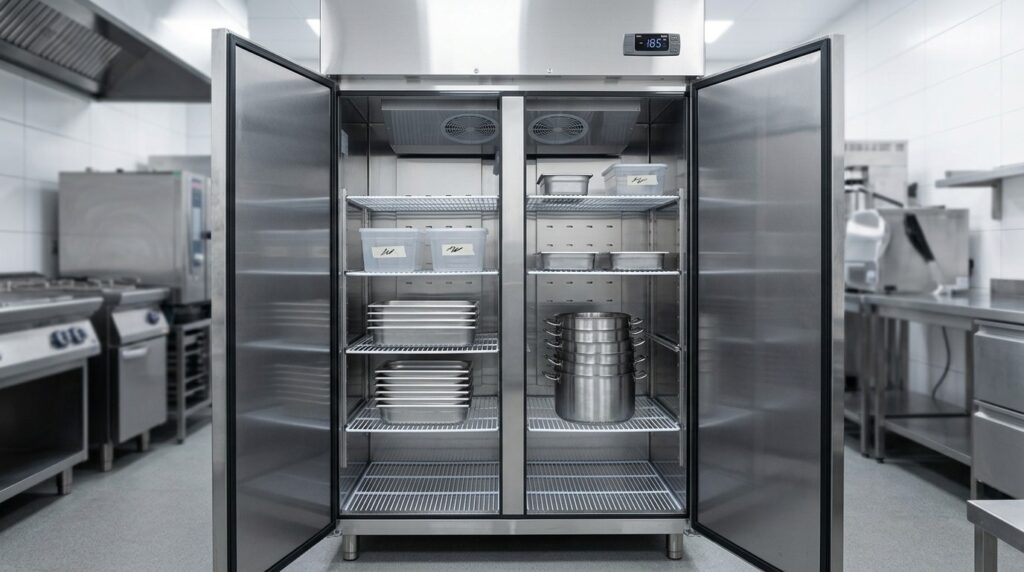
Optimize your Unifrost upright fridge freezer shelving for superior storage and compliance with Irish kitchen standards. Learn about GN pans and airflow.
Unifrost Upright Fridge Freezer Shelving and Racking Setup Guide (Ireland)
If your Unifrost upright fridge or freezer is slow to recover temperature, hard to keep organised, or constantly overfilled, your shelving layout is usually the cause. This guide shows you how to set up and adjust shelves in Unifrost uprights such as the R1000SV and R1300SV fridges and the F1000SV, F1300SV, F1310SV, F410SS, and F620SV freezers so you can store more product without blocking airflow or creating food safety risks.
You will work through the real choices operators face: when standard wire shelving beats GN pan storage, how much clearance you leave around food for circulation, how you separate raw and ready to eat items for HACCP, and how you avoid shelf bowing from heavy pots, boxed frozen stock, or loaded GN pans. You will also learn what to check before adding runners, racking, or third party GN shelves so you do not interfere with internal fans, door switches, or day to day loading speed.
Understanding Unifrost Upright Fridge Freezer Shelving
Unifrost upright fridge and freezer shelving is the adjustable shelf-and-support setup inside the cabinet. It decides three things day to day: how much you can store, how quickly staff can grab product during service, and how easy it is to keep HACCP separation (raw vs ready-to-eat, allergens, labelled prep) without constant reshuffling.
One important point for buyers: these uprights are supplied as shelving-based cabinets. Some models may suit GN pans if the internal dimensions and shelf arrangement allow, but you should not assume “GN-ready” unless the specific model listing states GN compatibility.
Unifrost upright models in scope and what “shelving-based” means
This section covers the Unifrost upright range including R1000SV and R1300SV (upright fridges), plus F1000SV, F1300SV, F1310SV, F410SS and F620SV (upright freezers).
“Shelving-based” simply means your default layout is adjustable shelves, not fixed GN runners like you’d see on a dedicated gastronorm cabinet or a trolley-style rack system. In practice, that gives you flexibility for boxes, sealed tubs, dairy crates, prepped items, and bulk storage. It also means the way you set shelf heights and loading patterns has a direct impact on airflow and temperature stability.
If you load an upright like a press and pack it tight, you usually pay for it in slower pull-down after door openings, warmer pockets in the cabinet, and wasted time moving things around when the kitchen is under pressure.
GN compatibility: what it means (and what it doesn’t)
GN compatibility in an upright is not a badge. It is a fit and workflow question:
Will the pan sit properly on the shelf or supports without rocking or bending the shelf?
Can you keep the air gaps needed around product and at the back of the cabinet?
Can staff lift pans in and out quickly without catching on supports or labels?
As a rule, treat GN storage in these uprights as possible with the right internal dimensions and shelf setup, not guaranteed out of the box. If your operation runs lots of open GN pans for mise en place, sauces or prepped proteins, you’ll want predictable spacing and wipe-clean access. If you are mainly storing sealed containers, boxes and bulk prep, standard adjustable shelving is often the more forgiving and flexible option.
Why shelf layout affects temperature control, food safety, and service pace
Shelf layout is not just about “fitting more in”. It affects how evenly the cabinet holds temperature, especially in a busy Irish kitchen where doors are opened constantly and ambient temperatures can run high.
From a HACCP point of view, the best shelving plan is the one that makes the safe option the easiest option. Clear zones for raw, ready-to-eat and allergens reduce mistakes when service gets hectic. Irish guidance also expects chilled food to be held cold enough to control bacterial growth, typically 5°C or below, as outlined by the Food Safety Authority of Ireland (FSAI) guidance on chilling food safely: https://www.fsai.ie/business-advice/food-safety-management/haccp
There is a cost angle too. A tidy cabinet with clear airflow paths generally recovers temperature faster after door openings, which reduces compressor run time and avoids unnecessary strain. If you are deciding between models or planning a fit-out, it’s worth thinking about shelving and container format at the same time, not as an afterthought.
Setting Up Shelving and Racking
Arrange shelves to suit what you actually store, while keeping the cabinet’s air path clear. Start with an empty cabinet, locate the air outlet and return (often at the back and around any internal fan cover), then set shelf heights for your most-used items. Load from the bottom up, keep gaps where air needs to move, and finish with a quick door-seal check and a temperature recovery check after a normal restock. A neat shelf layout is pointless if the door is being forced shut or the cabinet struggles to pull back down after deliveries.
1. Confirm your cabinet type and what “GN compatible” really means
Unifrost upright fridges and freezers are typically supplied with adjustable shelves rather than GN rail trolley systems. That matters because “a GN pan fits inside the cabinet” is not the same as “the unit is designed to run on GN shelves or slides”.
If you want to use GN pans on shelves, treat it as a fit-and-handle check:
Make sure the pan sits securely on the shelf supports without twisting or rocking.
Leave clearance around the edges so air can circulate.
If your exact model listing or manual does not state GN compatibility, plan around the standard shelving and use GN pans only where they sit properly and don’t interfere with the door seal.
2. Strip out shelves, clean, and find the no-block zones
Empty the cabinet so you can see the air path clearly. In uprights, the most common cause of poor performance is blocked airflow, usually from product pushed tight to the back wall or packed around an internal fan cover or duct.
Clean and dry shelf wires and supports before refitting. While you are there, check shelf clips are seated correctly and level. A shelf that is slightly out of square will sag under load, and that can lead to poor door closure and inconsistent temperatures.
3. Set shelf heights around your top 10 items
Set the cabinet up for what you reach for under pressure, not for the maximum number of shelves. In most Irish kitchens, the middle shelves should suit daily-use prepped food and open packs, with bulk back-up stock higher or lower where it is not slowing service.
Aim for spacing that avoids wasted headroom but still lets staff lift containers out without tipping. If you are trialling GN pans, test with a full pan and lid. Clearance and safe handling are usually the limiting factors, not the empty pan height.
4. Load for airflow first, then capacity (especially after deliveries)
Once shelf heights are right, load in a way that keeps air moving. You do not need big gaps everywhere, but you do need continuous air paths so the cabinet can recover after door openings and restocks.
A practical rule of thumb:
Keep product off the back wall and clear of any internal fan cover.
Avoid “wall-to-wall” trays or boxes that create a solid barrier across a shelf.
Be careful with warm loading. The FSAI advises cooling cooked food and getting it into refrigeration within two hours, and notes that overloading a fridge with warm food raises the overall temperature and increases risk (FSAI temperature control guidance).
5. Use shelf position to support HACCP (raw below, ready-to-eat above)
Your shelf plan should make cross-contamination harder to do by accident. In practice:
Raw meat, fish, and anything that can drip stays low.
Ready-to-eat, cooked, garnish, and dairy stays above, in covered containers.
Do not rely on “everything is wrapped” as the only control when the kitchen is flat out. A sensible shelf layout is a physical control that still works when labels peel and someone is trying to get a tray in quickly.
6. Freezer-specific setup: reduce frost and temperature swings
Freezers punish poor airflow because moisture becomes frost, and frost reduces both airflow and usable space over time. Keep boxed goods aligned and avoid crushing product into the back wall. Cover open product where you can, and avoid wide, shallow uncovered loads that expose a lot of moist surface area to circulating air.
Do not use an upright freezer as a blast chiller substitute. Uprights are for holding temperature once product is already cold or frozen. Loading large amounts of warm product at once slows pull-down and can create uneven cabinet temperatures.
7. Check shelf loading and lock in a simple reset routine
Maximum shelf loading depends on the shelf and cabinet design, so do not guess. If you are storing heavy stockpots, dense sauces, or stacked pans, check the manual for your model code and make sure the shelf and clips are intended for that load.
Once the layout works, take a quick photo of each shelf level and keep it as your reset standard after deep cleans or menu changes. It is a simple way to get consistent airflow, stock visibility, and more reliable temperature checks week to week.
Optimising for Safe and Efficient Storage
Organise your upright so it holds temperature reliably and staff can load it fast without guessing. Start with the target temperature, then set clear shelf zones for raw, ready-to-eat, allergens and high-turnover items. Use covered, labelled containers and leave deliberate air gaps so the cabinet can recover after door openings.
If you want to store GN pans in an upright, check the specific listing for GN compatibility. Many uprights are supplied as adjustable-shelf cabinets rather than dedicated GN racking.
1. Set the cabinet up for safe holding temperatures (before you touch a shelf)
In most Irish kitchens, an upright works best as a holding cabinet, not a rapid-cool solution. For chilled storage, set the thermostat so food is held between 0°C and 5°C, in line with the FSAI temperature control guidance for caterers.
For frozen storage, aim to hold at -18°C or colder, again per the FSAI temperature control guidance.
Be realistic about placement. If the unit is beside the cooker line, in a tight alcove, or in a hot prep area, you will see slower pull-down and recovery during service. That is when disciplined loading and spacing matters most.
2. Zone shelves to prevent cross-contamination (raw low, ready-to-eat high)
Decide what the cabinet is doing day-to-day, for example prep backup for a café lunch rush, mise en place for evening service, or bulk holding in a hotel kitchen. Then set shelves so the safe choice is the easy choice, even when someone is moving quickly.
A simple baseline is:
Top shelves: ready-to-eat food, cooked items, desserts, dairy
Middle shelves: prep items and high-turnover containers
Bottom shelf: raw meat, fish and poultry (and any raw that could drip)
Keeping raw meats on the bottom shelf aligns with the FSAI storage guidance. If you can run separate fridges for raw and ready-to-eat, it makes life easier. If you are sharing one upright, rely on lidded containers and fixed shelf allocation, not “we’ll be careful”.
3. Use lidded containers and clear labelling to reduce door-open time
Open trays and loose clingfilm might cope on a pass, but in an upright they create spills, drips and drying, and they slow staff down. Use rigid, covered containers and label clearly so nobody has to rummage with the door open.
If you are using GN pans, treat them like any other container:
cover them
label and date them
avoid stacking or packing so tightly that airflow is restricted
Do not assume GN runners are part of the standard setup. If your operation depends on GN, confirm the cabinet is listed as GN-compatible rather than trying to “make it fit”.
4. Protect airflow and temperature recovery with spacing and sensible loading
Uprights hold temperature by moving cold air around the product. Packing shelves edge-to-edge, or pushing containers hard against the back, creates warm spots and slower recovery, especially during busy service.
Practical habits that help:
leave visible gaps between containers
do not block internal vents or fan outlets (on forced-air cabinets)
keep fast-moving items on the middle shelves where they are easiest to grab
store bulk, low-turnover items top or bottom so the door is not held open while searching
5. Cool cooked food properly before it goes into the upright
Do not put hot food straight into an upright fridge or freezer. The FSAI advises cooling cooked food quickly and getting it into the fridge within two hours, and warns against overloading a fridge with warm food because it raises cabinet temperature and increases bacterial risk, per the FSAI cooling guidance for caterers.
If you are producing volume, this is where a blast chiller pays for itself. If you do not have one, reduce the load on the upright by portioning into smaller containers and using an ice bath before chilling. Your upright stays more stable when it is maintaining temperature, not trying to pull down a shelf of warm trays.
6. Build HACCP checks into the layout so issues show up early
A good shelf plan makes checking routine, not a chore. Keep a small, defined “quarantine” space for suspect deliveries, unclear labelling, or food that has been out during service, so it does not drift back into general stock.
As part of your HACCP routine, probe and record temperatures. If you consistently get warmer readings on one shelf, treat it as an operational issue first:
shelves overloaded
airflow blocked
too much warm food being loaded
door openings during peak service
Once the zoning works in real service, set shelf heights and storage formats around how you actually prep and plate, whether that is standard containers or GN where the model supports it. If you are unsure which cabinet layout suits your workflow, it is worth getting advice before you commit.
Configuring for GN Pans and Loose Containers
Decide early whether the cabinet will be GN-first (mostly gastronorm pans) or container-first (mixed tubs, boxes, cartons). Then set shelf heights around what you actually use day to day, not what you hope to use. Whatever you choose, make sure items sit flat, don’t overhang into the door seal area, and don’t get pushed tight to the back wall where airflow returns.
After your first busy week, do a quick reset. If staff are constantly reshuffling shelves during service, you will end up with blocked airflow, spills, and poor stock rotation.
1. Check what your Unifrost upright is supplied with
The Unifrost uprights in scope here (R1000SV / R1300SV and F1000SV / F1300SV / F1310SV / F410SS / F620SV) are shelving-based cabinets, not GN trolley or fixed runner units. In practice, that means you’re working with adjustable shelves rather than built-in GN rails.
If a listing says “GN compatible”, treat it as model-specific. Don’t assume every upright will take GN pans neatly without compromises. If GN pans are central to your prep, aim for a shelf layout that holds pans squarely without forcing them in and without blocking air paths.
2. Pick a layout: “GN-first” or “container-first”
GN-first layout
Set shelf spacing around the one or two GN depths you use most.
Keep one “buffer shelf” for awkward items (mixing bowls, decant tubs, milk crates) so you are not jamming them in front of air channels.
Standardise the setup so anyone can load it the same way on a busy shift.
Container-first layout
Accept it will look less uniform, but it can be faster in a mixed operation (café by day, dinner service later) if staff can grab and go.
Keep categories in consistent vertical zones so the cabinet doesn’t get re-packed differently every shift. That is when airflow gets blocked “by accident”.
3. Set shelf spacing to protect airflow and recovery
Upright cabinets rely on clear circulation to pull product back to temperature after door openings. Two common mistakes are:
Pushing stock tight to the back wall
Building a solid wall of product left-to-right, especially with wide GN pans or tightly packed tubs
Leave visible gaps at the sides and between tall containers. Avoid storing items on the cabinet floor unless the unit is designed for it and you can still clean properly and keep air moving.
In freezers, be stricter again. Open tubs and unwrapped product add moisture load, which increases ice build-up risk and makes temperature recovery harder. Lidded containers and boxed goods generally behave better in day-to-day use.
4. Use shelf zoning for HACCP separation (and quicker checks)
Make compliance easy under pressure by using both shelf height and lidded containment. The Food Safety Authority of Ireland’s HACCP guidance highlights controlling cross-contamination risks in storage, including separation of raw and ready-to-eat foods and using suitable protective covering/containers (FSAI HACCP guidance).
A practical zoning approach in Irish service kitchens:
Top shelves: ready-to-eat foods, dairy, desserts, open packs that must stay clean
Middle shelves: cooked and cooled items, prep mise en place in lidded containers or lidded GN pans
Bottom shelves: raw foods in sealed, leak-proof containers (keep raw poultry fully contained and segregated)
5. Adding GN shelves, runners, or third-party accessories: test before you commit
If you trial GN-oriented shelves, runners, or non-standard accessories, do a dry run with the door closed and a realistic load:
Check nothing interferes with the door seal line or door switch area
Make sure shelves still lift out easily for cleaning
Confirm a full pan can go in and out without snagging
If loading is awkward, staff will start parking items “temporarily” in front of air paths. Those temporary placements tend to become permanent, and performance suffers.
Once you settle on GN-first or container-first, lock the layout in so shelf positions, cleaning access, and stock rotation match your actual prep rhythm. If you’re unsure which way to go, it’s worth getting advice before you buy, as “GN compatible” storage can mean very different things depending on the cabinet and your workflow.
Troubleshooting Common Shelving Issues
Shelving problems in upright fridges and freezers are rarely “just a shelf” issue. Poorly supported loads and blocked air paths can cause bowing, reduce usable capacity, and create warm spots that look like a refrigeration fault. In day-to-day service, overpacking and putting warm food into chilled storage can also push temperatures in the wrong direction, which is a food safety risk under normal catering controls. See the FSAI’s temperature control guidance for caterers for the practical baseline you should be working to: https://www.fsai.ie/business-advice/running-a-food-business/caterers/temperature-control
It’s also worth saying plainly: not every “warm shelf” complaint is a breakdown. On upright cabinets, shelf layout, packing pattern, and door sealing can easily mimic a cooling problem.
Shelf bowing and “wobbly” shelves
Bowing is usually caused by point loading. Think stockpots, stacked GN pans, or boxed goods sitting on the same few wires, or a heavy load centred in one spot.
Treat it as a load management issue first:
Spread dense items across the shelf, not on two wires.
Keep heavier items low down so staff are not lifting awkward weights during a rush.
If you regularly store heavy stock, use fewer shelves with bigger gaps rather than forcing everything into tight spacing.
If you are unsure, do not guess a maximum per-shelf load. Check the manual for your exact model for shelf ratings and correct support positions. Shelf type and support layout can vary across upright cabinet ranges.
Temperature inconsistency after a shelf change
After a shelf reconfiguration, uneven temperatures are more often airflow-related than thermostat-related. Common causes are items pushed tight to the back, tall containers that “wall off” a section, or shelf heights that force everything to sit right up against the door.
Before you log a call-out, check these:
Performs better when half-empty: shelf spacing or packing is restricting circulation when fully loaded.
Top shelf warmest after service: frequent door openings plus product stored too close to the door can disrupt the return air path.
One corner frosting or freezing first: a single oversized box or pan can create a dead spot where moist air condenses.
Also be careful with pan formats. Upright cabinets are primarily shelf-based. Some will accommodate GN pans if the internal dimensions suit, but they are not automatically GN-shelved unless the specific model listing states GN compatibility. Forcing a “near-fit” GN layout often creates the airflow pinch points you are trying to avoid.
Doors not closing properly after rearranging shelves
If the door does not close cleanly, the cabinet will run longer, pull in moist air, and you will see frost and temperature swings that can be mistaken for a refrigeration defect. Typical causes are shelf clips not seated, a shelf sitting proud on one side, or containers protruding enough to catch the gasket when the door is shut quickly.
Fix it methodically:
Unload the problem shelf.
Reseat the supports and refit the shelf square.
Reload with one simple rule: nothing should touch the door liner, and tall tubs should not be positioned where they can creep forward if the shelf flexes.
Frost and ice build-up linked to how you store product
Frost is often a storage and workflow problem. Warm, wet air gets into the cabinet, then moisture condenses and freezes on cold surfaces. In practice, this usually comes from frequent door openings, poor door sealing, uncovered liquids, and food going in while still warm.
In freezers, open pans and unwrapped product are especially hard on temperature stability. They release moisture, then pick up frost, which eats into usable space and makes stock rotation harder. For boxed frozen goods, leave a small air gap around cartons and avoid packing tight to the back so the cabinet is not fighting a wall of cardboard.
Once you’ve cleared these basics, you can set shelves deliberately for your mix of GN pans, loose containers, and boxed stock, rather than letting a bad layout dictate your prep and service flow.
Connecting to the Unifrost Ecosystem
Shelving is not just about “making things fit”. It affects temperature control, food safety, service speed, and how hard the cabinet has to work. In Irish kitchens, shelf layout is part of your day-to-day HACCP routine. The FSAI’s HACCP guidance is clear that controls need to be practical and consistently applied, not just written down.
The right layout depends on your menu, your trading pattern, and what you store in the unit. Loose containers, boxed goods and GN pans all behave differently, especially if you are placing GN pans on standard shelves rather than using dedicated GN runners. With Unifrost upright fridges and freezers in this range supplied as adjustable-shelf cabinets, a sensible shelf plan is one of the quickest ways to make the unit run more predictably across shifts.
Match the shelving layout to service, not to how the cabinet looks on day one
If you run a mixed operation (say café by day and restaurant at night), the same upright ends up doing two jobs. You need fast access to prep during lunch, then heavier batch storage and mise en place for dinner.
A consistent shelf plan helps because it:
speeds up visual stock checks
reduces door-open time during service
cuts down on “where did that go?” moments when you are busy
It also makes training easier. When everyone knows what lives where, your fridge layout becomes part of your system, not something each shift re-invents.
Adjustable shelving is useful here because you can change the layout without locking the cabinet into one pan format. The trade-off is that GN pans only work well on shelves when they sit securely and don’t overhang. Plan shelves around what you actually store, then set heights to suit, rather than trying to force every level into a “GN-shaped” arrangement.
Treat shelf setup as a control your team can maintain
A good shelf plan supports separation rules your team can follow without thinking:
raw below ready-to-eat
allergens in clearly defined, bounded areas
open high-risk foods protected from drips and unnecessary handling
That consistency matters more than the perfect diagram. If the layout is awkward, people stop following it when the pressure comes on.
If you use GN pans for prep, treat them as containers that need stable support and predictable placement, not as a racking system. When pans are perched, double-stacked, or hanging over the edge, you tend to see spills, blocked airflow and uneven cabinet temperatures. That shows up later as avoidable waste in fridges and more icing issues in freezers.
Airflow and recovery time: why clearances matter
Shelf spacing and loading patterns affect how evenly the cabinet holds temperature and how quickly it recovers after door openings. In practice, that means fewer warm spots, less icing in problem areas, and less temptation for staff to prop doors while plating or grabbing stock.
With shelving-based uprights, the rule is simple: do not turn shelves into solid walls of product. Leave space for air to move around what you are storing.
If you are trialling third-party shelves, add-on runners or GN-compatible arrangements, watch for tight dead zones where air cannot circulate properly, particularly towards the back where cooling is typically delivered. If you block that path, the cabinet will work harder and temperature consistency will suffer.
Standardise across sites and models (and where Caterboss fits)
If you run more than one kitchen, or you have a prep unit plus a service unit, it is worth standardising the shelving “logic” even if the exact shelf heights differ between models. A repeatable plan reduces training time, improves rotation, and makes overloading and poor segregation easier to spot before they become habits.
A practical approach is to keep one core layout across your upright fridge and freezer fleet, then only vary the top one or two shelves for menu-specific items:
a deliveries and short-term staging shelf, kept deliberately underfilled so it stays usable when busy
a ready-to-eat zone that never takes raw items, even temporarily
a heavy-storage zone for stable containers, not improvised stacking that bows shelves or blocks airflow
When you need to move beyond “whatever came in the box”, the ecosystem piece is making sure accessories are compatible with your specific model code. Getting advice through Caterboss helps you avoid mixing runners, shelves and container setups that create unstable loading or poor airflow.
FAQs on Unifrost upright fridge freezer shelving setup
How do I arrange or adjust shelves in an upright commercial fridge to maximise capacity and airflow?
Start with airflow, then build capacity around it. In any upright cabinet, the fan needs clear paths for supply and return air. Keep the back panel, fan guards and vents unobstructed, and avoid pushing boxes tight to the rear wall.
Set shelf heights to suit your real containers. Group your most common items (milk crates, gastronorm pans in containers, labelled prep tubs, boxed produce) and set the shelves so those items fit without stacking into the air stream.
Use “zones” instead of random gaps. Reserve one shelf level for tall items, one for short prep tubs, and one for boxed goods. This reduces dead space while keeping consistent channels for air.
Don’t treat the bottom as a dump zone. Leave space at the lowest level for airflow and cleaning access. If you need a bulk zone, use robust containers and keep them clear of the air outlets.
Re-check after 24 hours of service. If you see hot spots, ice build-up, or slow temperature recovery, it usually means shelves are too tightly packed or items are blocking airflow rather than a lack of shelf space.
What is the best way to organise food in an upright fridge or freezer to keep it at a safe, even temperature?
Keep high-risk items in the most stable zone. Put ready-to-eat foods and open prep items where the cabinet temperature is most consistent, then keep doors shut as much as possible during service.
Use sealed, labelled containers. Lids reduce moisture loss and odours, and they help prevent frost and ice build-up in freezers.
Build a clear “raw to ready-to-eat” hierarchy. Store raw proteins below cooked or ready-to-eat foods to reduce drip risk. Keep allergens clearly separated and labelled.
Avoid warm-door storage for sensitive foods. The door area sees the biggest swings. Use it for less temperature-sensitive, sealed items, not open prep or high-risk foods.
Make stock rotation easy. Use front-to-back FIFO lanes on each shelf, and leave a small access gap so staff can rotate without pulling everything out and warming the cabinet.
Can I put hot food straight into a commercial upright fridge or freezer?
Generally, no. Putting hot food straight into an upright fridge or freezer can:
Raise the cabinet temperature, putting other foods at risk.
Create condensation and ice, increasing maintenance and slowing recovery.
Overwork the refrigeration system, which can shorten component life.
Practical alternatives in a busy Irish kitchen:
Cool first in shallow pans (more surface area cools faster), then cover and load once it has stopped steaming.
Use a blast chiller if you are cooling batches regularly.
Pre-chill containers where possible, and avoid tightly lidding items until they have cooled to prevent trapping heat.
If you must load warm product in an emergency, spread it out, leave airflow gaps, and keep the door closed so the cabinet can pull back down quickly.
Next step: choose an upright that matches how you actually store food
If your current layout is forcing you to overstack, block airflow, or constantly reshuffle shelves, it is usually a sign the cabinet size or shelf configuration is not matched to your containers and service routine.
Browse Unifrost Upright Fridge Freezers to compare upright options and plan a shelving setup that suits boxed goods, prep tubs, and GN pans in containers without compromising airflow.
Related Unifrost guides
Compare models, maintenance advice and support information related to this topic.
Understanding Unifrost Upright Fridge & Freezer Temperature Controller Defrost Messages
Learn about Unifrost upright fridge freezer controller messages for efficient, error-free kitchen operations.
Read guide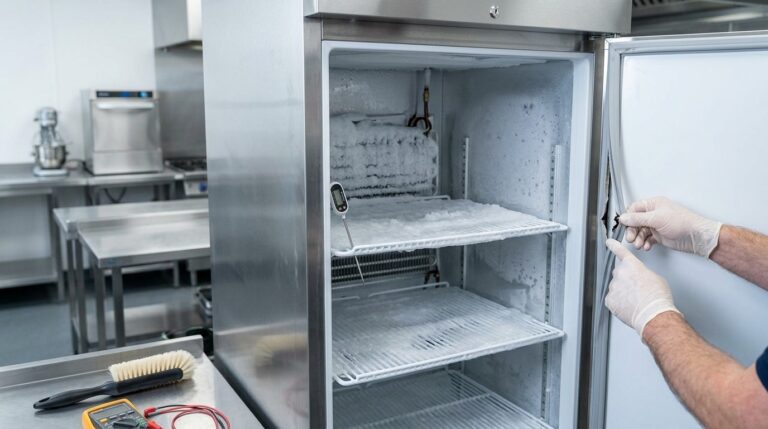
Troubleshooting Ice Build-up in Unifrost Upright Fridges: A Guide for Irish Kitchens
Learn how to manage ice build-up in Unifrost upright fridges and maintain food safety in Irish kitchens.
Read guide
Unifrost Upright Fridge Manuals & Installation Support
Task-first manual downloads, controller help, installation notes, and troubleshooting routes for Unifrost upright fridges.
Read guideCompare Unifrost freezer options on Caterboss
For current product options, pricing and availability, continue to Caterboss.