
Unifrost Upright, Undercounter, and Chest Freezer Stock Rotation & Loading Best Practices
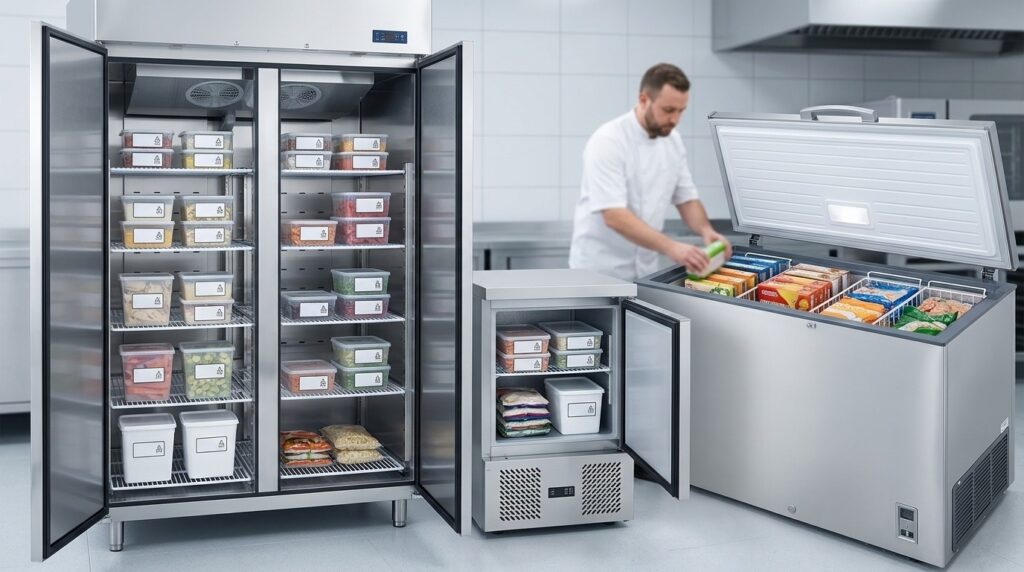
Master commercial freezer organization and loading. Keep Irish kitchens efficient and safe with Unifrost tips.
Unifrost Freezer Stock Rotation and Loading Best Practices for Upright, Undercounter, and Chest Models
If you run Unifrost upright, undercounter, or chest freezers in a busy kitchen, how you load them is as important as the set temperature. Poor stacking and weak FIFO rotation slow down service, hide out of date stock, and can restrict airflow so the cabinet works harder and struggles to recover after door openings.
This guide shows you the practical checks and routines that keep stock visible, safe, and easy to pick across common Unifrost formats, from upright models such as the F1000SV and F1310SV, to undercounters like the F200SN, and chest freezers like the CF601 and CF500HS range. You will learn how full to load, where to leave clearance for circulation, how to label and map shelves or baskets for simple HACCP records, and how to handle delivery day so new stock goes in without breaking the cold chain or disrupting FIFO. We also cover the most common loading mistakes and quick daily and weekly habits that prevent waste.
Why Proper Freezer Loading Matters
If you overload a freezer or block the air vents, it has to work harder to hold temperature. In upright, undercounter and chest freezers that usually shows up as warm spots, slower recovery after door openings, and heavier ice build-up. That feeds directly into reliability and running costs.
The bigger issue is food safety control. During a busy service or a delivery being put away, poorly loaded stock can sit in “borderline” areas for longer. That makes consistent temperature checks and HACCP records harder to stand over, and it increases the risk of quality loss through dehydration and freezer burn.
You often feel the impact operationally before you see it on a report. Service slows when portions are inconsistent or you are digging for stock, and waste creeps in when items get buried in the bottom of a chest freezer or hidden behind boxes in an upright. A sensible loading pattern keeps airflow clear and makes stock rotation simple enough to do properly, even on a hectic shift.
Core Checklist for Efficient Stock Rotation
Apply FIFO by making it physical: map each freezer, label everything the same way, and load so the oldest stock is the easiest to reach. Use uprights for high-pick items, undercounters for line-level par stock, and chest freezers for bulk and slow movers with a strict basket or crate system. Then lock it into your HACCP routine, because FIFO breaks down under service pressure, not on quiet days.
1. Assign each freezer a job (upright vs undercounter vs chest)
Decide what each cabinet is for: speed of access, tight stock control, or bulk holding. A workable split in many Irish cafés, pubs and restaurant kitchens looks like this:
Upright freezer: high-turn items and anything you need to find fast during service.
Undercounter freezer: line-level par stock you top up daily, not deep storage.
Chest freezer: bulk packs, awkward cartons, and lower-frequency backup stock.
This matters because FIFO is a handling system. If you run a chest freezer like an upright, stock gets buried, rotation slips, and staff lose time when it’s busiest.
2. Standardise labels so FIFO is one glance, not a hunt
Pick one label format and use it everywhere, including on outer boxes where the supplier label is not clear at a glance. Your label should make two checks quick: what’s oldest and what’s still within date guidance.
Use the same fields across uprights, undercounters and chests:
Item name (plus allergen flag if relevant)
Date received
Use-by or best-before (per supplier guidance)
Opened date (if cases are split)
Initials (who put it away)
If you’re recording temperatures as part of your controls, keep it consistent with your freezer management. Quick-frozen foods are expected to be distributed and stored at -18°C or lower, and you should keep appropriate temperature records as part of routine monitoring, as set out in FSAI guidance on quick-frozen foods and temperature monitoring.
3. Set a physical FIFO rule: oldest front (upright), oldest left (undercounter), oldest top (chest)
FIFO works when the layout forces the right behaviour, even for a new starter on a Friday evening.
Uprights (front-loading FIFO): newest goes behind or underneath; pick from the front edge of the shelf. Keep one shelf as a clearly marked hold/quarantine area for deliveries that are not checked and labelled yet.
Undercounters (left-to-right FIFO): pick a direction and stick to it. One side is the pick face, the other is replenishment. Undercounters sit closest to the action, so the rule needs to be simple enough to survive service.
Chest freezers (top-down FIFO): oldest stock must live in the top layer in baskets or crates, not loose at the bottom. If it’s buried, it won’t rotate.
4. Control airflow with loading discipline, not guesswork
Poor loading shows up as soft product, excess ice build-up, and slow recovery after door openings. The goal is simple: keep air moving and make sure doors and lids close properly.
In practice:
Don’t pack stock tight against the back panel of an upright.
Don’t let boxes protrude and compromise the door gasket.
Don’t “dome” stock above baskets in a chest so the lid has to force down.
A useful rule for staff: if you can’t remove one pack without dragging out three others, the freezer is too full for FIFO, even if it still feels cold.
For model-specific spacing around fans, evaporators or lids, use the manual for your exact unit rather than assuming a universal clearance.
5. Handle high-risk foods and bulky items so they don’t break the system
Freezing reduces risk, but it doesn’t fix poor organisation. Most cross-contamination and date control problems come from rushed handling in mixed storage.
Raw meat, fish and poultry: keep them in a clearly labelled zone. In uprights, that usually means the lowest shelves in sealed, cleanable crates. In chests, use a dedicated basket or crate, not loose packs.
Bulky joints and large packs (especially in chests): avoid laying them across the full width where they block access. Keep them in one “bulk” crate so you can lift the crate out to reach stock underneath.
Frozen bakery: protect it from crushing and drying. Keep it in intact inner liners or lidded crates, and don’t stack delicate packs under heavy cases. Frost on exposed bakery packs is often a handling or packaging issue before it’s a setpoint issue.
6. Make FIFO measurable: daily checks and a weekly reset
FIFO only holds if you can prove it in routine.
Daily (60 seconds at close): remove unlabelled items, check one pick from each zone to confirm the oldest is most accessible, and fix any “new stock in front” mistakes straight away.
Weekly (quiet time): pull older stock forward, clear anything beyond date guidance or with damaged packaging, and tidy zones back to the agreed map.
Chest freezers benefit most from a weekly lift-out and re-stack. It’s the only reliable way to stop forgotten stock building under baskets, and it makes your stock and temperature records easier to stand over when you’re under inspection pressure.
Avoiding Common Loading Mistakes
Overloading a freezer or blocking airflow creates warm pockets, longer compressor run time and slower pull-down after deliveries. In day-to-day terms, you get more temperature drift during busy service, more frost and ice build-up, and the kind of “mystery stock” that ends up crushed at the back.
From a food safety point of view, Irish food businesses are expected to keep frozen food at -18°C or colder and to monitor and record temperatures as part of HACCP, as set out in the FSAI temperature control guidance: <https://www.fsai.ie/business-advice/running-a-food-business/caterers/temperature-control>. Loading practices won’t usually cause instant spoilage, but they can make it harder to stay consistently on temperature, especially with frequent door openings.
Upright freezers: blocking the air path
The most common upright issue is packing cartons tight to the back wall or up into air outlets. When cold air cannot circulate, the cabinet works harder and some areas run warmer than others.
What helps:
Treat the back wall and top air outlets as no-storage zones.
Load so air can move around product, not just hit the front faces.
Keep open boxes tidy and contained so they do not slump into the airflow.
The other practical problem is door-time. If staff are standing with the door open while deciding what to take, the freezer has to recover over and over. A simple shelf map and fixed zones help: fast-moving items where they are quickest to grab, heavier boxed items lower down. Less searching equals less warm air drawn in.
Undercounter freezers: “service freezer” creep
Undercounters often fail in practice when they are used as bulk storage. They get jammed with mixed stock, drawers or doors do not close cleanly, and people leave product sitting out while they dig around. That is when the cold chain gets sloppy.
A workable approach:
Keep undercounters for service-critical, high-turnover items only.
Push bulk and slower-moving stock into an upright or chest freezer, where it is easier to organise and less exposed to warm kitchen air during service.
For HACCP checks, a tighter undercounter stock list also makes monitoring simpler and more consistent, in line with the FSAI expectation that temperatures are monitored and recorded.
Chest freezers: lost stock and crushed product
Chest freezers are efficient, but they are easy to mismanage. The classic mistake is “gravity loading”: new deliveries on top, older stock disappearing to the bottom, and waste showing up later. The second is stacking delicate items (bakery, pre-portioned foods) without protection, which leads to crushed packaging, torn wrap and freezer burn.
What works in busy kitchens:
Use baskets or colour-coded crates as layers (one per category or allergen group).
Top up by lifting a crate out, not digging by hand.
Keep heavy items from pinning everything else down, and reduce lid-open time so the freezer holds temperature more reliably.
If you want this to stick across shifts, a short rotation routine (who checks, when, and what “full” looks like) is usually more effective than a once-off clean-out.
Organising Stock in Different Freezer Types
Organise each freezer around speed, temperature stability, and FIFO, not around “fitting more in”. Start by setting clear zones, then standardise how food is packed and labelled before it goes in. Load each type differently: uprights for high-turnover working stock, undercounters for line access, and chest freezers for bulk with a simple “top layer = this week” rule. Keep an eye on airflow and buried stock, because poor organisation quickly turns into longer door-open time and temperature drift.
1. Build a simple zone map for each freezer (before you load anything)
Set zones based on how the kitchen runs on a busy Friday, not on a tidy stocktake day.
Upright freezers: Work best with vertical, shelf-based zones. Keep light, fast-moving items at eye level, portioned proteins and prep where they are easy to grab, and heavier cartons down low.
Undercounter freezers: Zones should match stations. Allocate a drawer or shelf area per section (pass, fryer, desserts), based on your menu and service flow.
Chest freezers: Think layers and baskets, not shelves. Decide what lives in baskets (high-turnover packs, open packs, allergens) and what can sit below (sealed bulk, full cartons, longer-hold items). One rule that saves time: don’t put loose packs underneath the basket layer, because that is how stock disappears until stocktake.
2. Standardise packing and labelling so FIFO does not rely on memory
Make stock freezer-ready at goods-in or during prep, not during service. Portion into the pack sizes you actually use, then label consistently with:
product name
prep or freeze date
initials (useful when staff change mid-week and for traceability)
Use packaging that protects food and survives handling. Loosely wrapped bakery dries out quickly, and soft items get crushed if they are stacked badly. Where it suits your operation, use rigid, lidded food-grade containers and keep squashable items in a dedicated zone so they do not end up under cartons of chips.
3. Load uprights, undercounters, and chests differently (to protect airflow and access)
Uprights: Make the oldest stock the easiest to reach. Keep “use first” at the front of each shelf and backstock behind it. Avoid pushing product against the back wall or covering internal air outlets. Door-open time is the big problem: the longer someone is hunting, the harder the cabinet works to recover temperature. For temperature control expectations in Ireland, see the FSAI guidance on freezer temperatures and routines (typically -18°C or colder in normal operation): https://www.fsai.ie/business-advice/running-a-food-business/caterers/temperature-control
Undercounters: Design for speed, not perfection. Keep only short-hold, high-frequency items here and move bulk to your upright or chest. If undercounters become “just in case” storage, doors stay open longer, packs tear, labels go missing, and you will feel it at service.
Chest freezers: Don’t optimise for “filling it”, optimise for “finding it”. Treat baskets as working stock and keep the base for sealed, clearly dated bulk only. Group bulk so you can lift out a block without excavating. If a product needs two people and a prayer to reach, FIFO will break under pressure.
4. Set rules for delivery day and daily checks so the system survives the week
On delivery day, load new stock into the backstock position for each zone and physically pull older stock forward so FIFO happens automatically. If you split stock across multiple units, a pattern that works in many Irish kitchens is:
Undercounter: tonight and tomorrow
Upright: working stock for the week
Chest: true bulk and long-hold
Add one quick daily habit: scan for unlabelled items, torn packs, crushed product, and anything sitting in the wrong zone. When the layout does the work, FIFO checks are faster, HACCP records are easier to stand over, and the freezer stops becoming a daily rummage.
Incorporating Best Practices in Daily Operations
Integrate good loading and FIFO by making it part of the same routine as receiving and put-away, not an extra job for “when things calm down”. Keep it anchored to temperature control: in Irish food businesses, freezers should be kept at -18°C or colder per the FSAI temperature control guidance for caterers. After that, your two biggest levers are (1) a clear layout people can follow at speed and (2) labels that remove judgement calls during service.
1. Set a freezer “map” that suits the format (upright vs undercounter vs chest)
Treat each format as a different job, not just extra capacity.
Upright freezers suit stock that must rotate cleanly and be picked quickly. Shelves and visibility make it harder for products to disappear to the back.
Undercounter freezers are best for high-frequency “line support” items during service, where quick access matters more than bulk storage.
Chest freezers work for bulk, slower-moving items, overflow and awkward packs, but only if you commit to a basket or crate system. Without containers, FIFO fails quietly at the bottom.
Whatever Unifrost models you are running, keep the logic consistent. If staff have to remember different rules per unit, it will drift.
2. Standardise labels so FIFO and HACCP stay simple under pressure
Your label should do the thinking. For anything opened, decanted, portioned or prepared and frozen, label:
Product name
Date received or date frozen
“Use first” date (your site rule)
Allergens, where it helps your controls
Portion size and intended use if it is a prep item (for example: “curry base, 2L, reheat only”)
Tie this to your daily checks. If you already log freezer temperatures, labels should make it obvious what is old stock while you are at the unit. If you use coloured crates for allergen control, keep it blunt and visual, and do not allow “temporary” uncoloured boxes. They become permanent.
3. Run delivery-day put-away like a short service
Delivery day is where most FIFO damage happens. Set it up so frozen product gets back to frozen storage quickly.
Pre-clear a shelf zone (upright) or a crate (chest) so new stock has a home immediately.
Get stock back into the freezer first. Tidy second. Do not stand with doors or lids open while deciding where things go.
A simple delivery-day FIFO rule:
Upright: pull older stock forward, load new stock behind it.
Chest: older stock sits on top, but only inside labelled crates/baskets so it does not get buried.
If an item has no clear location, it does not go in “for now”. That is how you end up with dead stock and waste.
4. Load for airflow and access, not maximum squeeze
Overpacking usually increases door-open time because nothing is easy to lift out.
Uprights: keep packs tidy on shelves and avoid pushing cartons hard against the back if it blocks internal air movement.
Undercounters: keep the most-used items at the front/top of the stack so you are not digging with the door open.
Chests: load vertically by crate (for example poultry, beef, fish, bakery, veg), in a way that suits your menu and allergen controls. Split heavy bulk items across two shallower crates rather than one deep stack so the first item you need is also the easiest one to lift.
Do not guess weight limits. Shelf and basket limits vary by model and fit-out, so check the unit documentation or data plate rather than relying on what “seemed fine last week”.
5. Make it stick: one owner per shift, one short check routine
Organisation lives or dies on ownership. Assign one person per shift to do a quick reset, and one person per week to do a deeper check. FIFO should not depend on whoever last opened the door.
Daily (2 minutes): remove empty cartons, make sure doors and lids are fully closed, pull older stock to the front/top of its zone, and tag any unlabelled items for immediate labelling.
Weekly (10 to 20 minutes): pick one zone (a shelf or a crate), pull it out, wipe spills and ice fragments, restack by date, and list any dead stock for disposal or for planned menu use.
If you want this to run without constant chasing, turn your freezer map into a simple one-page checklist and keep it where staff actually do the work. If you are unsure which freezer format suits each part of your operation, it is worth reviewing the Unifrost range and getting practical advice based on your menu, service pace and available footprint.
Relating Practices to Unifrost Ecosystem
Loading and stock rotation matter for Unifrost upright, undercounter, and chest freezers for the same reason they matter for any commercial freezer: poor loading looks like poor performance. Block airflow, overfill shelves, or leave the lid open while someone hunts for a SKU and you create longer pull-down times, bigger temperature swings, more frost, and more wasted stock.
It also feeds directly into HACCP. If your team cannot find, date-check, and rotate frozen food quickly, your paperwork becomes a best-efforts exercise. The FSAI Safe Catering Pack notes that frozen food should not be stored indefinitely, referencing a six-month limit in line with freezer star rating in its Safe Catering Pack update notes. In a busy Irish kitchen, the “right” method is the one your team can repeat on a Friday night, not the one that looks tidy straight after a delivery.
How good loading supports efficiency and day-to-day reliability across Unifrost formats
Upright freezers (e.g. F1310SV and larger upright families)
Uprights live or die on airflow and access. Give product a small breathing space and avoid wedging cartons tight to the back wall where cold air typically circulates. The practical goal is faster recovery after door openings, not a perfect Instagram shelf.
Undercounter freezers (e.g. F200SN family)
Undercounters are opened little and often, so organisation is about speed. Set up “grab stock” at the front (current week, opened packs, service portions) and sealed overflow behind it. If you stop rummaging, you shorten door-open time and reduce the kind of temperature swings that show up as soft packs, excess frost, and quality loss in delicate items.
Chest freezers (e.g. CF500HSOG, CF501, CF601)
Chest freezers are usually less sensitive to shelf airflow and more vulnerable to the “invisible stock” problem. When product sinks to the bottom, you over-order, waste increases, and the lid stays open while someone digs. Use a simple crate system and clear labels so the chest is storage, not a lucky dip.
Mapping FIFO and allergen control to real Unifrost layouts (upright vs undercounter vs chest)
A split that works in many Irish sites is:
Upright: structured, labelled long-hold stock
Undercounter: short-hold service line stock
Chest: bulky packs or slower-moving reserve
That’s not about brand. It’s about behaviour. Uprights make it easier to run a shelf map (Shelf 1, 2, 3) that matches your checks and helps new staff find stock without “reorganising” it mid-service.
For higher-risk raw items (meat, fish, poultry), your main freezer control is containment and separation, not “top vs bottom”. Keep raw proteins in sealed, leak-proof outer containers and dedicate a zone. If a bag splits, it should not be anywhere near open bakery, veg, or allergen-free items.
Bakery and prepared portions benefit from consistency. Stack too tightly and you crush product. Store loosely and you increase dehydration and quality loss. The fix is simple: standardise the pack size you freeze in, and keep each SKU in the same spot every time so rotation happens naturally, not as a painful weekly clear-out.
The Unifrost-friendly routine that keeps HACCP records simple under pressure
Keep the routine repeatable and the same across all freezers. Use one labelling rule (date frozen or date opened, initials, and allergen note where relevant). Put a basic storage map on the door or lid so it survives staff changes.
Daily: keep the “first-out” zone accessible, remove anything unlabelled, and fix any stacking that blocks access or stops doors and lids closing cleanly.
Weekly: audit one category properly (proteins this week, bakery next week), remove anything past your site rule, and reset the front-to-back order to restore FIFO.
Delivery day: load new stock into reserve zones first (often chest, or the back of uprights), then pull older stock forward before service so FIFO happens without an argument at 6pm on a Saturday.
If you are running the common three-format set-up, one upright for structure, one undercounter for speed, and one chest for bulk, write down what goes where. The best system is the one everyone follows when it’s busy.
FAQs: Loading and stock rotation in Unifrost commercial freezers
How full should commercial upright or chest freezers be loaded to work efficiently?
Aim for a full but not packed cabinet.
Keep airflow paths open: don’t press product hard against internal air outlets, the back wall, or the door seal areas. In fan assisted uprights, blocked airflow leads to warm spots and longer run times.
Leave “service space” for circulation: build in small gaps between cartons and avoid creating a solid wall of boxes.
Avoid overfilling chests: if stock rises above basket level or piles against the lid line, you increase lid opening time and bury older stock.
Don’t run them empty either: very low loads can mean more temperature swing during busy service. If you’re light on stock, use fewer, clearly zoned crates rather than spreading items across the whole freezer.
How do I organise and label food in a commercial freezer for easy access and stock control?
Set the freezer up so a new starter can find items in seconds.
Assign fixed zones: e.g. raw proteins, veg, prepared meals, bakery, allergens. Keep the same map across the week.
Use durable freezer labels: include item name, prep/pack date, use by date, and initials. Put labels on the front-facing edge so they’re readable without lifting boxes.
Standardise containers: use same size gastronorms/crates where possible so stacks stay stable and countable.
Create a simple “shelf map” or lid map: laminate a one-page layout and keep it on the door/lid. Update it when you change a section.
Batch and band small items: group open bags and small packs in a labelled crate (e.g. “gluten free”, “desserts”, “chips”) to prevent loose stock drifting around the cabinet.
What is the best way to apply FIFO stock rotation in freezers?
Make FIFO a physical system, not just a policy.
Two-step loading rule: when deliveries arrive, pull the older stock forward first, then load new stock behind or below it.
Use a front-to-back or top-to-bottom direction: choose one direction per freezer type and stick to it (e.g. uprights: older at front, chests: older in top baskets).
Date codes must be visible at pick point: if the date is on the side you can’t see, relabel the front edge.
Quarantine “unknown date” items: have a small clearly marked crate for anything that arrives without a legible date. Either label it immediately or reject it for storage.
Set a quick audit cadence: a 5 minute daily glance (front row and top baskets) plus a weekly deep tidy catches expired or buried stock before it becomes waste.
Next step: make your freezer routine easier to run
If you want these loading and stock rotation habits to stick, pair them with a simple maintenance routine so doors, seals and airflow stay consistent week to week.
See Unifrost maintenance tips for practical checks and support guidance that help reduce waste and keep service moving.
Related Unifrost guides
Compare models, maintenance advice and support information related to this topic.
Unifrost Upright Freezer vs Chest Freezer: Model Comparison Guide for Irish Kitchens
Compare Unifrost upright and chest freezers for Irish kitchens. Find the best fit for your business needs efficiently.
Read guideCompare Unifrost freezer options on Caterboss
For current product options, pricing and availability, continue to Caterboss.