
Unifrost Upright Fridge Freezer: Wire Shelves vs GN Pans Storage Layout Comparison
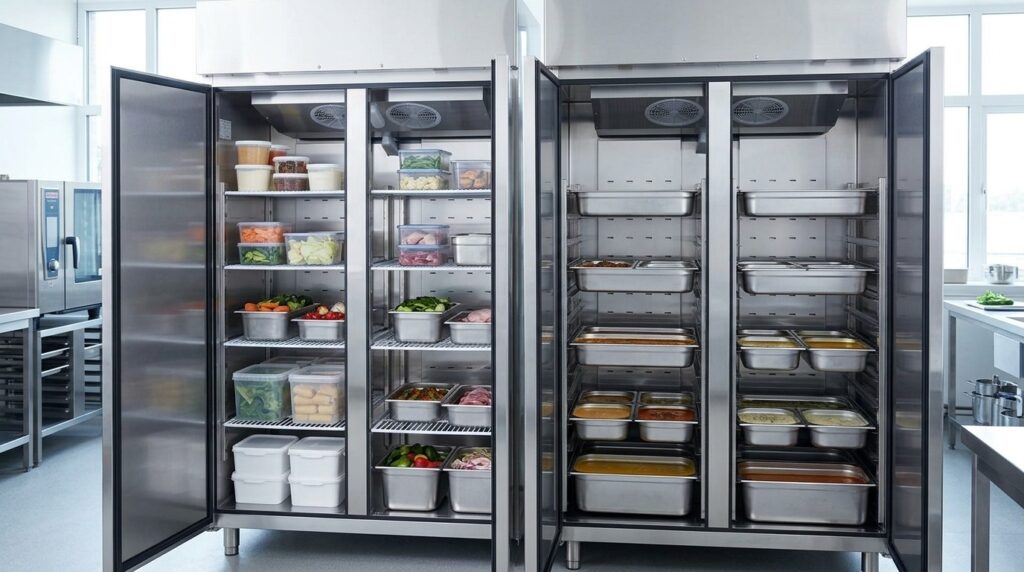
Compare Unifrost upright fridge freezer storage: GN pans vs wire shelves for Irish commercial kitchens.
Need more detail? For model comparisons, setup steps and troubleshooting, see the related guides below.
Unifrost Upright Fridge Freezer Layout: Wire Shelves vs GN Pans
When you buy or reconfigure a Unifrost upright fridge or freezer, the internal layout quickly affects speed of service, stock rotation, cleaning time, and how consistently the cabinet holds temperature. The big choice is usually adjustable wire shelves with loose containers versus running the cabinet on GN pans in a GN compatible model such as Unifrost large all stainless GN 2/1 refrigeration uprights.
On this page you compare wire shelves vs GN pans in day to day use, including what you gain in flexibility versus what you gain in standardisation. You will work through the practical checks that matter before you commit, like whether your cabinet is truly GN compatible, how pan spacing and loading impacts airflow and usable volume, and whether retrofitting runners or rails is realistic or if stepping up to a dedicated GN cabinet makes more commercial sense.
You will also see how this decision connects to the wider Unifrost GN ecosystem, especially blast chillers like the BC5UN and BC10UN that are designed around GN pan levels, so your storage, prep, and chilling formats line up across the kitchen.
Understanding Wire Shelves and GN Pans
Wire shelves are open, adjustable shelves used in upright fridges and freezers. They suit mixed stock like boxes, tubs, bottles and loose containers, and the open design helps cold air move around the load.
GN pans (gastronorm pans) are standardised trays used across commercial kitchens. The idea is simple: prep in the pan, chill or store in the same pan, then move it into service or cooking equipment with less handling. Just note that “GN-compatible” only works properly if the cabinet is actually built around GN sizes, with the right internal width, supports and spacing. A standard upright with generic shelving may not take GN pans neatly or securely.
Wire shelves in practical Irish kitchen terms
Wire shelving is common because it’s forgiving when your menu, deliveries and storage needs change week to week. In a café, pub kitchen or small restaurant, you are usually juggling dairy, veg boxes, sauces, desserts, open tubs and part-used packs. Adjustable wire shelves let you change heights quickly without redesigning your whole storage system.
They also tend to recover temperature faster after repeated door openings because airflow is less restricted. The trade-off is organisation and usable space. Mixed containers waste space, smaller items migrate to the back, and stock rotation depends on good labelling and discipline.
GN pans in practical Irish kitchen terms
GN pans are a good fit when your kitchen already runs on gastronorm across prep, holding and cooking. Using the same format in refrigeration reduces re-packing, speeds up service, and makes portion control and labelling more consistent. It also helps with HACCP routines because there’s less “decanting” between containers, which is where mistakes and cross-contamination risks tend to creep in.
If you batch cook, cool and hold food in pans, GN storage is usually about workflow rather than pure capacity. You are buying a repeatable system that staff can follow under pressure.
How each option shapes your storage system (not just the cabinet)
Choose wire shelves if you mainly store products in packaging and you want flexibility: mixed deliveries, mixed container sizes, and storage that changes with the menu.
Choose GN pans if you mainly store food in production-ready containers and you want speed and consistency: batch prep, labelled pans, quick grabs during service, and a layout that matches how the kitchen actually works.
You can sit GN pans on wire shelves, but it’s often a compromise. You may lose space, pans can rock if the support isn’t right, and you can end up blocking airflow inside the cabinet. If GN is central to your operation, a cabinet designed with GN spacing and proper supports is usually the cleaner, safer way to run it.
Core Differences Between Wire Shelves and GN Pans
Wire shelves and GN pans do different jobs inside an upright Unifrost fridge or freezer. Wire shelving is open and adjustable, so it suits mixed stock and changing deliveries. GN pans are a standard tray system, so they suit structured prep, portioning, and moving food between prep, storage, and service.
In practical terms:
Wire shelves work well for boxes, milk crates, bottles, and awkward packaging, but they can turn into a “bit of everything” cupboard when service is busy.
GN pans keep storage more consistent and transferable, but only if the cabinet is genuinely GN-compatible (correct supports, spacing, and clearances). Balancing pans on general shelves usually ends in wasted space or spills.
Plenty of Irish kitchens run a hybrid. It works best when you decide, early on, which levels are for GN and which are for general storage, and you keep airflow gaps in mind rather than packing every shelf tight.
How do wire shelves and GN pans compare overall?
If your menu relies on ready-to-go mise en place, GN pans cut handling because the pan is the storage unit. Staff can lift, label, date and rotate without decanting. That’s useful in hotels, busy carveries and high-volume prep kitchens, especially where different people are on early and late shifts.
If most of what you store arrives in supplier packaging (dairy, boxed meats, bottled mixers, bagged veg), wire shelving often saves time because you are not constantly transferring stock into pans. For cafés, pubs and smaller restaurants where the upright is a mixed store for ingredients and service items, adjustable shelves usually give you more usable flexibility week to week.
Compatibility is the deciding factor. If your kitchen already runs GN in prep counters, saladettes, or a blast chiller, choosing a GN-friendly upright keeps the workflow consistent. If you are not set up around GN, wire shelves can be the simpler, more forgiving option.
Wire shelves in an upright Unifrost fridge/freezer
Wire shelves earn their keep when the cabinet is doing multiple jobs: drinks overflow, desserts, boxed deliveries, and whatever needs chilling in a hurry. You can change shelf heights quickly, which matters when deliveries change or you need one tall level for bulk tubs.
They are also more tolerant of a kitchen that is not fully standardised on containers. The trade-off is control. Mixed packaging spreads out, and that increases door-open time because staff spend longer searching, especially when the kitchen is flat out.
Cleaning is straightforward, but spills can drip to the level below. If you are storing uncovered items, that becomes a regular cleaning job. In real-world operations with tight labour, “quick to wipe down and reset” tends to matter more than an ideal storage plan that nobody has time to maintain.
GN pans in an upright Unifrost fridge/freezer
GN pans make most sense when the upright is an extension of your prep system. You store a known set of pans that match your pass and prep stations, so staff can move food with fewer steps and fewer decisions.
They can also support portion control and stock rotation because pan size naturally limits how much you prep and how you top up during service. The key trade-off is fit: the cabinet needs proper GN supports or runners and enough clearance for pans to slide in and out cleanly. If staff have to twist pans past shelf clips or fight for clearance, they will stop using the system properly.
Airflow is the other operational point. GN pans create more solid “blocks” than open wire storage, so you need to leave deliberate gaps for cold air to circulate. This matters most in freezers and in busy kitchens with frequent door openings, where recovery time becomes a daily irritation.
Which is best for you?
If you are a hotel, contract caterer, school kitchen, or any site doing structured prep and holding, lean towards GN where your chosen cabinet format supports it. It reduces handling and keeps the kitchen consistent.
If you are a café, pub, or smaller restaurant with mixed inventory and variable deliveries, wire shelves usually win on flexibility and “fits what arrives at the back door”.
Mixing wire and GN on the same level can work for light items, but be realistic about stability, spillage risk, and awkward dead space that is hard to clean quickly. A better approach is to set specific shelves as GN levels and the rest as general storage, set the heights once, and keep it consistent.
If your wider kitchen is already GN-led, check that the upright you are considering is actually GN-compatible rather than assuming you can retrofit it later. Once you know that, you can plan a layout that matches your prep counters and any GN-based chilling you rely on during the week.
Performance in Diverse Kitchen Settings
In Irish hospitality operations, choosing wire shelves or GN pans in an upright fridge or freezer is less about “best” and more about how food moves through your kitchen from delivery to prep to service.
Wire-shelf cabinets are general-purpose. You choose the containers, adjust shelf heights, and store mixed shapes and packaging.
GN-based storage uses gastronorm trays (GN). It is a standardised container system that matches prep tables, trolleys and, in many kitchens, cooking and holding equipment.
Both approaches can work well if you avoid overloading and keep clear airflow. Whatever you choose, your day-to-day controls should still sit within your HACCP routines, as outlined in the FSAI guidance.
How wire shelves and GN pans behave under real service pressure
Wire shelves suit kitchens with high variation in what comes through the door. If deliveries arrive in mixed outer cartons, tall tubs, milk crates, and odd-shaped produce, wire shelving usually stays usable because you can adapt the space quickly. It is also the easiest way to “park” bulky items without dedicating a second cabinet just to awkward stock, which matters in tight back-of-house layouts.
GN pans suit repeatable production. A consistent tray format can move from prep to cold storage to service with less decanting. That reduces handling steps, which helps on busy trading days when the same people are managing deliveries, temperature checks, labelling and service support.
Hotels and high-output kitchens (banqueting, carvery, events)
Hotels often get more value from GN because prep is typically batched and held for defined service windows. A GN-aligned upright makes it easier to keep like-with-like across shelves, label consistently, and avoid the “Tetris stacking” that happens when everything is in different tubs.
If blast chilling is part of your workflow, GN becomes a practical choice rather than a tidy preference. Unifrost blast chillers (including BC5UN and BC10UN) accept GN pans, so staying in the same container format can reduce transfers, spills and mislabelling, and it shortens the time food spends out of controlled temperature while someone finds a clean tub.
Cafés, pubs, and small restaurants (mixed stock, tight storage, fast changeovers)
Wire shelves usually make more sense when one upright is doing several jobs: ingredient storage, drinks overflow, and “hold the delivery until we sort it”. In a café, being able to shift a shelf and take a tall container, or store bakery trays flat, often beats trying to force every item into GN.
GN can still work in smaller venues, but it tends to pay off when you use it for genuinely repetitive lines, for example sandwich mise en place, salad prep, or pre-portioned desserts. If the GN layout only makes sense to one person on the team, it will look organised at 9am and drift by lunchtime.
Schools and contract catering (predictable menus, strict routines, lower tolerance for mess)
Schools and contract catering usually prioritise repeatability, portion control and clear labelling over maximum “anything fits” capacity. GN pans support that because the pan becomes the unit of planning. You can allocate a pan per recipe, per service period, or per group and keep the cabinet consistent even when staffing changes.
Wire shelves still earn their place for sealed dairy, fruit and veg crates, and unopened packs you want stored off the floor with minimal decanting. In practice, many sites land on a split approach: wire shelves for reserve and delivery stock, GN for prepared and ready-to-serve items. That is often the point where it is worth getting advice on the right cabinet format before you buy, rather than trying to retrofit a system after the fact.
Operational Implications
Switching an upright from wire shelves to a GN pan layout changes more than “what fits”. It affects airflow, cleaning time, temperature recovery during service, and how easy it is to keep your HACCP checks straightforward.
GN storage usually gives you neater, standardised organisation, but it also adds solid surfaces. If pans are packed tight, they can restrict circulation and create warm or cold spots. That matters because you are expected to control and monitor chilled storage as part of your food safety system, and consistent temperatures are harder to demonstrate when airflow is compromised, in line with FSAI food safety guidance for businesses: https://www.fsai.ie/business-advice/food-safety-guidance
In day-to-day terms, poor layout tends to show up as slower pull-down after loading, more temperature swing during busy service, and extra cleaning around rails, pan lips and spills.
Cleaning and maintenance: what gets easier, what gets annoying
Wire shelves
Fast to wipe down and you can spot spills quickly, which suits busy café and takeaway routines.
The downside is fallout. Drips and crumbs drop through levels, so you often end up cleaning the cabinet base and back panel more frequently.
GN pans
Better containment. Spills stay in the pan, which helps in prep-heavy kitchens and hotels where open product is constantly moving.
More detail cleaning. Pan rims, corners, and any runners or supports are where residue builds up if the wash routine slips. Those are also the awkward bits that get missed when the shift is tight.
From a food handling point of view, GN pans can make it easier to separate raw and ready-to-eat foods by container and shelf position, which supports the cross-contamination controls the FSAI highlights in its safe food handling advice: https://www.fsai.ie/business-advice/food-safety-guidance
Airflow and temperature management: where layouts go wrong
Wire shelving is naturally air-permeable, so cold air moves around product with fewer dead zones. In an upright used hard during service, that usually means more forgiving temperature recovery when the door is opened repeatedly, especially in pubs and quick-service sites.
GN pans can perform just as well, but only if you load them with airflow in mind:
Do not overfill pans to the point product sits above the rim and blocks air movement.
Avoid pushing pans hard against the back or blocking fan outlets and returns.
Leave a bit of breathing space. A fully packed cabinet with no air gaps is where uneven temperatures creep in.
If you want checks that stand up to a busy week, align your routine with the FSAI’s temperature control expectations for chilled foods: https://www.fsai.ie/consumer-advice/food-safety-and-hygiene/keeping-food-safe/keeping-food-cold
Food safety and day-to-day handling: stock rotation, traceability, and staff behaviour
Wire shelves suit mixed boxes, irregular packs, and delivered goods that you are storing “as is”. The risk is behavioural: stacking and shoving can crush packs, hide date labels, and leave older stock stranded at the back.
GN pans tend to push better habits because portioning and labelling become part of the workflow. That can make rotation and traceability easier under pressure in high-volume sites with repetitive prep.
The GN risk is a different one: because everything looks organised, teams can get casual about basics like cooling food properly before loading, or keeping pans covered. An upright fridge is for holding temperature, not pulling hot food down quickly. Loading warm pans raises the cabinet temperature and puts surrounding food under stress. If rapid chilling is part of your operation, treat it as a defined control step in your system rather than relying on storage refrigeration, consistent with HSE food safety information for businesses: https://www.hse.ie/eng/services/list/1/environ/food/
These trade-offs are why the “right” interior is not just about capacity. It is about how your team loads, opens, cleans, and checks the unit when service is busy.
Choosing the Right Layout for Your Venue
Choose your upright layout the same way you’d plan a prep station: based on what you store, how often you access it, and how disciplined your labelling and rotation are. Wire shelves suit mixed packaging and changing stock. GN spacing suits kitchens already working in gastronorm from prep to service. Either way, your HACCP routine still depends on good loading practice and temperature control, including holding chilled food between 0°C and 5°C in line with the FSAI temperature control guidance.
1. Audit what’s actually going into the upright
List what lives in the cabinet on a normal week, not what you’d like to be doing:
delivered packs and cartons
prepped ingredients in tubs
portioned proteins
dairy and desserts
sauces and dressings
allergens or segregated items
If you’re storing a mix of awkward shapes (tall buckets, boxes, small tubs), adjustable wire shelves usually make life easier because you can change heights quickly and avoid wasting vertical space.
If your kitchen already runs on GN containers at prep and service, keeping that system inside your upright can reduce handling. A GN-compatible upright makes most sense when you regularly store covered, labelled GN pans and want them to slide in and out cleanly on consistent spacing.
2. Match the layout to service pressure and labour
Capacity matters, but labour and “reach time” matters more in a busy kitchen.
Cafés, delis, pubs: Wire shelves tend to be the least fussy. Staff can grab from mixed packaging, and you can reconfigure for weekend volume, seasonal stock, or events without committing the whole cabinet to one format.
Hotels, high-volume restaurants, contract catering, schools, healthcare: A GN-led layout can cut double-handling. If you prep and label in GN, you can store in GN and move straight back to prep or service with fewer container changes.
If you’re using blast chilling as part of your workflow, GN handling becomes even more relevant, because blast chillers are typically operated around trays and pans moving through defined levels. The point is not the equipment, it’s the reduction in decanting under pressure.
3. Confirm “GN-compatible” means compatible with your GN
Treat this as a fit check, not a label. Before you commit, confirm:
GN size: are you standardising on GN1/1 or GN2/1?
Shelf supports and spacing: do the supports suit the pan depth you actually use?
Door clearance: will the door close comfortably with covered pans and labels?
If you’re trying to standardise across the kitchen, check the full chain (upright, prep counter or saladette, and any blast chilling). Standard GN sizes reduce the daily friction: mismatched lids, last-minute decanting, and containers that do not stack safely.
4. Be realistic about mixing wire shelves and GN pans
Mixing can work, but only if it’s stable and repeatable. The problem is rarely “will it fit”. It’s whether it stays safe and tidy when a junior staff member is in a hurry.
If you do mix, set a simple rule that matches how people actually work, for example:
boxed and sealed items live on wire shelves
GN pans only go on dedicated levels where they slide in/out cleanly
Pay attention to airflow and recovery. Overfilling an upright, pushing items against the back wall, or loading deep pans in a way that blocks air paths will hurt temperature stability, especially with frequent door openings during service.
5. Retrofit vs a dedicated GN cabinet
Retrofitting a wire-shelf upright towards GN can be tempting, but it often falls down on the practical details: safe supports, usable spacing, and day-to-day loading. If GN is going to be your main storage format, a dedicated GN-compatible upright is usually the cleaner operational choice.
If you only need GN for a few high-turn items, keep the cabinet primarily wire-shelf and use GN where it genuinely saves labour. You keep flexibility, and you avoid forcing the whole kitchen into a format it does not need.
If you want a second opinion on which layout suits your menu and service style, browse the commercial fridges range on Unifrost.ie or ask for guidance based on your footprint, volumes, and workflow.
Connecting to the Unifrost Ecosystem
How you “connect” refrigeration across a kitchen usually comes down to one choice: are you building a GN-first (gastronorm) flow, or do you need flexible cold storage that can take whatever packaging and containers land through the back door?
In Ireland, that choice is tied directly to temperature control and safe cooling routines. The Food Safety Authority of Ireland guidance on refrigeration and cooling is a useful anchor here, because it reminds you that loading patterns and workflow affect temperature just as much as the cabinet spec does. A GN layout can make hand-offs cleaner between stations, but it can also reduce flexibility if your menu and pack sizes change week to week.
If you want a GN-based kitchen flow, plan the “tray journey” end-to-end
If your kitchen already runs on gastronorm, the main benefit is consistency. The same GN pan can move from prep to upright storage to service. In cook-chill operations it can also move through a blast chiller without repacking. That reduces handling, supports clearer labelling and date rotation, and cuts down on the container mix-and-match that creeps in with multiple suppliers and rotating staff.
Where Unifrost tends to fit best is when you commit to GN across more than one station. GN acceptance matters most in specialist equipment like blast chilling, where you want trays to load and space correctly so you can chill evenly, not just “find a shelf that fits”.
How GN-compatible uprights and prep counters change the day on the floor
A GN-compatible upright is most valuable when it’s doing more than back-of-house bulk storage. In hotels, schools, busy canteens, carveries and function kitchens, the upright often becomes an extension of production: trays are in and out constantly, and you’re relying on predictable spacing and stable loading when the service pressure is on.
That’s where a standard wire-shelf upright can be fine on paper but awkward in practice. You can store GN pans on wire shelves, but you typically end up compromising on:
Shelf spacing (either wasted height or pans sitting too tight)
Stability (pans not sitting square, especially when loaded)
Consistency across stations (upright doesn’t “match” the prep counter or pass)
A dedicated GN layout usually makes rotation and grab-and-go access calmer because the footprint is predictable at every stage.
Can you mix wire shelves and GN pans, and should you?
In real kitchens, a hybrid setup is normal. You might run GN for proteins, sauces and mise en place, but keep at least one adjustable wire shelf for taller items like dairy crates, boxed deliveries, desserts or awkward catering packs.
Mixing can work, but the constraint is airflow and access, not the container itself. If pans or stacks block circulation inside the cabinet, you can create warm spots and slower recovery after door openings. That shows up in day-to-day temperature stability during busy service, and it can also mean the unit works harder than it needs to.
Retrofitting vs stepping up to a dedicated GN model
Retrofitting an existing upright to “become GN” is sometimes possible, but it’s rarely tidy unless the cabinet was designed for it. Even if runners can be added, you still need the right internal geometry and door clearance for pans to slide properly. Avoid DIY modifications that make cleaning harder or create spill traps.
If your blast chilling and prep are already built around GN, moving to a dedicated GN-compatible upright is often the simplest way to keep containers consistent across stations. If your storage is more mixed use, or you regularly hold supplier packaging and tall items, a standard upright with adjustable wire shelves may give you better usable capacity day to day.
If you’re weighing those trade-offs properly, focus on what wire shelves and GN pans change in usable space, airflow, and handling during service, not just whether a pan technically fits.
FAQs: Unifrost upright fridge freezer wire shelves vs GN pans
What is the difference between wire shelves and GN pans in Unifrost fridges?
Wire shelves are general-purpose racks designed for mixed storage such as boxes, tubs, and loose containers. They maximise airflow and are easy to reconfigure level-by-level.
GN pan layouts use Gastronorm (GN) container sizing and spacing, so you can slide standard GN pans in and out consistently across your kitchen line. Some Unifrost upright cabinets are GN-compatible (for example GN 2/1-style uprights promoted for high-usage commercial kitchens) and are set up to suit GN containers rather than relying only on loose shelving.
Can I convert my Unifrost fridge from wire shelves to GN pans?
Sometimes, but it depends on the exact cabinet model and interior fittings.
GN-compatible cabinets may already be designed around GN spacing and may only need the correct shelves, runners, or supports.
Standard uprights that ship with wire shelves are not automatically GN-ready. Retrofitting can require purpose-made rails or shelf supports that match the cabinet’s fixing points and door opening.
Practical step: check your model number and confirm whether a GN runner/rail kit is available for that specific unit. If there is no supported conversion, the most reliable route is stepping up to a dedicated GN-compatible upright so pans slide in securely and the door seals and airflow remain as designed.
How do GN pans affect the energy efficiency of Unifrost fridges?
GN pans can be efficient when loaded sensibly, but they can also increase running cost if they restrict airflow.
More blockage, less airflow: Solid GN pans and tightly packed layouts can reduce air circulation, making the system work harder to recover temperature after door openings.
Lids and organisation help: Using lids, keeping like items together, and avoiding overfilling reduces moisture loss and shortens door-open time, which can improve day-to-day efficiency.
Loading matters: Leave space around fan outlets and don’t let pans press hard against internal walls. If your operation needs dense GN loading, a GN-optimised cabinet is usually the safer choice because the shelf spacing and supports are designed around that workflow.
Next step: browse GN-compatible Unifrost storage options
If you are standardising on GN pans across prep, service, and storage, it helps to choose an upright fridge or freezer that is designed around GN spacing from the start. Browse Unifrost’s GN-compatible refrigeration options and compare layouts before you commit.