What cleaning chemicals are safe for use on Unifrost freezer glass doors?
 FAQ
FAQ
Use non-abrasive, food-safe cleaners that leave minimal residue:
Need more detail? For model comparisons, setup steps and troubleshooting, see the related guides below.
Use non-abrasive, food-safe cleaners that leave minimal residue:
Daily wipe-down: warm water with a small amount of pH-neutral washing-up liquid, then rinse with clean water and dry with a microfibre cloth.
Sanitising (when needed): a food-safe sanitiser used at the manufacturer’s dilution, followed by a wipe with clean water if the product label requires it.
Stubborn fingerprints/grease: an ammonia-free glass cleaner is usually safest for coated or heated glass, applied to the cloth rather than sprayed into vents or seals.
Avoid scouring pads, abrasive powders, chlorine bleach, caustic degreasers, and solvent-based cleaners as they can scratch glass, haze plastics, or prematurely harden door gaskets. If your site has a prescribed chemical set, cross-check it against the unit’s user manual and your HACCP chemical list.
Read the full guide: Unifrost Upright Display Freezer Cleaning and Hygiene Best Practices.
More help with this question
Compare models, maintenance advice and support information related to this topic.
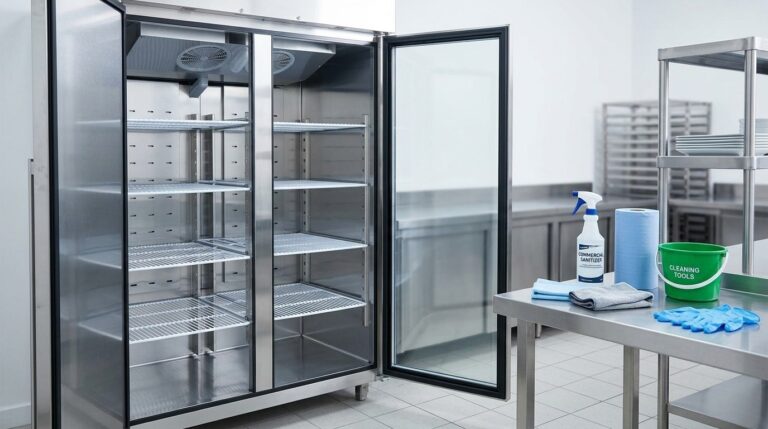
Unifrost Upright Display Freezer Cleaning and Hygiene Best Practices
Discover best practices for cleaning Unifrost upright display freezers, ensuring hygiene and efficiency in Irish commercial settings.
Read guide