
Unifrost Upright Freezer vs Chest Freezer: Model Comparison Guide for Irish Kitchens
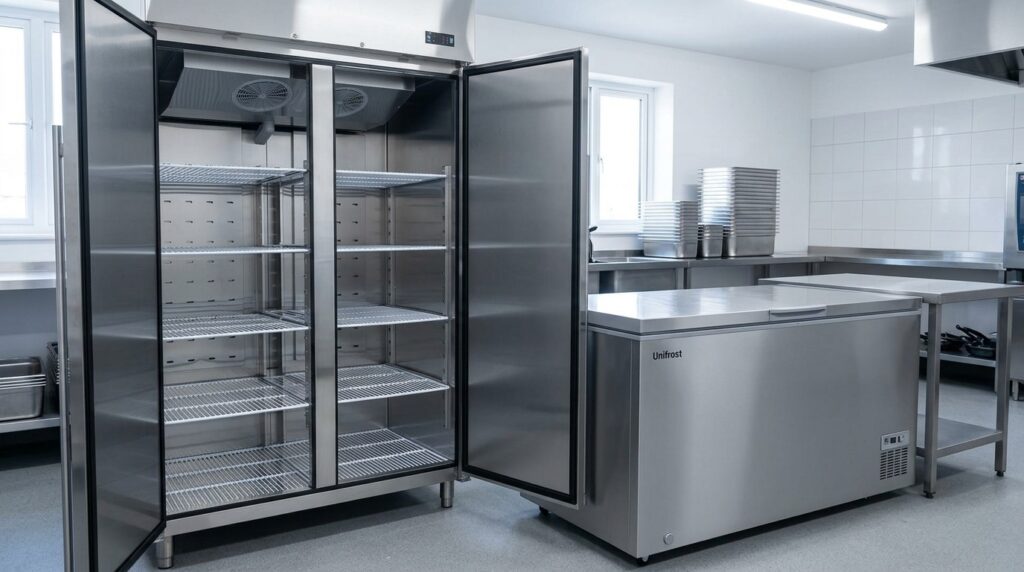
Compare Unifrost upright and chest freezers for Irish kitchens. Find the best fit for your business needs efficiently.
Unifrost Upright Freezer vs Chest Freezer: Choosing Between F1000SV, F1300SV, F410SS, F620SV and CF Series
You are usually choosing between speed of access and organisation (upright) versus maximum bulk storage per square metre and better cold retention when opened (chest). That choice affects service flow, stock rotation, HACCP checks, energy use, and even whether the unit will physically get through your doors.
This guide compares Unifrost upright freezers such as F1000SV, F1300SV, F1310SV, F410SS and F620SV with Unifrost chest freezers including CF500HSOG, CF501 and CF601. You will see what to check on footprint and siting, how day to day loading and retrieval differs, what defrosting and cleaning typically look like, and when it makes commercial sense to run an upright and a chest together rather than forcing one format to do every job.
Core Differences Between Upright and Chest Freezers
If you need quick access and tidy stock organisation during service, an upright freezer is usually the better fit. If you need bulk frozen storage that you are not opening constantly, a chest freezer generally makes more sense.
From an Irish HACCP point of view, either format can work as long as you are consistently monitoring and recording freezer temperatures. The FSAI Safe Catering Pack includes fridge/freezer record sheets you can use for this: FSAI Safe Catering Pack record books. The real trade-off is workflow versus heat gain. Uprights are faster to work from, but you lose cold air each time the door opens. With a chest freezer, cold air tends to stay in the cabinet when the lid is opened, but it is slower to pick from.
Design and access in real kitchens
Upright freezers suit busy back-of-house work because you can set them up with shelves and clear zones such as “chips”, “desserts”, “gluten-free”, or “prep for tomorrow”. That matters in restaurants, hotels, cafés, and pubs serving food where staff are in and out all day and you cannot afford a rummage every time an order comes in.
Chest freezers are simpler, but day-to-day access is slower because stock sits in layers. Where they earn their keep is bulky and longer-hold items like chips, ice, frozen veg, boxed product, pre-portioned meats, seasonal stock, or reserve stock for another outlet.
Typical usage scenarios for Irish operators
Upright freezer: service stock you are picking regularly during the shift (desserts, chips, breakfast items, banqueting prep).
Chest freezer: bulk storage and overflow, especially where you want a “buffer freezer” that is opened a few times a day rather than every few minutes.
Combined approach: an upright near the pass or prep area for daily picks, plus a chest in a storeroom for reserve stock. This keeps the “opened often” freezer smaller, easier to organise, and quicker to work from.
Organisation, stock rotation, and HACCP record-keeping
Uprights generally make FIFO easier because you can see what is on each shelf and label areas by product group or date band. In practice, that reduces forgotten stock and helps your temperature checks and corrective actions mean something operationally, not just on paper.
Chest freezers can still be HACCP-friendly, but they need a system: date-labelled crates, a simple “what lives where” layout, and a rule that new stock goes underneath or behind so older stock is pulled first. If you are already using FSAI-style recording sheets, the paperwork is the same. The difference is how long the lid stays open while someone searches.
Cleaning, defrosting, and day-to-day maintenance you will notice
With uprights, mess tends to happen at shelf level, and door seals take more day-to-day wear, especially when staff are opening the door with hands full. With chest freezers, the pain point is usually the base. Broken packaging, ice build-up, and loose product end up down low, and cleaning is more physical because you are leaning in and lifting layers out.
Neither format is maintenance-free in a working kitchen. Uprights reward shelf discipline and minding the door. Chests reward crate systems and keeping stock in tidy blocks so you are not digging.
Space and placement checks before you decide
Uprights usually give better day-to-day access for the floor space they take, but you need door swing clearance and you do not want the unit jammed into a hot corner with poor ventilation.
Chest freezers can be easier to park in a storeroom because there is no door swing, but you do need overhead clearance for the lid and enough safe standing space to sort stock without blocking a walkway.
Once you are clear on how you work, the comparison is less “upright vs chest” and more:
what you need to store,
how quickly you need to pick it,
and how much usable space you are willing to give up to do it properly.
Performance Comparison: Storage, Access, and Footprint
If you are choosing between a Unifrost upright freezer and a Unifrost chest freezer, the decision usually comes down to two things: how often you need to get in and out during service, and whether the freezer is “working stock” or reserve storage.
Uprights suit busy kitchens where frozen product is part of the daily flow. They are quicker to pick from and easier to keep organised.
Chests suit bulk holding where you open the lid less often. They generally hold temperature well once loaded, but they rely more on good labelling and basket discipline.
Uprights tend to use less floor area but need height and a clear door swing. Chests need more footprint and overhead clearance to lift the lid, but they can be easier to place under lower ceilings or awkward bulkheads.
How do Unifrost uprights and chests compare overall?
In a commercial kitchen, “capacity” is only useful if your staff can actually access it without pulling half the freezer apart. Uprights typically give you better usable capacity per square metre because you store vertically and can zone shelves for deliveries, allergens, or menu sections.
If you are opening the freezer repeatedly in a shift, access speed matters. Uprights put stock at eye and waist level, so you get fewer slow “door-open while deciding” moments. That supports better temperature control in practice and reduces the temptation to overload shelves or block air paths with badly stacked product.
Chest freezers work best when your frozen stock is predictable and uniform (for example chips, ice, portioned proteins) and you can keep it separated with baskets or clear zones. Without that structure, chests can turn into a “bottomless pit”, which is where stock rotation slips and waste creeps in.
Unifrost upright freezers (F1000SV / F1300SV / F1310SV / F410SS / F620SV range)
Choose an upright when frozen stock is part of your mise en place, not just backup storage. Shelves make it easier to set clear zones by delivery day or product type, so FIFO is visible rather than aspirational.
Uprights are often simpler to live with in tight Irish back-of-house layouts because they take less floor space. The trade-off is practical: you need a proper door swing and you cannot block access with a trolley, a delivery drop, or “temporary” storage that becomes permanent.
From a food safety and HACCP point of view, uprights make it easier to keep product labelled, separated, and retrievable without long search times. That supports the kind of stock rotation and storage controls expected in everyday compliance routines, including date coding and FIFO practice, as reflected in FSAI guidance on common compliance controls around storage and stock rotation: https://www.fsai.ie/business-advice/starting-a-food-business/starting-and-running-a-takeaway/common-compliance-issues-and-controls
Unifrost chest freezers (CF500HSOG / CF501 / CF601)
A chest freezer is usually the stronger fit when you want to hold volume and you are not in and out constantly. For carvery kitchens, busy takeaways, function venues, or anywhere with seasonal peaks, a chest can act as a bulk buffer when deliveries are delayed or weekends run ahead of forecast.
Workflow is the main compromise. With mixed stock, chests are slower because stacking is unavoidable. That is fine for uniform cartons, but awkward for smaller packs, irregular shapes, or anything staff need to grab quickly mid-service.
Space planning is different too. You are paying in footprint and lid clearance rather than height. In older city-centre premises with low ceilings, tight corridors, or awkward soffits, that can actually make placement easier. Just be honest about reach: if staff cannot comfortably access the bottom, you will end up unloading to find stock, which defeats the point.
Which is best for you?
Choose a Unifrost upright (F1000SV, F1300SV, F1310SV, F410SS, F620SV) if frozen food is accessed repeatedly during service and you want faster picking, clearer zoning, and easier FIFO discipline.
Choose a Unifrost chest (CF500HSOG, CF501, CF601) if you mainly need bulk reserve storage, you open it less often, and your stock is in predictable cartons you can basket and separate.
If you are short on floor space but have height, an upright is usually easier to fit. If height is limited but you can spare footprint, a chest can be the simpler install.
If you need both fast access and bulk holding, pairing an upright for “working stock” with a chest for reserve often gives the cleanest workflow. It only works if you decide in advance what lives where, so stock does not get duplicated, buried, or forgotten.
Operational Considerations for Daily Use
Choose the freezer format that matches how your team pulls stock during service, then lock in simple routines for loading, labelling, rotation, cleaning and checks. That is what prevents the usual headaches: stock getting “lost”, doors left open, ice build-up, and temperature records that do not stand up during an inspection. Before you commit, also check the basics on-site: access for delivery and positioning, safe working height for staff, and enough clearance to keep the unit serviceable.
1. Match the freezer format to how you work (not how you hope to work)
In a busy Irish kitchen, the right format is usually the one that lets staff move quickly without damaging packaging or leaving the door open.
Upright freezers tend to suit high-turnover items because you can organise by shelf level, label clearly, and reduce “search time”. The trade-off is obvious: every door opening dumps cold air, so the benefit only shows if staff can take what they need and close the door properly, rather than propping it during prep.
Chest freezers usually suit bulk storage where you are not in and out all service. The trade-off is labour. If people are regularly reaching past the top layer to find stock, service slows, handling increases, and torn packaging turns into ice and debris inside the cabinet.
2. Standardise loading and rotation so HACCP is easier to prove
Your freezer choice affects how easily you can rotate stock, spot out-of-date product, and show control if you are asked.
Uprights: keep it simple: one SKU, one shelf zone, with clear front-facing labels. Build the habit of moving older stock forward and loading new stock behind.
Chests: focus on containment. Use labelled baskets, crates or dividers so you can lift out a whole category, take what you need, and return it without rummaging.
If you do not enforce this, chest freezers in particular become black holes for stock. That costs money long before it shows up as a “freezer problem”.
3. Clean where the mess actually builds up (and keep ice under control)
Most day-to-day hygiene issues are predictable once you know where staff hands, packaging and trolleys make contact.
Uprights: prioritise door gaskets, shelf supports, and the lower threshold where cartons get bumped.
Chests: watch the lid seal area, the rim/top edge, and basket rails.
For audits and consistency between staff, follow a proper clean and disinfect sequence rather than a quick wipe. The FSAI outlines a structured approach in its guidance on the 6 stages of effective cleaning.
4. Plan defrosting like a job, not an afterthought
Defrosting is not just maintenance. It is downtime, temporary storage, labour, and meltwater management.
Uprights are often quicker to empty neatly because stock is already separated on shelves, but you still need a plan for where that stock sits while you clean.
Chests can take longer because product is layered. If you cannot clear the unit quickly, you end up half-defrosting and re-freezing, which drives ongoing ice build-up and makes the next clean harder.
The practical rule: if you cannot realistically empty it, you will not defrost it properly.
5. Record temperatures properly and treat frequent openings as a control point
Freezers in catering operations should be kept at -18°C or colder as per the FSAI’s guidance on temperature control. How you protect that temperature day-to-day depends on the format:
Uprights: more frequent openings, so your control is speed, organisation and making sure doors are not left ajar.
Chests: fewer openings, but lid-open time can be longer if stock is not organised. Your control is layout, labelling, and a safe lifting method that avoids “searching with the lid up”.
If you use the Safe Catering Pack, keep records simple and consistent. The FSAI notes that Recording Form 2 (Refrigeration) is used for recording temperatures of fridges and freezers. Record what you actually checked, investigate repeat drift, and note corrective actions. That is what closes the HACCP loop.
6. Make maintenance access a day-to-day decision, not a service-call surprise
A lot of preventable failures come down to blocked airflow and missed basic checks. Do not turn the freezer’s “service space” into a storage spot for boxes, linens or dry goods. If ventilation is restricted, recovery slows and the unit runs harder.
Also treat physical wear as operational, not cosmetic:
Uprights: check door seals and hinges so the door closes cleanly.
Chests: check lid seals and hinges, and keep the lid sitting square.
When you are choosing between an upright and a chest freezer in the Unifrost range, think about who will actually clean it, check it, and rotate stock on a wet Tuesday in February. That reality matters more than the plan you had at install.
These daily-use points feed directly into the comparison most kitchens care about: how much you can store, how quickly you can access it, and how manageable it is in a tight back-of-house.
Choosing the Right Freezer for Your Venue Type
The choice between an upright freezer and a chest freezer usually comes down to how you work, not the headline litre figure. In a busy kitchen, “capacity” only counts if staff can find product quickly, rotate stock properly, and close the door again without a queue forming.
From a food safety point of view, consistency matters too. The FSAI guidance for food businesses is that freezers should be maintained at -18°C or colder as part of temperature control routines (FSAI temperature control guidance). Frequent openings, overfilling and poor labelling will make that harder in any format, especially in tight back-of-house spaces.
Restaurant kitchens: prioritise access and rotation, then add bulk storage
For a high-turnover restaurant, an upright is usually the “working” freezer. Shelves make it easier to separate product types, keep labels visible, and rotate stock during service without digging. In the Unifrost range, that typically means looking at upright options such as F1000SV, F1300SV, F1310SV, F620SV, or a smaller upright like F410SS where space is tight.
Chest freezers tend to suit “deep storage” in the same operation. They are better for bulky, slower-moving items and backup stock you do not want disturbed mid-service. If you are using a chest for bulk, models such as CF500HSOG, CF501, CF601 make more sense operationally when the lid is not being opened every few minutes.
Pubs and bars: decide based on menu simplicity and delivery rhythm
In many pubs, freezer use comes in bursts rather than constant picking. The practical question is often where the unit can live without getting in the way of cellar runs, glasswash flow, or deliveries.
If the food offer is simple and deliveries are frequent, a compact upright is often easier day to day. You are in and out quickly for chips, wings, desserts or prepped items, and stock rotation is more visible.
If deliveries are less frequent, weekends are your peak, or you store bulky items (chips, ice, larger packs), a chest freezer can suit better in a storeroom where it is opened less often.
The trade-off is labour. If staff are rummaging in a chest during service, you will feel it immediately in speed and waste.
Hotels, caterers, and multi-outlet sites: split the job across formats
Larger sites usually run better when you separate roles: uprights for day-to-day production and prep areas, and chest freezers for bulk, banqueting and contingency stock. That reduces disturbance on long-term storage and keeps temperature checks simpler because each unit has a clearer purpose.
It also helps avoid a common hotel headache: one oversized freezer becoming the single point of failure and the single point of mess. Two or more units make it easier to separate allergens, raw vs ready-to-eat, or stock for different outlets when things get busy.
High pick rates (restaurants): prioritise uprights (F1000SV, F1300SV, F1310SV, F620SV, F410SS), then add a chest (CF500HSOG, CF501, CF601) for bulk backup
Pubs and bars with a simple frozen range: a smaller upright often gives the cleanest day-to-day workflow
Hotels, contract catering, event venues: uprights for working stock, chests for bulk and banqueting so you are not constantly disturbing long-term storage
Seasonal sites and sports clubs: chest freezers suit batch buying and irregular usage, but only if you commit to crates, labels and a simple “map” so stock does not vanish to the bottom
Small cafés and tight galley kitchens: the doorway and gangway matter more than you expect
In a galley kitchen, the wrong format becomes a safety and workflow problem. Uprights need door swing clearance and space for someone to pass behind the door. Chest freezers need lid clearance above and working space in front, which can clash with undercounter prep and potwash lanes.
Before you choose, measure the narrowest doorway, the tightest turn, and where the freezer door or lid will sit when it is “parked open” during deliveries and put-away. Once you know what genuinely fits the building and the flow of work, you can make a sensible call on usable storage, access time and how the freezer will behave during trading.
Integrating Freezer Choices into the Wider Unifrost Ecosystem
The right freezer choice depends on what you need it to do day-to-day: fast access during service, or low-intervention bulk storage that supports your wider cold-chain routine. In Ireland, the practical test is whether the setup makes it easier to keep labelling, checks, and stock rotation consistent with your HACCP system. The FSAI’s HACCP guidance for food businesses is a useful reference point here because it focuses on controls you can actually run in a busy kitchen.
In practice, the “best” freezer often changes once you factor in where deliveries land, how often frozen stock is touched during service, and how your team will do temperature checks and rotation when it is flat-out.
How uprights and chests fit with the rest of your Unifrost cold chain
Upright freezers generally suit a service-led workflow. If you want frozen stock to behave like the rest of your prep system, organised on shelves, clearly labelled, easy to count, and quick to grab during a rush, an upright format usually integrates better alongside upright and undercounter refrigeration.
Chest freezers tend to earn their keep as bulk buffer storage. They suit predictable frozen lines where you can work to a simple rhythm: receive, store in reserve, and pull forward into a smaller day-use freezer as needed. That approach also reduces door openings on the “working” freezer during peak periods, which helps with temperature stability in tight back-of-house spaces.
Pairing formats instead of forcing one freezer to do every job
A common, sensible setup in Irish cafés, pubs serving food, and mid-volume restaurants is one upright near the prep line, paired with a chest freezer in a store or back area for bulk. The upright carries the high-turnover items and keeps the frozen section easy for staff to maintain. The chest takes pressure off by holding back-up stock, so you are not cramming everything into the freezer that gets opened all night.
This split can also help operationally when you are handling different types of stock. Items you need to keep clearly separated and easy to audit tend to work better on shelves with clear visibility, while sealed packaged bulk can sit in reserve without becoming a daily handling job.
Support, spares, and operator consistency across a mixed Unifrost kitchen
Where “one ecosystem” pays off is consistency. Similar routines across units make it easier to train staff and keep standards steady: how you label, where you record temperatures, and what gets checked during cleaning, including door seals and any areas that collect grime.
If you are choosing between chest and upright purely on purchase price, it is worth asking a more commercial question: which format will your team realistically keep organised, defrosted (when required), and checked properly when you are short-staffed in February and under pressure in December.
Kitchen layout, delivery access, and installation checks that protect the wider system
Before you commit to a larger upright or a chest, treat delivery and placement as part of the decision. A freezer that technically fits on paper but is awkward to position or access usually becomes a daily compromise.
One quick pre-order check:
Measure the full delivery route (door widths, internal turns, lifts, kerbs) and confirm the final location has sensible airflow clearance, safe access for cleaning, and a dedicated power supply that avoids trailing leads or overloaded shared sockets.
You will find the right format faster once you compare how each option behaves for storage density, access speed, and footprint in your actual back-of-house, not an idealised layout.
FAQs: Unifrost upright freezer vs chest freezer
Should I choose an upright freezer or a chest freezer for my commercial kitchen?
Choose upright when day to day access and stock rotation matter most. In a busy line, an upright is usually faster to work from because you can label shelves, separate allergens, and find items without unpacking a whole basket.
Choose a chest when you want bulk storage with fewer openings. A chest freezer is typically best for backup stock, seasonal volume, and boxed goods you only need occasionally.
A practical rule: if the freezer will be opened repeatedly during service, go upright. If it is mainly for holding reserve stock and you can load it in organised layers, go chest.
Which type of freezer is more energy efficient: upright or chest?
In real kitchens, chest freezers are often the more energy efficient format because cold air stays in the cabinet when you lift the lid, while an upright loses more cold air each time the door opens.
That said, the biggest energy driver is usually how the unit is used, not just the format. To keep consumption down:
Reduce door open time by zoning products (ready to use items at eye level in uprights, bulk stock in a chest).
Avoid overfilling air needs space to circulate.
Keep seals clean and intact and make sure the lid or door closes fully every time.
Defrost when ice builds up, as ice acts like insulation and makes the system work harder.
If your operation needs frequent access, an upright may still be the better choice operationally, even if a chest can be cheaper to run in theory.
What capacity do I actually need for my restaurant, café or bar?
Start with what you are storing, how often you receive deliveries, and whether you freeze raw materials or mainly hold bought in frozen product.
A quick sizing method that works well in Irish service kitchens:
List your frozen lines (chips, desserts, ice, seafood, prepped items) and estimate peak weekly usage.
Decide your cover period: many venues aim for 3 to 7 days of frozen stock on site, plus a buffer for delivery delays.
Choose a layout that matches workflow: use an upright for the items staff need to reach during prep and service, and add a chest only if you genuinely need bulk reserve storage.
If you are regularly stacking boxes on the floor, blocking shelves, or struggling to rotate stock, that is usually a sign you need either more usable storage or a second unit rather than simply a larger single cabinet.
Next step: browse freezer formats and sizes
If you are at the shortlist stage, it can help to scan what is available across upright and chest formats, then narrow down by the way your kitchen actually works (service access vs bulk holding).
Browse Caterboss’s Frozen Storage category to compare freezer types and sizes side by side and pick the best fit for your layout and stock profile.
Related Unifrost guides
Compare models, maintenance advice and support information related to this topic.
Unifrost F410SS Upright Freezer Guide for Irish Hotels
A practical Unifrost F410SS guide for Irish hotels, covering installation, daily use, maintenance and troubleshooting.
Read guide
Understanding the Unifrost F410SS Upright Freezer: Temperature Alarm Basics for New Owners
Discover the essentials of managing temperature alarms on your Unifrost F410SS upright freezer for optimal performance in Irish kitchens.
Read guide
Unifrost Upright Freezer Door Not Closing or Popping Open in Summer: Troubleshooting Guide
Resolve Unifrost upright freezer door issues during Irish summers. Practical troubleshooting for commercial kitchens.
Read guideCompare Unifrost freezer options on Caterboss
For current product options, pricing and availability, continue to Caterboss.