
Unifrost F410SS vs F620SV: Service Line vs Backup Storage Planning for Irish Kitchens
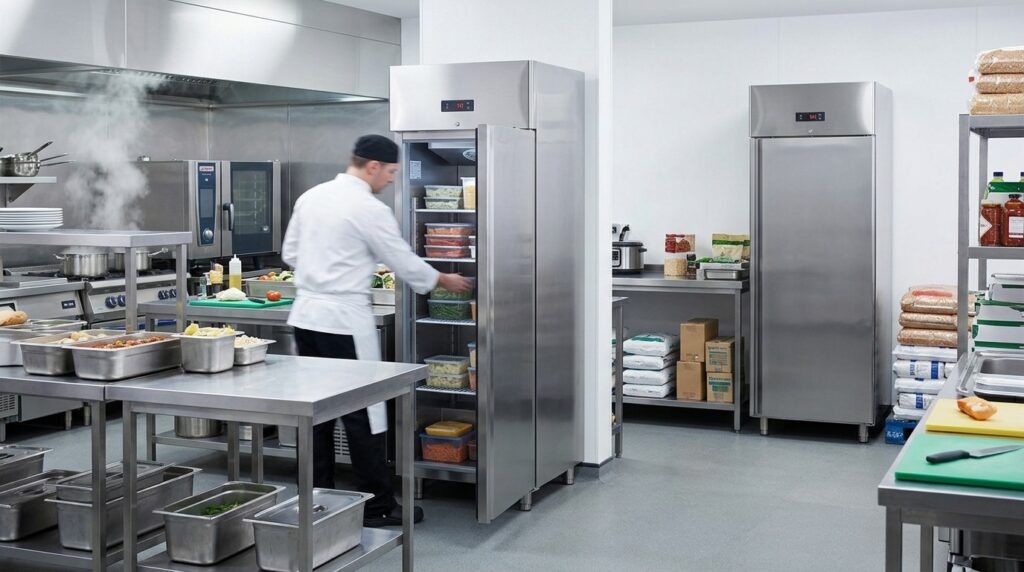
Explore Unifrost F410SS vs F620SV for service line and backup storage in Irish kitchens. Practical, informed guidance for smart freezer choices.
Unifrost F410SS vs F620SV: Choosing a Service-Line Upright Freezer or Backup Storage for Irish Kitchens
You are usually choosing between speed on the line and depth of storage when you compare the Unifrost F410SS and F620SV upright freezers. The F410SS sits naturally as a single-door, service-line friendly upright you open all shift. The F620SV is a taller single-door upright built for higher-capacity backup storage, with a larger footprint and height to plan around.
This page helps you decide what to buy and where to put it. You will work through the checks that actually affect cost and service: how much “days of cover” you need in frozen stock, what your kitchen layout can take (including access routes, door swing and the F620SV’s 680 x 710 x 2010 size), how to reduce door openings and temperature spikes during busy periods, and what cleaning, defrost and maintenance approach keeps you trading if the service-line freezer is mission-critical.
You will also see when one larger upright is enough, and when it makes commercial sense to run F410SS for service plus F620SV for backup to protect availability, menu consistency and purchasing efficiency.
Core Differences Between F410SS and F620SV
When you are choosing between the Unifrost F410SS and F620SV for an Irish kitchen, the useful question is simple: is this freezer for live service access or backup stock cover?
F410SS makes most sense near the line, where the door is opened a lot and you need quick, organised access.
F620SV suits back-of-house storage, where you want more space for bulk buying and batch prep without overloading shelves.
Both are single-door uprights in the Unifrost Upright Freezers range. The best fit comes down to workflow, footprint, and how much frozen stock you need to hold safely.
How do F410SS and F620SV compare overall?
A practical way to compare them is by door openings per hour.
If chefs are in and out for chips, portioned proteins, pastry, or prepped components, a service-line upright reduces walking and keeps service moving.
If you are mainly pulling stock once or twice a day for prep, or holding cover to manage supplier lead times, a larger storage upright is usually the calmer option.
Food safety expectations do not change just because the unit is “service” or “storage”. You still need to keep product properly frozen and limit warm-up during handling, in line with FSAI guidance on chilling and freezing. The difference is that frequent openings put more pressure on temperature stability, so layout and stocking discipline matter more on a line unit.
F410SS (service-line upright)
Choose the F410SS when the freezer is part of the service rhythm: the team needs predictable access, key SKUs within reach, and you want to avoid constant trips to a store area during a rush. This approach typically suits cafés, smaller restaurants, takeaways, and pubs where space is tight and speed matters.
You will get better results if you stock it like a working freezer, not a deep store:
Keep high-turn items at the front and at usable height.
Avoid cramming shelves, which restricts airflow and slows recovery after door openings.
Train the habit of “open, grab, close” so the door is open for seconds, not minutes.
If this is your only upright freezer, plan cleaning and defrost routines around trading patterns so you are not compromising storage during peak periods.
F620SV (tall upright for backup stock)
Choose the F620SV when you need upright freezer capacity that stays organised over time, especially if you buy in bulk, batch production, or carry seasonal lines. It is a taller format, so it generally suits back-of-house or a dedicated store area where you can maintain access routes and ventilation clearance.
The supplied dimensions for the F620SV are 680 x 710 x 2010. That footprint is worth checking against doorways, corners, and where staff will actually stand to load and pick safely.
This type of unit earns its keep in higher-volume kitchens and sites where frozen stockholding supports both cost control and continuity, for example hotels, schools, healthcare catering, and busy restaurants. It also reduces the temptation to overpack a smaller service freezer, which is a common cause of poor airflow and soft product near the door.
A sensible day-to-day workflow is often:
Put deliveries and bulk stock into the F620SV.
Decant a controlled amount into the service freezer nearer the line, so you limit door openings where it matters most.
Which is best for you?
Pick F410SS if the freezer needs to sit near the line, be opened frequently, and your priority is access and service flow.
Pick F620SV if you need deeper frozen stockholding for cover, bulk buying, or batch cooking, and you can site a tall unit sensibly (680 x 710 x 2010).
Run both if the line freezer is operationally critical but you also need protected backup stock. The service unit keeps you moving; the storage unit keeps you covered.
Once you are clear on “service access vs stock cover”, the decision usually comes down to your actual layout: galley kitchens versus production spaces, local ambient temperatures, and how often the door will be opened during a typical service.
Performance and Fit in Different Environments
An upright freezer on the service line has a different job to one holding backup stock. In most Irish kitchens, the decision comes down to workflow and space, not brand preference.
As a rule of thumb:
F410SS is the better fit as a service-line, single-door upright where staff need quick access during a busy run.
F620SV is the better fit as a higher-capacity, tall upright for bulk holding away from the heat and traffic.
Because both are uprights in the same range, the practical questions are: how tight is the pass, where will people stand when the door is open, and how many days of frozen cover do you realistically need?
How F410SS and F620SV compare in day-to-day kitchens
In a tight galley, the “best” freezer is often the one that causes the least disruption. A service-line upright earns its keep when it reduces steps and keeps service moving, but only if it’s positioned so the door can open fully without blocking a route or pinning someone into a corner.
A larger backup upright is a different play. Put it in a calmer back-of-house area and you usually get:
fewer service-time door openings
easier stock organisation by case or batch
more predictable temperature control simply because it’s not being opened constantly
Food safety still applies whichever way you go. The Food Safety Authority of Ireland notes freezers should be kept at -18°C or colder for safe storage, so the unit that gets opened most needs the tightest habits around door time, stock rotation and temperature checks. (FSAI temperature control guidance)
Unifrost F410SS: service-line fit and accessibility
The F410SS makes most sense when frozen items are part of live mise en place. Typical examples are cafés with frozen bakery and chips, pubs pushing high-turnover appetisers, or smaller restaurants where the chef needs portioned frozen items without leaving the line.
To make a service-line upright work properly:
site it out of the hottest zone (not beside a fryer line if you can avoid it)
make sure the door swing doesn’t block a walkway
plan shelves so the busiest items are quick to grab and don’t encourage long “door-open” searching
In practice, you’re not only buying storage. You’re buying fewer steps, fewer bottlenecks, and less chance of service slowing because someone has to trek to the store for every second item.
Unifrost F620SV: backup storage, height, and siting realities
The F620SV suits operations that need bulk frozen holding and can give it a dedicated spot off the line. The key detail for fit is its stated size (680 × 710 × 2010). That height can be a big advantage for capacity, but it’s worth checking realities in older Irish buildings, including low ceilings, overhead pipework, and awkward access routes through doors and tight turns.
Where this type of upright tends to work best is a back corridor, store room, or separate prep area, where you can load it during quieter periods and bring forward stock in controlled batches. That also makes temperature logging, stock counts and allergen zoning simpler, because you’re not dealing with multiple people opening the door during peak service.
Which is best for you in Ireland: service line, backup, or both?
Choose F410SS if frozen stock is accessed repeatedly during service and you need the unit close to the line without creating traffic.
Choose F620SV if you can allocate space to a dedicated backup unit and want to keep bulk stock away from service heat and constant door openings.
Choose both if you want a clear split: F410SS for “today and tomorrow” stock, F620SV for deliveries, batch prep, seasonal peaks and longer-hold items.
In shared kitchens, a single service-line upright can work early on, but add backup capacity once you’re losing time to stock shuffling or carrying extra cover for weekends and bank holidays.
Don’t use any storage upright as a rapid-cooling workaround. Putting warm product into a freezer drags temperatures and increases risk. Plan proper cooling and loading routines instead.
Once the model matches the room and workflow, the biggest gains usually come from how you run it: clear labelling, sensible shelf layout, and a cleaning and defrost routine that keeps access predictable during service.
Operational Considerations for Irish Kitchens
How an upright freezer performs day to day depends less on the badge on the door and more on how you use it. If it is being opened constantly during service, your HACCP routine and your operating habits need to reflect the extra heat load. FSAI guidance is clear that loading cabinets with warm food pushes temperatures up, and that rapid cooling is a blast chiller job, not something to force through a standard freezer (FSAI temperature control for caterers).
In practical terms, a smaller upright used as a “quick access” freezer needs protecting during peak periods. A taller upright used mainly for reserve stock can be run more like a controlled store where door openings are fewer, but loading is heavier.
Service-line vs backup storage: what changes day to day
If your freezer sits on or near the line, door openings are the main issue. Every open-close cycle drags in warm, moist kitchen air. That increases frost, drives longer compressor run time and slows temperature recovery, especially when staff stand with the door open deciding what they want. You will usually get better control by stocking a service freezer for today and tomorrow and treating it as a pick face, not a deep store.
For a backup upright, the risk shifts to how you load it. Deliveries tend to involve full cases, bulky cartons and larger prepped batches. Those loading events matter more than speed. If you plan a restock window mid-morning and get the door closed for service, you protect temperature stability for the rest of the day.
Siting and workflow: reducing temperature spikes and cross-contamination risk
In many Irish premises, you are working around fire doors, tight corridors and older back-of-house layouts. The “best” position is the one that cuts unnecessary traffic and keeps the unit away from heat sources and exhausts.
A simple workflow rule that holds up in busy kitchens:
Put the service freezer where staff can grab frozen items without crossing the pass or cutting through the cooking line.
Put the backup freezer where deliveries can be stored without dragging boxes through hot or high-risk areas.
That reduces door-open time on the unit that gets hammered during service and makes the kitchen calmer when you are putting stock away.
Zoning is easier when you treat the two roles differently. FSAI’s Safe Catering Plan prompts you to separate food to avoid cross-contamination, including allergen controls (FSAI Safe Catering Plan Section 3). Operationally, that means keeping frequently used items clearly labelled and easy to reach in the service freezer, and reserving the backup freezer for sealed reserve stock, batch components and longer-hold items with tighter stock rotation.
Energy and running costs: what actually makes a difference
Running cost is driven by conditions and behaviour as much as the cabinet itself. A freezer opened constantly beside a fryer line will work harder than the same unit in a cooler prep area, because warm air infiltration and recovery do the damage.
The wins are unglamorous but reliable:
Keep stock organised so the door is open for seconds, not minutes.
Avoid loading warm product.
Fix damaged door gaskets quickly. A poor seal leaks cold air all day.
For backup storage, avoid the “door left ajar while we break down deliveries” habit. Do the breakdown on a bench, then load in one clean sequence. Also look at the room the freezer lives in. A tight store with poor airflow and heat from a dishwasher or plant room will push any freezer harder than it needs to run.
Defrost, cleaning, and planned maintenance without disrupting service
If a freezer is service-critical, you need a routine that stops frost and hygiene issues building up, without taking you out during a rush. The practical approach is a short weekly routine in a quiet window, and a deeper clean on a scheduled monthly slot, with a plan to move stock to reserve storage while you work.
For monitoring, many Irish kitchens still use straightforward “record and sign” logs. FSAI’s example refrigeration record sheet lists frozen food at less than or equal to -18°C (FSAI SC2 refrigeration temperature records PDF).
Daily: check for ice at the door edges, make sure the door closes cleanly, wipe handles and high-touch points, and record temperatures as per your HACCP plan.
Weekly (quiet period): remove and clean shelf liners or baskets, deal with spills before they set hard, inspect seals for splits, and clear obvious dust from accessible vents and grilles.
Monthly (planned): rotate stock out in a controlled way, deep clean interior surfaces, check the cabinet is level so the door seals properly, and arrange condenser cleaning where accessible, especially in floury prep areas.
Seasonal peaks: tighten stock discipline, reduce mixed cartons, and confirm you have spare freezer capacity before you add extra frozen lines (ice cream is usually where it starts).
Power and ergonomics in older Irish buildings
Most single-door commercial uprights are specified for standard commercial electrical supply, but older Irish sites often have shared circuits, limited spare capacity and awkward isolator locations. The real-world issue is nuisance tripping when multiple appliances start up together. Get your electrician to confirm the circuit, protection and isolation point are suitable before install.
Ergonomics is also an operations issue, not just comfort. A tall backup freezer makes good use of vertical space, but it increases above-shoulder handling unless you plan shelf use properly. HSA manual handling guidance advises avoiding loads above shoulder height and keeping heavier items around waist height where possible (HSA Guidance on the Management of Manual Handling). Store light, awkward items up high, keep heavy cases mid-level, and do not put service-critical items somewhere staff need a step or a long reach to access during a rush.
These are the details that turn a paper comparison into a freezer that actually holds temperature, supports your HACCP routine, and does not create extra work when service is busy.
Choosing the Right Freezer for Your Venue Type
To choose between the Unifrost F410SS and Unifrost F620SV for an Irish kitchen, start with the job: is it a working freezer for live service, or backup holding for bulk stock? That decision matters more than headline capacity because it affects recovery after door openings, how you organise stock for HACCP, and whether the unit ends up being in the way on a busy weekend.
Before you commit, check access routes, door swing, and where the unit can realistically sit without blocking prep. Also be clear that a standard upright freezer is not designed to cool hot food quickly.
1. Decide if the freezer’s job is service-line access or backup holding
If chefs are opening the freezer repeatedly during a rush, you are buying for access and day-to-day workflow, not just litres. In most kitchens, the F410SS suits that “working freezer” role best: a single-door upright that can sit closer to the line for frequent picks of chips, frozen garnish, portioned proteins, or dessert components.
If the freezer is mainly there to take deliveries, hold boxed stock, and protect you mid-week, you need height and stock depth. That is where the F620SV is the more natural fit as a higher-capacity upright for backup storage. The supplied product context also flags a 680 × 710 × 2010 mm footprint, so you can plan space, clearances, and manoeuvring properly.
2. Map your venue type to the right unit (and when a pair makes sense)
Match the unit to how your kitchen runs on a normal Irish trading week, including weekends and supplier lead times.
Café or deli with light hot food: F410SS if frozen lines are limited and you want quick access near prep. Add F620SV if you take bigger weekly deliveries or you carry a serious pastry and dessert range.
Pub food kitchen: F410SS near the pass for high-frequency items (chips, wings, starters). F620SV in the store for bulk stock so you are not caught short on a busy weekend.
Restaurant with varied menu and batch prep: Often best as a pair: F410SS for organised, high-turn service stock, plus F620SV for backup so the line freezer stays tidy and fast to work from.
Takeaway with peak bursts and tight footprint: Lean F410SS if it can live close to the make line and stock turns quickly. Choose F620SV if you rely on fewer, larger deliveries and need deeper holding.
Hotel, school, or production kitchen: F620SV is usually the better base unit for volume. Add an F410SS only where service is split across stations and you need a dedicated “working freezer” to stop constant traffic to the main stock unit.
3. Use “days of cover” to avoid overspending or running short
“Days of cover” is a simple way to decide if one larger upright is enough, or if you need a service freezer plus a backup freezer.
A practical approach:
List your main frozen lines.
Estimate portions sold on a busy day.
Multiply by the number of busy days you want to cover.
Add a buffer for supplier delays and weekend trading.
If that pushes you into stacking boxes in front of high-use items, you are already in backup territory. In that case, the safer pattern is F620SV for bulk holding, with the F410SS kept for clean, labelled, high-turn service stock.
4. Place the freezer to protect workflow, temperature stability, and HACCP habits
Put the working freezer where it saves steps without stealing prep space. In many kitchens that means an F410SS within short reach of the fryer or plating area, while the F620SV sits in a back-of-house store or cold room area so it is not being opened every few minutes.
For food safety, aim for predictable stock rotation and separation. Keep clear zoning for raw versus ready-to-eat and allergens, and mirror that in your labels and checks. Your HACCP system should reflect what actually happens during service, as set out in FSAI guidance on HACCP-based food safety management.
5. Plan cleaning, defrost, and resilience so service isn’t hostage to one unit
If the freezer is critical to service, treat it like line equipment:
Keep stock shallow and organised.
Reduce cardboard where possible.
Build a quick clean routine that fits quieter windows.
Where possible, keep backup stock in the F620SV so you can empty the F410SS for a proper clean without disrupting service.
Do not use a storage freezer as a shortcut for rapid cooling. Safe cooling needs controlled steps and time limits, and putting hot food into cold storage can create food safety and performance issues, as outlined in FSAI advice on safe cooling of cooked foods. If cooling is a regular requirement, you either need a different process or dedicated rapid chilling equipment rather than expecting an upright freezer to do a blast chiller’s job.
Once you are clear on service versus backup, the choice between these two models becomes straightforward, and you can site and size the unit for real Irish trading conditions rather than best-case assumptions.
Integrating Unifrost Freezers Into a Larger Ecosystem
The right setup depends on what you are trying to protect: service speed, stock cover, or both. In most Irish kitchens, your freezer lineup also has to support documented controls around storage and separation as part of your food safety management, as set out in FSAI guidance on HACCP-based food safety management systems. What looks “best” on a spec sheet can be the wrong choice once you factor in door openings, access routes, and who is actually restocking during a rush.
Service-line plus backup: when two uprights beat one bigger unit
A common approach is to run one upright as the “touch it all day” service freezer and a second as the “touch it once or twice” backup unit. In this example, that means treating the F410SS as the service-line freezer and the F620SV as deeper storage. The service unit sits close to the pass or prep line for fast pulls. The backup unit sits somewhere less exposed to constant traffic, holding cover stock without being opened every few minutes.
Splitting the roles reduces the risk of one busy cabinet becoming your single point of failure mid-service. It also improves discipline. The freezer staff can see and reach is the one they will use, so giving it a clear purpose helps stop backup stock creeping onto the line and turning into clutter.
Planning “days of cover” across a mixed Unifrost fleet (uprights plus undercounters)
“Days of cover” is a simple control: how many trading days can you run if a delivery slips, the weather disrupts supply, or trade jumps unexpectedly (bank holiday weekends, match days, functions). The point is not the maths. It is where that cover stock lives.
If your cover stock is in the same cabinet that gets opened constantly, you will feel it in slower temperature recovery, messier organisation, and extra staff time. A practical way to plan is to separate by cadence rather than by product category:
Service freezer: fast-moving items, service portions, and “this week” lines
Backup freezer: sealed cases, batch-prepped components, and longer-hold stock
That split makes rotation easier and reduces the “archaeology” problem during service when someone is digging for the older box at the back.
Where to site uprights so they support food safety and workflow
Siting is not just convenience. You are aiming for fewer openings on the busiest cabinet, shorter carrying distances with open product, and a layout that discourages cross-traffic between raw handling and ready-to-eat assembly.
Ergonomics matters more with taller uprights because door swing, aisle width, and reach height can turn restocking into a daily frustration. In older or tighter premises, decide in advance what should live low, mid, and high so staff are not lifting awkward loads at pace. For manual handling risk reduction, use the HSA guidance on manual handling.
Zoning, allergen control, and HACCP documentation without overcomplicating it
Zoning is easier when each freezer has a job. A workable setup many operators use is:
Service-line freezer: portioned items and near-term stock
Backup freezer: sealed cases and longer-hold items
Undercounter freezers: peak-speed stations where every step matters
Where allergen segregation is required, allocating whole shelves or clearly marked zones is usually more reliable than relying on memory during a rush. It also makes your checks and logs easier to keep consistent, and easier for new staff to follow. The test is simple: could someone on their first week understand the system without asking three questions?
Defrost, cleaning, and maintenance: keep service resilient
If the F410SS is your service-line unit, plan maintenance so it can be taken out of action without chaos. In practice, that means keeping enough space in the F620SV (or another backup freezer) to temporarily hold stock during a defrost, deep clean, or a call-out. It is a lot easier than improvising with bins or borrowing space from chilled storage.
Running cost is also a fleet issue, not a single-unit issue. The cabinet opened all day will rarely be the cheapest to run in real conditions, even if two units look similar on paper. Reducing unnecessary door openings and keeping heat sources away from refrigeration is repeatedly emphasised in SEAI guidance on energy efficiency in food and drink businesses. Once roles and locations are clear, the remaining decision is whether each cabinet suits your actual ambient conditions and service pattern.
FAQs: Choosing between F410SS and F620SV for service-line and backup storage
What’s the difference between a service-line upright freezer and a storage/backup upright freezer?
A service-line upright freezer is chosen for speed and frequency of access during prep and live service. In practice that means you optimise for:
Location near the pass or prep section to cut steps.
Fast pick access for smaller, high-turn items (chips, seafood portions, pastry, veg, prepared components).
Predictable organisation so chefs can open, grab, close quickly.
A storage or backup upright freezer is chosen for depth of stock and stability rather than constant opening. You optimise for:
Higher on-hand volume and clearer “bulk stock” zoning (cases, outer cartons, batch items).
Fewer door openings (often accessed once or twice per shift) which supports better temperature stability.
Back-of-house placement in a storeroom or goods-in area, where it does not fight with the line for space.
In this Unifrost comparison, the F410SS is typically specified as the service-line friendly single-door upright, while the F620SV is typically specified as the taller storage upright for backup stock.
When should an Irish kitchen choose a Unifrost F410SS as a service-line freezer and a separate F620SV as backup storage, versus running only one larger unit?
Choose two units (F410SS on the line plus F620SV for backup) when any of these apply:
You have “live service risk”: if the only freezer is down or blocked, service stops. A second cabinet protects continuity.
High door-opening during service: keeping the busy, frequently-opened freezer smaller and closer to the line helps you avoid constant disturbance to your bulk stock.
You buy in bulk or do batch prep: the backup cabinet takes deliveries, case quantities and longer-hold items so the line freezer stays tidy and fast.
You need tighter segregation (common in HACCP routines): for example, dedicating one cabinet to allergens or raw items and the other to ready-to-eat components.
Run one larger unit only when:
Service volume is low to moderate and the freezer is opened infrequently.
Space, routes, or electrical constraints mean a second cabinet creates more problems than it solves.
You have alternative frozen capacity already (for example, an undercounter freezer on the line or a separate chest freezer for deep storage).
A simple planning rule that works well in Irish kitchens is: keep 1 to 2 service days of “fast-pick” frozen items in the line freezer (F410SS), and hold the rest of your cover (bulk, cartons, slower-moving SKUs) in the backup freezer (F620SV).
What maintenance and servicing approach should operators use if the F410SS is critical for live service while F620SV holds long-term stock?
Treat the F410SS (service-line) as the critical cabinet and plan maintenance around zero disruption:
Daily: quick check that the door closes cleanly and nothing is preventing a proper seal (boxes, trays, ice buildup). A poor seal is one of the fastest routes to performance problems.
Weekly (quiet period): wipe down door gaskets and high-touch areas, and do a short “organisation reset” so staff are not holding the door open while searching.
Monthly: schedule a proper clean-out by section, rotating stock into the F620SV temporarily so the line freezer can be cleaned without impacting service.
Use the F620SV (backup storage) to make servicing easier and safer:
Keep a buffer zone: reserve a small amount of empty space so you can move stock across during a breakdown, deep clean, or inspection.
Plan defrost and deep cleans around deliveries: do the bigger tidy and rotation just before or just after goods-in so stock is not left out.
Log temperatures and issues: if the F410SS is mission critical, keep a simple fault and temperature log as part of your HACCP file so small issues (seal wear, repeated icing) are spotted before they become downtime.
If you ever need to take the F410SS out of use unexpectedly, the operational goal is: move high-risk, high-turn items first, then rebuild the service-line “fast pick” layout once the cabinet is back online.
Compare your frozen storage options before you commit
If you are deciding between a service-line F410SS, a backup-storage F620SV, or a two-cabinet setup, it helps to compare the full frozen-storage range side by side before you finalise layout and ordering.
Browse Caterboss’s Frozen Storage category to review current availability and options, then shortlist the cabinet types that best match your workflow and stock cover.
Related Unifrost guides
Compare models, maintenance advice and support information related to this topic.
Customising Advanced Settings on the Unifrost F410SS Upright Freezer Controller
Learn to adjust the Unifrost F410SS freezer controller for Irish commercial use, balancing food safety and efficiency.
Read guide
Unifrost Upright Freezer Temperature Controller: Energy Optimisation for Irish Kitchens
Learn to optimise Unifrost upright freezer temp settings for energy efficiency and HACCP compliance in Irish kitchens.
Read guide
Customising Advanced Settings on Unifrost Upright Freezer Controllers for Irish Kitchens
Guide to customising Unifrost upright freezer controllers for optimal Irish kitchen use, covering temperature settings and advanced configurations.
Read guideView Unifrost fridges at Caterboss
For current product options, pricing and availability, continue to Caterboss.