
Unifrost F410SS Upright Freezer Planning Guide for Irish Hotel Banqueting Kitchens
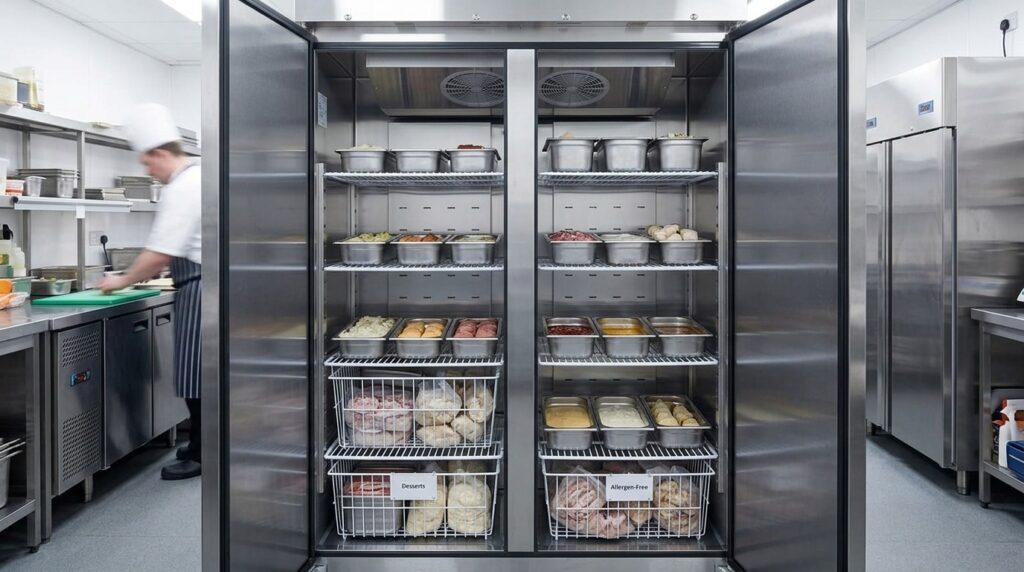
Plan your F410SS freezer layout for efficient high-volume banqueting in Irish hotels. Optimize GN pans and workflow.
Unifrost F410SS Upright Freezer Layout Planning for Irish Hotel Banqueting Kitchens
If you run hotel banqueting, your Unifrost F410SS often becomes the main “grab and go” frozen cabinet during peaks. How you space shelves, mix GN pans with wire baskets, and zone products decides whether chefs move quickly or waste minutes hunting, propping doors open, and fighting soft product and ice build-up.
This guide walks you through the practical layout decisions you need to make before a 100 to 300 cover function, including:
How to choose between GN pans and baskets for portioned banqueting items versus bulk components, and what that means for airflow and temperature stability
Example shelf-by-shelf zoning ideas for desserts, sides, sauces, and allergen-separated items, so staff can load and pick with fewer steps
How to plan a bank of F410SS cabinets by function (banquets, breakfast, bar, overflow) to cut door-open time and reduce cross-traffic
The setup pitfalls that cause “freezer Tetris”, blocked vents, poor stock rotation, and HACCP headaches, plus simple checks to avoid them
You will finish with a repeatable plan for day-one setup, seasonal re-spacing, and a clear trigger point for when you need extra shelving and baskets, a second upright, or a dedicated overflow option for banqueting spikes.
Why this topic matters in commercial use
Optimal upright freezer layout matters in Irish hotel banqueting kitchens because banqueting drives repeated, high-frequency door openings. If GN pans, baskets, and shelves are awkwardly set up, every pick turns into “freezer Tetris”. Door-open time creeps up, temperature recovery slows, and you start chasing issues that look like “the freezer isn’t holding” when it is really access and organisation.
Food safety expectations are clear rather than optional. The FSAI notes that freezers should be maintained at -18°C or colder, so anything that increases door-open time or blocks airflow makes compliance harder during peak service (FSAI temperature control guidance). Layout will not fix an undersized cabinet or a unit installed beside heat sources and traffic pinch points, but it is often the quickest operational win you can make without changing equipment.
Banqueting speed is mostly about reducing door-open time, not just “more space”
In a 100–300 cover function, the freezer is not just storage. It is a staging point for timed releases: plated desserts, pre-portioned sides, frozen garnishes, backup bread, and the “save the pass” items when a section runs short. If staff have to lift and shuffle GN pans to reach the right tray, the door stays open longer and the cabinet has to work harder to pull back down. In service, that shows up as softer product at the front, more frost, and slower recovery on the next round of picks.
A planned internal layout also avoids the classic bottleneck where one person blocks access while others queue for the same shelf. The most effective setups make the grab obvious, fast, and repeatable, especially for relief staff who did not set the freezer up in the first place.
GN pans, baskets, and shelf spacing affect airflow and temperature stability
Upright freezers rely on consistent internal airflow to recover after openings. When GN pans are packed tight front-to-back, or baskets are overfilled so product sits above the basket line, airflow drops and warm spots develop. You usually notice it first on high-turn items near the door.
This matters in Irish hotel kitchens because banqueting peaks often sit alongside higher ambient load in the same zone: ovens running, dishwash heat, hot holding, and constant staff movement. Even a good cabinet will struggle if you combine frequent access with blocked airflow. Layout is part of temperature control, not just organisation.
A planned layout reduces waste, overtime, and HACCP friction during busy functions
The cost of a messy freezer shows up in small but expensive ways: missed items, duplicate prep “just in case”, and slow stock takes because nothing has a consistent home. It also adds HACCP friction because product spends longer out of controlled conditions while staff search, sort, and re-stack.
A practical layout plan typically delivers:
Faster picking for banqueting and breakfast crossover items, with fewer door-open minutes across the shift
Clearer segregation for allergens and raw versus ready-to-eat components using dedicated shelves or zones
More accurate ordering because the team can see what is actually there, not what is buried at the back
Treat layout as a performance tool rather than a tidy-up job, and the priorities for upright freezer organisation become much easier to set.
Key factors in F410SS layout planning
Plan your F410SS layout around two things: airflow (so the cabinet holds temperature and recovers quickly after door openings) and repeatability (so anyone on shift can load and pick without digging). In an Irish hotel banqueting kitchen, that usually comes down to zoning, sensible GN and basket use, and a layout that supports HACCP labelling and allergen separation under pressure.
1. Split the F410SS into “service” and “storage” zones before you load anything
Banqueting freezers tend to fall down in two predictable ways: the door is opened constantly during prep, and the item you need is buried behind three others. Zoning fixes both.
Service zone: items you need to reach quickly during plating or regen runs. Keep these on the middle shelves where access is easiest.
Storage zone: bulk and longer-hold stock that should only be touched during planned prep windows. Put these higher or lower so they are less likely to be disturbed.
If you reduce searching, you reduce door-open time. That is the easiest win you will get.
2. Choose GN pans when control matters; choose baskets when speed and awkward packs matter
Both have a place. Use each for what it does best.
GN pans: best for portion control, stock counting, and labelling. They suit pre-portioned soups, sauces, sides, dessert components, and allergen-separated items where a clear label on a single container prevents mistakes.
Wire baskets: best for irregular shapes and “grab-and-go” packs. They help stop packets slumping into the back of the cabinet, but only if you avoid overfilling and don’t wedge baskets tight to the walls.
3. Protect airflow first, then chase capacity
An upright freezer can look full and still work well, but only if air can move around product.
Avoid:
Loading hard up against the back wall
Overhanging pans that create a curtain across a shelf
Tight packing that stops air circulating around packs and containers
Give the team a rule they can actually remember: if a pan or basket blocks the natural air route, recovery time after door openings gets worse. That matters most during a 100 to 300 cover push.
4. Build a shelf-by-shelf plan that matches banqueting reality
Pick a default layout your team can stick to. In practice, two versions is usually enough: one for peak wedding volume and one for quieter mid-week functions. Change shelf spacing only when the menu genuinely changes.
A workable starting point:
Top shelf: long-hold, low-access stock (backup portions, sealed bulk)
Upper-middle shelves: labelled GN pans for pre-portioned components (group by course and allergen risk)
Middle shelf: “today” stock for the next function (next 24 to 48 hours only)
Lower-middle: baskets for wrapped items and awkward packs you need quickly (fries, veg portions, boxed product, ice packs)
Bottom shelf: heavier bulk that should not be lifted above waist height, kept tidy so it does not become a forgotten pile
If you can’t explain the layout to a new commis in 60 seconds, it won’t survive the weekend.
5. Plan GN depth and combinations around access, not just “what fits”
Deeper pans can make sense for bulk components, but they often slow you down. They also increase the temptation to leave a pan open while portioning. Shallower pans often suit banqueting better because you can rotate stock faster and keep “lid off” time down.
Whatever depth you choose:
Keep pans lidded or wrapped where appropriate
Avoid stacking that forces staff to pull multiple pans out just to reach one item
6. Make labelling and allergen separation part of the physical layout
Don’t rely on memory or “who was on last night”. Assign consistent shelf positions for allergens and higher-risk items so the system still works with agency staff.
This supports HACCP checks and temperature control. The Food Safety Authority of Ireland notes frozen food can remain frozen if the freezer is still below −18ºC during disruption, which is easier to maintain when the layout reduces door-open time and prevents rummaging. (Source: FSAI guidance on frozen food and −18ºC in a freezer: https://www.fsai.ie/Business-Advice/Running-a-Food-Business/Caterers/Flooding-of-a-Food-Business)
7. Coordinate loading with your blast chiller so you do not warm the cabinet during peaks
If you run cook-chill for functions, don’t let the F410SS become a “cool-down zone” for warm product or freshly chilled trays. Load in batches during quieter windows, keep the door closed between runs, and use a staging trolley so you’re not deciding shelf space with the door open.
If you regularly need to load large volumes at once, treat it as a workflow and capacity issue. You may need an overflow plan or separate backup storage, rather than squeezing more into one cabinet.
Common pitfalls in freezer setups
A lot of freezer performance problems are self-inflicted. If you run an upright like a “freezer Tetris” box, trays jammed tight, mixed product types, no fixed homes, you will usually see longer door-open time and warmer product at the front because airflow and recovery suffer.
From a food safety point of view, your baseline is simple: food business freezers should be kept at -18°C or colder. That’s the practical reference point for HACCP checks in the FSAI temperature control guidance: https://www.fsai.ie/business-advice/running-a-food-business/caterers/temperature-control
In busy Irish kitchens, these issues tend to show up quickly, especially after the first heavy weekend of breakfast and functions, and then become the “normal” as stock levels creep up and staff change over.
Airflow gets sacrificed for short-term capacity
The most common mistake is organising the cabinet around “how much can I fit today” instead of “how will this recover when we’re opening the door 50 times during service”.
Trays hard against the back or sides can block air circulation.
Overfilled baskets let product sit above the basket line, which creates warm spots and slows pull-down.
Mixed loads shoved together make it harder for the cabinet to recover between picks.
In hotel banqueting kitchens, peaks are predictable and intense. If the freezer is doing double duty as bulk storage and fast-access service stock, airflow and recovery matter more than the last bit of capacity.
The layout doesn’t match how your team actually picks food
A tidy layout on paper can fall apart in service if the container choice doesn’t match how staff grab product.
Baskets usually suit high-frequency picks where you’re grabbing by the handful: chips, wedges, par-baked bread, individually wrapped desserts.
GN pans suit flatter, portioned, labelled items that need separation: pre-portioned components, allergen-controlled items, gluten-free sides.
If you don’t match storage to pick behaviour, the cabinet gets reshuffled during service, labels go missing, and door-open time creeps up.
“No homes” storage causes HACCP and stock-control headaches
When shelves aren’t zoned, every door opening turns into a micro-decision: where does this tray go, what do I pull first, what’s for breakfast versus functions.
That usually leads to:
FIFO slipping, because new stock lands at the front.
Allergen separation relying on memory, not a repeatable system.
More waste, missing items mid-service, and end-of-shift stock corrections.
This is why it’s worth treating freezer layout as a set of fixed rules, shelf heights, container types, labelled zones, rather than a once-off tidy-up that lasts until the next busy shift.
Tailoring the F410SS to your kitchen workflow
How you set up a Unifrost F410SS should reflect what actually happens in your kitchen, not just what fits on day one. Banqueting, breakfast and bar service all drive different door-open frequency, portioning, and stock rotation. If you organise the cabinet around those patterns, you’ll spend less time with the door open and more time keeping stock under control.
Most Irish kitchens also need the layout to support HACCP routines such as segregation, traceability and allergen management. Keep it aligned with your existing system and the approach set out in the FSAI’s HACCP guidance for food businesses. The best setup is usually the one that stays workable on a busy Saturday as well as a quiet midweek.
Start with workflow zones, not “what fits”
Treat the freezer as a set of zones based on who opens it, when, and why:
Banqueting: batch in, batch out, bursty access.
Breakfast: predictable, time-critical, low tolerance for rummaging.
Bar food: lots of small picks, high door-open frequency.
Mixing those behaviours on the same shelves is how you end up with longer door-open time and messier stock control. A simple rule that holds up in service is:
Fast access at comfortable reach height.
Bulk and long-hold lower down.
Rarely accessed items higher up.
It also makes it easier to assign responsibility, so banqueting stock doesn’t become a shared “free-for-all” during peak trade.
Banqueting (100–300 covers): use containers for control, baskets for quick picks
For banqueting, you want predictable portions and quick counts.
GN pans suit portioned components like soups, sauces, sides and prepped elements. They make visual checks easier and keep batches consistent. The watch-out is overpacking or tight stacking that restricts airflow and slows recovery.
Wire baskets suit individually wrapped items, frozen bakery, or awkward shapes that don’t stack neatly. They also make “grab and go” faster without lifting half a shelf to reach what you need.
A practical approach is: use pans where portion control and traceability matter, and baskets where speed and easy picking matter. It keeps service moving and reduces the temptation to leave product sitting out while someone holds the door open behind them.
Breakfast and bar: set up for short door-open time and one-handed access
Breakfast is repetitive and time-bound. Aim to reduce door-open time rather than chasing maximum theoretical capacity:
Keep a breakfast pull zone on one or two shelves.
Keep it stable week to week so early staff can work without stopping to ask where things are.
When menus change, change labels and spacing then, not every day.
Bar service is different. If the bar team is picking frequently from the main kitchen freezer during peak trade, you’ll feel it in slower service and warmer air ingress. Put the highest-pick bar items where staff can grab quickly and close the door. Don’t store them behind deep stacks or banqueting trays.
If bar picking is constant, that’s usually a sign you should either dedicate a clear bar zone within the cabinet or move those lines to a nearer service freezer, so the main unit can behave like storage rather than a speed rack.
A shelf-by-shelf plan you can actually run in a hotel kitchen
Adjust for your menu and delivery pattern, but this structure keeps access fast and labelling simple:
Top shelf (rare access): overstock, seasonal, or function-only stock that shouldn’t be touched during breakfast or bar.
Upper-middle (banqueting pick zone): pre-portioned banqueting components, grouped by course or station.
Middle (breakfast pull zone): breakfast lines for the next 24–48 hours, kept together to avoid cross-picking.
Lower-middle (bar and late service): high-pick items, often best in baskets for quick grabs and quick counts.
Bottom (bulk and heavy): cartons and heavy items that are safer to handle low down, away from fast-pick zones.
If you’re storing plated desserts as well as bulk components, keep plated items in a dedicated, clearly labelled zone so you’re not shifting trays to reach cartons.
Keep it adaptable for wedding season without weakening controls
In Irish hotels, volume swings hard between wedding season and midweek corporate trade. The easiest way to stay on top of it is to standardise a few shelf positions that suit your usual mix of pans and baskets, then change labels and zone ownership as the menu changes.
If you’re moving product through cook-chill workflows, keep a clearly labelled area for items coming in, then move them to long-hold storage once checked, dated and signed off. That supports traceability expectations in the FSAI guidance on food business operator responsibilities.
For allergens, use a system your team will follow when it’s busy. Colour-coded labels or shelf tags that match your kitchen’s allergen matrix work well, as long as allergen-separated lines are physically grouped so staff don’t have to rely on memory during service.
Once you’ve got the workflow right, the layout decisions become simpler: prioritise access, keep airflow clear, make rotation obvious, and fit it to the footprint and service pressure you actually have.
Practical next steps for hotel kitchen planners
Start by mapping your banqueting menu into freezer “zones” (rapid-access service items versus deep storage) and give each zone a fixed shelf or basket location. Set shelf heights around the GN depths and pack formats you actually use, then agree a simple labelling and pick routine that supports FIFO and allergen separation. Run it for two weeks through at least one busy function, then adjust based on door-open time, stock-outs and mis-picks, not on what looks tidy on day one.
1. Be clear what job the F410SS is doing
In an Irish hotel, an upright freezer like the F410SS usually becomes either:
a service-line freezer for banqueting and breakfast, or
a “bridge” cabinet between production and functions.
Decide which it is before you plan GN pans and baskets. If you try to use the same cabinet as a fast-pick station and long-term store, it turns into freezer Tetris and you pay for it in door-open time and missed items.
A workable split is:
Fast access (mid-shelves, easiest reach): chips/wedges, pastry sheets, ice cream tubs for dessert stations, pre-portioned sides.
Once-per-shift (top and bottom): bulk proteins, back-up veg, seasonal items.
If you cannot name the primary user for each shelf (banqueting, breakfast, bar, pastry), you are heading for mixed stock and longer searches during service.
2. Turn the menu into zones and give each zone a fixed home
At 100 to 300 covers, you are not organising “food”. You are organising speed, consistency, and risk. Build zones that match how the team moves, for example:
banqueting mains components
banqueting desserts
breakfast top-ups
bar food back-up
deep storage (“do not touch” unless authorised)
This is where GN pans versus baskets becomes straightforward:
Use GN pans where portion control, counting and presentation matter (pre-portioned sauces, sides, dessert portions).
Use baskets where odd-shaped packs and grab-and-go items dominate (chips, breaded products, mixed veg bags).
The rule to enforce is consistency. If the same product flips between pan, carton and loose packs depending on who puts it away, you will lose time when it matters.
3. Set shelf spacing for real packs, and protect airflow
Set shelf heights so staff are not forcing lids, film or cartons to fit. That’s what leads to overpacking and blocked air paths. Upright freezers recover more slowly when they’re packed tight and the door is held open while someone hunts.
A simple habit that pays back is “no overhang”. If a GN pan, carton or tray blocks normal air circulation inside an upright cabinet, you’ll get temperature variation across shelves, plus softer product and heavier frosting.
Use temperature as the checkpoint, not opinions. Freezers in food businesses should be maintained at -18°C or colder, as set out in the FSAI temperature control guidance for caterers.
4. Make it work with blast chilling, not against it
If you’re running cook-chill for banqueting, define a clean handover from blast chiller to freezer so you’re not loading warm product into the upright during peak prep. A practical workflow is:
blast chiller racks labelled by function
decant into the freezer by zone
one person owns the decant, so stock doesn’t drift into the wrong shelves
Also make it a hard rule that the freezer is not a cooling device. Loading warm food into refrigeration raises cabinet temperature and increases risk elsewhere. The FSAI guidance on temperature control is clear on cooling quickly and avoiding overloading cold cabinets with warm product.
5. Labelling, allergen separation, and a pick routine people still follow at 1am
Banqueting pressure is where allergen controls fail, so design the layout to be difficult to misuse. Separate allergen-controlled stock by zone and shelf location, not just by a sticker. Keep higher-risk items (nuts, gluten-containing pastry, dairy-heavy desserts) in a defined section that never gets mixed.
For compliance, allergen information for non-prepacked food in Ireland must be provided in writing and accessible before sale or supply, per the FSAI allergen labelling guidance. In practice, your freezer labels should mirror your kitchen allergen system: product name, production date, use-by guidance, and a clear allergen flag that matches your written allergen file.
For HACCP records, tie the freezer into the same daily check rhythm as your other cold storage, using one standard record rather than ad hoc notes. The FSAI Safe Catering Pack Recording Form 2 (Refrigeration) is built for fridge and freezer temperature checks and is familiar to EHO inspections.
6. Stress-test the layout and agree overflow before wedding season does it for you
Don’t wait for a Saturday wedding to discover you have no landing space for deliveries or last-minute function top-ups. Run a two-week trial and track:
average door-open time during prep
how often staff can’t find stock quickly
how often shelves get overfilled and need repacking
Then decide what happens when the cabinet hits capacity. In hotels, overflow often lands in whatever freezer has space, which breaks zoning and allergen separation. A better approach is a pre-agreed overflow hierarchy (for example, a designated chest freezer for sealed back-up stock only), with the same labelling and logging rules as the main cabinet.
Once the workflow holds up under service, you can fine-tune the decisions that drive day-to-day performance: how GN format, basket choice and zoning affect airflow, temperature recovery, and labour.
FAQs for F410SS GN and basket planning in hotel banqueting kitchens
How should I lay out GN pans and wire baskets in a Unifrost F410SS specifically for high-volume Irish hotel banqueting?
For 100 to 300 cover banqueting, set the F410SS up so the “fast-pick” items live between waist and shoulder height, and the slower-moving bulk sits top and bottom.
Allocate zones by job, not by ingredient: e.g. Dessert garnishes, Pre-portioned sides, Sauces and stocks, Gluten-free and allergen-controlled, Bulk backups. This reduces door-open time because staff stop scanning.
Use wire baskets for high-touch, irregular packs (pouched purées, bags of berries, boxed pastries, open cartons) so you can pull a whole basket to the pass for a short pick, then return it.
Use GN pans for repeatable portions (scooped sides, portioned desserts, sauce portions) because they stack and label cleanly.
Keep one “landing shelf” empty or lightly loaded at a comfortable height during peak prep days. It’s where trays and pans pause while staff reorder, label, or count portions.
Don’t mix bulk and service portions in the same shelf band. Bulk causes “freezer Tetris” and blocks access to ready-to-go items when you are under time pressure.
Practical banqueting rule: anything you need during plating should be reachable with one door opening and one hand movement. If it takes rearranging, it belongs in a different zone.
What GN depths and pan combinations work best in an F410SS for pre-portioned banqueting items while maintaining airflow?
Choose GN depths and combinations based on portion format and pick speed, then protect airflow by avoiding overhangs and tightly packed “solid blocks”.
Shallow to medium GNs (commonly used for portioning) tend to work best for banqueting because they freeze and temper more predictably and let you see stock at a glance.
Standardise one or two pan depths across the team for sides, petits fours, portioned desserts, and sauce portions. Consistency speeds up shelf resets and reduces misfits that block air.
Leave clearance around pans and baskets: avoid packing pans edge-to-edge. In uprights, airflow suffers most when you create a continuous wall of product.
Use “like with like” per shelf: one shelf for portioned soups/sauces, one for portioned sides, one for dessert components. Mixed heights and mixed packaging usually leads to crowding and poor air circulation.
Label on the short end and face labels outward so staff can pick without pulling pans out and holding the door open.
Also: Can standard GN pans go straight into an upright freezer? Yes, in day-to-day use they can, but for best results make sure they are freezer-suitable (no cracks or warping), properly covered/lidded, and not filled so high that lids dome. Avoid putting hot product into the freezer. Chill first (for example via your cook-chill process) so you don’t drive up cabinet temperature and create excess ice.
How can I zone a bank of F410SS upright freezers in a hotel kitchen to cut door-open time and staff steps?
Treat each F410SS as a named station with a clear purpose, then enforce a simple “one task, one cabinet” rule during peak periods.
Zone by service stream: Banqueting prep, Banqueting plating, Breakfast, Bar and room service, Functions overflow. This stops staff crossing paths and opening multiple doors to build one trolley.
Mirror shelf maps across cabinets where possible (same shelf numbers for the same product types). Staff learn one layout and work faster, even with agency staff.
Put the highest-velocity cabinet closest to the pass or trolley park. The slow-moving bulk cabinet can sit further away.
Assign ownership: one team or section owns stock accuracy and labelling for each cabinet. Shared ownership is where FIFO breaks down.
Use a simple “door discipline” workflow: pick lists by cabinet, pull one basket/pan set at a time, close the door, then portion/plate at the bench.
If you already have HACCP zoning in place, align freezer zones with it (for example allergens, raw vs ready-to-eat components) so the layout supports compliance instead of fighting it.
Next step: match your freezer setup to your hotel workflow
If you are planning a new banqueting season setup or adding capacity, it helps to compare cabinet formats and internal configurations before you commit. Browse the Unifrost Upright Freezers range to shortlist options that suit how your team portions, labels, and picks stock in a busy Irish hotel kitchen.
Related Unifrost guides
Compare models, maintenance advice and support information related to this topic.
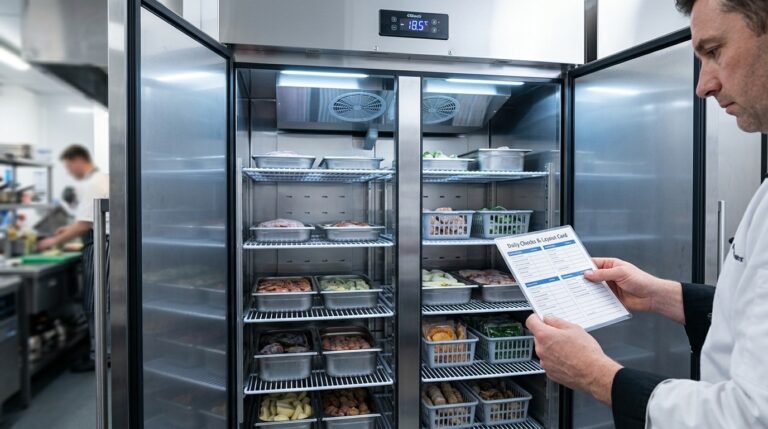
Unifrost F410SS Upright Freezer: Quick Start Guide for Hotels
Get started with the Unifrost F410SS in your Irish hotel. Temperature setup, layout guidance, and quick checks for optimal freezer use.
Read guide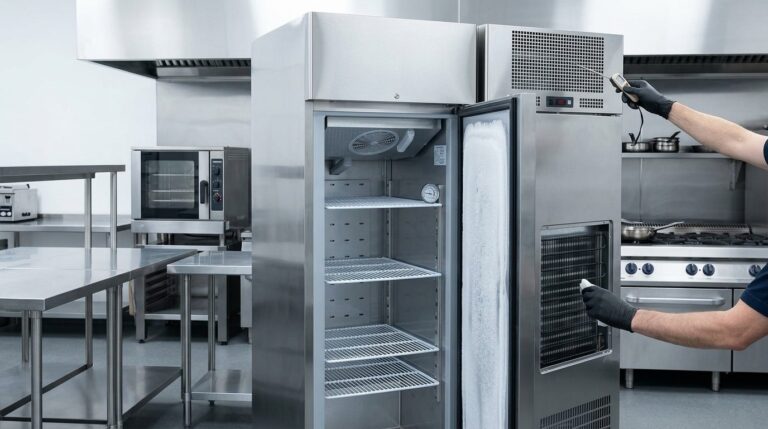
Unifrost F410SS Upright Freezer Ambient Heat & Ventilation Troubleshooting
Troubleshoot Unifrost F410SS freezer temperature issues. Learn how ambient heat and ventilation affect performance in Irish kitchens.
Read guide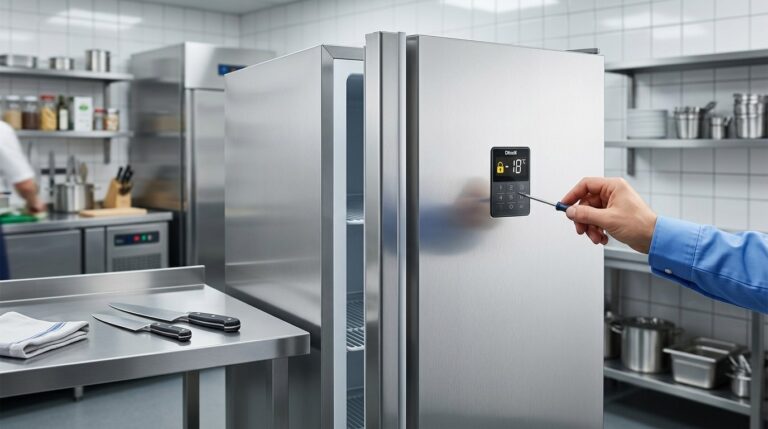
Unifrost F410SS Upright Freezer: Door Controller Locking Troubleshooting Guide
Find solutions for Unifrost F410SS freezer door controller lock issues in busy Irish kitchens. Unlock guidance, common safety checks, and service tips.
Read guideCompare Unifrost freezer options on Caterboss
For current product options, pricing and availability, continue to Caterboss.