
Optimizing GN Basket Plans for Unifrost F410SS Upright Freezer in Hotel Banqueting
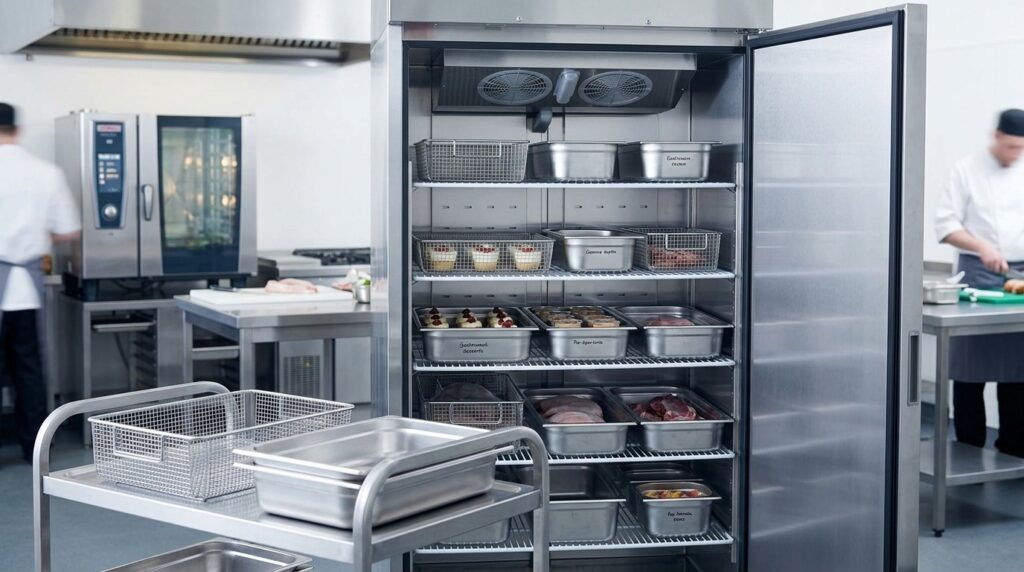
Explore GN basket planning in the Unifrost F410SS for Irish hotels. Optimize layouts for efficiency in banqueting.
Planning GN Baskets and Pan Layouts in the Unifrost F410SS Upright Freezer for Hotel Banqueting
You use your Unifrost F410SS because it gives you upright access and GN flexibility, but your layout choices decide whether service runs smoothly or staff spend the night hunting through frozen product with the door open. In hotel banqueting, the right GN basket and pan plan helps you hit pick speed, keep airflow clear, protect temperature stability, and avoid last minute shortfalls when covers jump.
This guide walks you through the real decisions you make with the F410SS day to day: when to use GN runners versus wire shelves and baskets, how to mix GN depths without choking circulation, how full to load the cabinet, and how to zone the freezer for pre production, day of service picks, backup stock, and leftovers. You will also get practical checks for setup and performance, including ambient and ventilation considerations, labelling and layout maps for rotating teams, and how to position the F410SS alongside other service equipment so you reduce steps without creating bottlenecks.
Why GN Basket Planning Matters in Hotel Banqueting
GN basket planning is less about being “tidy” and more about keeping the freezer stable when banqueting pressure spikes. A planned layout reduces door-open time, avoids blocking airflow, and makes it easier to hold safe frozen temperatures. The Food Safety Authority of Ireland notes that food can continue to be kept frozen as long as it is held below -18°C. You are far more likely to stay there when stock is zoned and spaced properly rather than packed in tight and searched through at speed.
The practical payoff is straightforward: faster picks, fewer temperature swings, and fewer compromised items when breakfast, bar food and functions are all pulling from the same storage.
Banqueting isn’t short of food, it’s short of time (and door-open tolerance)
In most hotel kitchens the freezer gets hit in bursts: pre-event prep, last-minute top-ups, and two or three people grabbing product at once. Without an agreed GN and basket plan, people stand at the open door rummaging. The cabinet then has to recover back down again while service keeps moving.
On a tall single-door upright, that search time quickly turns into unstable temperatures and a freezer that always feels like it is “catching up”.
Good GN layouts protect airflow, which protects temperature stability
Upright freezers need clear circulation paths to move cold air around the load. If deep GN pans are packed tightly, or baskets are overfilled with cartons and loose bags, you create dead spots. That is when product can freeze unevenly and cabinet temperature can drift under heavy use.
A proper GN and basket layout forces a few good habits:
leave deliberate gaps for airflow
group like-with-like so staff are not shifting pans around
avoid stuffing the back and corners where airflow is easiest to choke
A labour-saving tool for mixed-use hotel kitchens
Most Irish hotels are not running a “banqueting-only” freezer that nobody else touches. If breakfast pastries, bar food backups and banqueting portions share the same upright, you need zones that any chef, KP or agency staff member can follow without guesswork.
A simple map of what lives on runners versus shelves versus baskets cuts training time and reduces the classic problem: someone rearranges pans to make space, and the 150-cover dessert portions disappear until 6pm.
Less waste, fewer mysteries, and no panic decisions
Poorly planned freezers lead to crushed packaging, broken lids and unlabeled items migrating between shelves. That is how you end up with mystery bags, freezer burn and food binned because nobody can confirm what it is or when it went in.
A consistent GN and basket plan supports HACCP routines because rotation, labelling and stock counts are quicker and less error-prone when the kitchen is under pressure.
Turning one upright into predictable cover capacity
Banqueting planning is capacity planning in disguise. When you decide that one shelf run is always canapés, one basket is always bread backup, and one runner section is always desserts, you can scale up and down without rebuilding the whole cabinet before every function.
That predictability is what makes a single-door upright workable in a real hotel week, when conferences, weddings and Sunday lunch collide. It also sets you up for the practical GN layout rules inside the cabinet.
Key Factors in GN Layout for F410SS
How should you plan a GN pan and basket layout in a Unifrost F410SS upright freezer for Irish hotel banqueting so it holds temperature and stays workable in service?
Plan the layout around airflow first, then standardise your GN sizes so staff can pick quickly without keeping the door open. Decide early if you want a GN runner setup (fast, repeatable) or wire shelves and baskets (better for mixed packaging). Once you’ve picked a system, keep the layout consistent and test it under real service conditions. Door-opening frequency, proximity to hot passes, and ventilation clearance will decide whether it reliably holds frozen storage temperatures in practice.
1. Build the layout around airflow, not “how many pans fit”
In an upright freezer, a tidy GN plan can still create warm spots if you block the air path. Your goal is straightforward: cold air needs to move around every pan or basket and return freely, without being choked by tight packing, overhanging lids, cardboard, or a solid wall of product.
Two rules that usually stand up in busy Irish hotel kitchens:
Don’t load flush to the back. Leave a small, consistent gap behind pans and boxes so air can circulate properly.
Avoid creating a solid shelf face. Packing deep pans edge-to-edge across a full level can restrict airflow and lead to uneven temperatures across that shelf.
Most Irish operators use -18°C as the working reference point for frozen storage checks. FSAI advice also uses -18°C as a key reference for freezer temperature during disruptions (see FSAI guidance).
2. Choose GN sizes and depths that leave clear “air lanes”
GN layouts fall apart when depths and footprints are mixed without a plan. You get tall pans blocking the front, smaller pans disappearing behind larger ones, and longer door-open time while staff hunt.
For banqueting, it’s usually easier to standardise by job:
Shallow to mid-depth GN pans for items you need to pick quickly (portioned desserts, canapé components, portioned proteins).
Deep GN pans only where needed. Deep pans can act like thermal mass and slow recovery when the door is being opened repeatedly during prep.
Avoid storing pans nested inside pans unless you know they’ll be separated quickly. In practice, it often turns into extra door-open time at the worst moments, during turnarounds and late plating pushes.
3. Pick runners vs wire shelves vs baskets based on service pressure
For banqueting, GN runners are about speed and discipline. They support a “one pan, one slot” approach, which reduces searching and stops people shoving items wherever there’s space.
Wire shelves and baskets suit mixed formats like boxed desserts, frozen bread, branded packs, and awkward shapes that don’t sit well in GN. The trade-off is that baskets are easy to overfill. When a basket becomes a compressed heap, it behaves like a blocked vent.
If you use baskets:
keep contents in low layers rather than piled high
don’t let product press hard against side walls or the back
avoid “bagged items welded together by frost” by rotating and tidying little and often
Whatever route you choose, keep the logic consistent across your kitchen. In hotels using seasonal or agency staff, a simple, repeatable freezer map reduces door-open time more than any clever pan combination.
4. Match pan material and lids to handling and frost
Pan material matters in a freezer because it affects handling speed, visibility, and how much frost you end up fighting.
Stainless GN pans are durable and familiar, but rims and lids can ice up if you’re in and out all day.
Polycarbonate pans make it easier to see labels and product at a glance, but they can crack if handled roughly. They still need freezer-suitable lids if you want to reduce dehydration and freezer burn.
Two lid rules worth sticking to:
Long-term storage: favour a tighter seal to limit dehydration and ice crystals.
Short-term staging (same-day picking): favour lids that open cleanly and quickly, because that keeps door-open time down.
5. Set loading limits that protect recovery time during banqueting peaks
Upright freezers work best when they’re loaded sensibly, not packed tight. Overloading with dense product reduces usable airflow and makes it harder for the cabinet to recover when breakfast prep, bar food, and banqueting picks overlap.
A practical check 24 to 48 hours before a big function:
Confirm the cabinet is holding your HACCP setpoint consistently, and verify the reading using your normal check method.
Walk the layout top to bottom and remove anything that has drifted into air gaps or been shoved into the wrong zone.
Re-pack baskets so nothing is pressed against sides or packed above the basket line.
If frost build-up is starting to interfere with door sealing or pan removal, deal with it before service, not during service.
Once the airflow-first layout is stable, you can zone the cabinet so breakfast, bar food, and banqueting aren’t competing for the same prime shelves.
Common Challenges and Solutions
Upright freezers rely on forced-air circulation. If GN pans, lids, wire shelves or baskets are loaded in a way that blocks the air path, you can end up with uneven product temperatures, slower recovery after door openings, and alarms at the worst possible time. It’s the same basic issue the HSE highlights for fridges: if a cabinet is overfilled, air can’t circulate properly and temperature control suffers (HSE food poisoning prevention advice).
You’ll see this most in hotels during breakfast turnover and banqueting builds, where the door is opening constantly and the load is a mix of boxes, shallow GN pans and tall, lidded trays.
Air circulation problems caused by “solid walls” of GN pans and boxes
Stacking GN pans tight to the back wall, or running a full shelf of lidded pans with no gaps, can create a “wall” the fan can’t push air through properly. In practice, you’ll often see one part of the cabinet holding colder than another, and frosting building up where warm, moist air is repeatedly dragged in during busy picks.
Focus on airflow, not just how many pans fit:
Leave deliberate gaps at the back and sides.
Avoid loading full-width lids and trays as a continuous sheet from end to end.
Use heavier, stable items (boxed product, bulk frozen) as your buffer load, rather than filling every level with flat pans that block circulation.
Temperature instability when swapping between GN runners and wire shelves
Switching from wire shelves to GN runners changes how air moves around the cabinet. The same setpoint can behave differently depending on whether you’ve got open wire, baskets, or solid stainless pans. The typical symptom is a freezer that looks fine on the display, but recovers slowly after repeated openings, or has one area softening product while another over-freezes and ices up faster.
Treat the first week after a change as a setup and check period:
Log temperatures at opening, mid-shift and close for a few services.
If you see swings, reduce obstruction first (add gaps, remove solid lids where possible, avoid tightly packed flat trays) before assuming the unit is the issue.
Keep loads consistent while you’re validating, otherwise you’re chasing a moving target.
Busy-kitchen effects: ambient heat, ventilation, and door discipline
In back-of-house, upright freezers often end up beside hot equipment, boxed into a corner, or placed where staff are crossing the kitchen during service. Higher ambient heat and poor ventilation mean longer run times and slower temperature recovery after each door opening. That’s when doors get left ajar while someone searches for “the one tray”.
Solve it like an operations issue:
Give the cabinet space to breathe and keep the condenser area clean.
Standardise where items live so staff can open, pick and close in seconds.
If the door is being opened repeatedly for the same items, re-zone the load so the high-pick trays are quickest to reach.
Good loading and quick door routines usually cut temperature swing more than any controller tweak.
Tailoring GN Layouts to Banqueting Events
Arrange GN pans and baskets around service style (plated vs buffet) and time-to-service, not just what physically fits. In an upright freezer like the Unifrost F410SS, your layout should reduce door-open time, keep airflow clear, and make picking obvious for anyone on shift.
Start with a simple pick list that matches your GN pans, shelves and baskets. Then zone the cabinet by “how soon you’ll need it”, keeping service picks at eye level and bulk backup lower down. Leave clear air gaps around pans and cartons so cold air can circulate. Before a big function, confirm you are holding frozen storage temperature and that nothing is blocking airflow. Frozen food should be kept at or below -18°C for safe storage, per FSAI guidance.
1. Convert the event brief into a freezer pick plan (plated vs buffet)
Plated and buffet service create different freezer patterns:
Plated: lots of small items, frequent access, quick picks (portioned proteins, prepped sides, plated desserts).
Buffet: fewer lines in higher volume, longer door-open time during replenishment (dessert slabs, canapé trays, bread, bulk proteins).
Write the plan in kitchen terms. For each menu line, decide what format it lives in:
GN pans on runners: fastest access, easiest portion control, tidy labelling.
Wire shelf: mixed cartons, irregular packs, items you pick less often.
Basket: small boxed items that otherwise disappear behind cartons or fall into gaps.
The goal is simple: staff should know where to go without “having a look” with the door open.
2. Build cover-based GN packs that scale in real hotel conditions
Banqueting rarely lands on the exact cover number. Late adds, staff meals and organiser changes are normal. A workable approach is to standardise frozen mise-en-place into modular packs that stack neatly and can be counted at a glance.
Use a Base + Top-up method:
Base pack: your common minimum (for example, 80 covers).
Top-up pack(s): add-ons (for example, +70, +100) that can be pulled without stripping the whole cabinet.
Match the pack format to service style:
Plated: smaller, lidded GN pans or clearly separated portions so you can lift one pack and shut the door.
Buffet: fewer, deeper pans or grouped cartons by course so replenishment is one organised trip, not five scavenger runs.
3. Zone the cabinet by time-to-service and enforce door discipline
In a tall, single-door upright, temperature stability is usually lost through door behaviour, not lack of capacity. Your layout should make the right pick the quickest pick.
A practical zoning logic for Irish hotel banqueting:
Eye-level zone: day-of-service picks for the next service window.
Plated: “next 1 to 2 hours”. Buffet: “next two replenishments”.
Lower zone: bulk backup and anything you will not touch often.
Bottom and corners: avoid the “graveyard” of odd cartons. If it cannot be labelled and counted quickly, it does not earn prime space.
Door area: avoid using it for banqueting-critical items unless your team is disciplined. It sees the biggest swings during service.
4. Choose GN depths and basket use for airflow and handling (not maximum fill)
GN layout in an upright freezer is not a packing challenge. If pans are tight to the back and sides, or cartons are wedged with no air path, you will see slower pull-down after loading and slower recovery after door openings.
General trade-offs:
Plated banqueting: shallower pans and “single lift” units usually work best. Less rummaging means less time with the door open.
Buffet: deeper pans can make sense, but only if you keep clear space around them and avoid overhanging product that blocks airflow.
Baskets: useful for small boxed desserts, rolls and canapés where loose packs spread across shelves. Load baskets so air can move through them, not as a compressed block.
If you are repeatedly struggling with recovery during service, it is often a layout and picking issue before it is a refrigeration fault.
5. Standardise labelling and a shelf map so anyone can pick fast
Irish banqueting relies heavily on relief, agency and seasonal staff, especially in summer and December. If the layout only makes sense to the head chef, you will pay for it in door-open time and stock errors.
Keep it blunt and visual:
Give each shelf runner position or basket a zone code.
Every GN pan or carton label should include event name, date, pack size and zone code.
If you run multiple uprights, keep the same zone codes across units so staff are not re-learning the system under pressure.
A good test is whether a new staff member can find a top-up pack without moving other product. If your map needs constant exceptions, you are usually mixing plated and buffet storage styles in the same zone, or you have not separated service picks from backup properly.
Zoning the F410SS for Efficient Workflow
Good zoning is about two things: faster picks during service, and fewer food safety mistakes when the kitchen is busy. Treat the F410SS like a one-door stock room. Decide what each area is for, assign it physically (shelves, GN runners, baskets), and label it in the same language your team uses on prep sheets and BEOs. Keep high-touch, day-of items separate from deep backup so the door is not held open while people hunt.
Build a quick check into your HACCP routine: confirm the freezer is holding safe frozen storage temperature and that the cabinet is not overfilled to the point that airflow is compromised.
1. Define zones in plain English (and label for mixed teams)
In hotel kitchens, different people pick stock across the week. Your zones need to make sense to a night porter, an agency chef, and your pastry section without anyone having to ask.
Use names that match your operation, for example:
Banqueting day-of picks
Banqueting backup
Breakfast and bar
Allergens segregated
Leftovers and returns
Put the same wording on the freezer labels, the event sheet, and your internal product labels. If the language changes between systems, items drift, and drift is what leads to the wrong tray leaving the freezer at the wrong time.
2. Assign top, middle, and bottom by access frequency and handling risk
You get the best workflow when the most-used items sit at comfortable reach, and deep backup sits lower down where it is less likely to be disturbed.
A practical layout:
Mid-height = service pick zone for the next 24–48 hours.
Bottom = deep backup and heavy cartons so nobody is lifting frozen boxes above shoulder height during set-up.
Top = lighter, high-rotation items that should be grabbed quickly and the door closed again.
Avoid turning any “easy reach” area into a dumping ground. If it becomes a mixed zone, it stops working under pressure.
3. Match zones to production stages: pre-production, picks, backup, returns
Zoning holds up best when it mirrors your banqueting timeline.
Set a simple rule your team can follow:
Next service window lives in day-of picks.
Not needed yet stays in backup.
Anything returned goes into leftovers and returns until it is checked, relabelled, and either safely reused or discarded.
This is how you avoid pulling next weekend’s conference desserts when you meant to pull tomorrow’s wedding. Where you need a reference point for frozen storage, the FSAI notes food should remain frozen below -18°C in its guidance on frozen food storage temperatures.
4. Make zones “self-enforcing” with runners, shelves, and baskets
A zone fails when it is easy to put the wrong item in the wrong place. Make the correct behaviour the simplest behaviour.
If you use GN pans, dedicate runner levels to clear functions (starters, sides, desserts) so trays do not migrate.
If you use shelves and baskets, use baskets for loose packs and bagged items so they can be lifted out as a unit, rather than shoved to the back where they block airflow.
Keep one quarantine space for unclear labelling or damaged packaging, so it does not contaminate the logic of the rest of the cabinet.
5. Standardise a freezer map that matches covers, not just product names
Banqueting goes wrong when you store by product name but pick by guest count. Label by both when it helps decision-making, for example: “beef bourguignon portions 80” or “dessert slices 250”. The aim is to reduce counting and second-guessing at peak time.
If you run more than one upright freezer, keep the same zoning pattern across each unit, even if contents change week to week. Consistency is what stops doors being held open while someone re-learns the layout at 6pm during a wedding turnaround.
Integrating F410SS with Other Equipment
Where you place an upright freezer like the Unifrost F410SS should be driven by service flow. The aim is simple: shorter trips, less door-open time, and enough breathing space around the cabinet to run properly.
In Irish kitchens, layout is also a safety issue, not just a convenience. Under the HSA’s approach to risk assessment, you’re expected to identify hazards created by how work is carried out and reduce them, including pinch points, awkward lifts, and avoidable crossings in busy areas (HSA guidance). A layout that works for breakfast and bar food can fall apart during banqueting when pick intensity spikes and staff start queuing at the freezer with the door held open.
Put the F410SS on your fastest “pick path”
In many hotel and high-volume kitchens, a cabinet like the F410SS ends up acting as a pick freezer rather than deep storage. If that’s your reality, it belongs close to where you portion, plate, or replenish, and on a route staff can repeat without weaving through other stations.
If you hide it behind prep tables to save floor space, you usually pay for it later in extra steps, longer door-open times, and slower temperature recovery during peak periods.
A quick test is to watch two busy windows: breakfast replenishment and pre-function build. If staff have to cross a main gangway, squeeze past potwash, or cut through a KP run to reach frozen items, you’re baking delays and collision risk into every service.
Positioning near deli and service counters
If you’re running deli counters for breakfast displays, carvery, or conference breaks, keep the freezer close enough for quick restock, but not so close that the door swings into the counter’s working zone.
A few day-to-day trade-offs to watch:
Too close: staff start propping the door while they count or portion. It speeds up the job, but it’s hard on temperature stability and increases the chance of icing and nuisance alarms in warmer areas.
Too far: teams overfill counter storage “to be safe”, which can hurt rotation and increase waste, especially when different shifts cover the same counter.
In practice, the best setup is often a short, clear hop between counter and freezer, with a small landing space nearby where a crate or GN pan can be set down briefly without blocking the run.
Avoid heat sources and pinch points
A lot of “not holding temperature” complaints come back to where the cabinet is sitting and how it’s being used, rather than a fault with the freezer.
Check for:
Heat or steam nearby: dishwasher outlets, combi vents, hot holding, or direct sun through a back-of-house window in summer.
Doorway pinch points: spots where loading blocks the only route, especially during pre-event pulls when two people need to pass.
If the only available location is a tighter zone, treat it as controlled access: limit who uses it during peak, label clearly, and keep pick routines tight so the door isn’t held open during busy stretches.
Make access and cleaning realistic
A good location on paper is no use if you can’t open the door fully, remove shelves, or clean around the cabinet without shifting other kit. In hotels, deep cleans are often squeezed between events, and “we’ll pull it out later” tends to become “never”.
Allow working space to:
open the door properly for fast picks and safe loading
wipe and sanitise touch points as part of HACCP routines
keep ventilation space clear so the cabinet isn’t starved of air
Once the positioning is right, the next gain is internal setup: organise shelves and product groups so staff can pick quickly without blocking airflow inside the cabinet.
FAQs on GN basket planning for the Unifrost F410SS
How does the GN layout affect freezer airflow and temperature?
GN layout matters because an upright freezer relies on unobstructed air movement to pull product down evenly to temperature and to recover quickly after door openings.
Avoid “sealing” the air path. Deep pans pushed hard against the back, foil overhangs, and tightly stacked lids can create a solid wall that slows circulation and causes warm spots.
Leave consistent gaps. Build layouts with small, repeatable clearances around pans and baskets, especially at the back and on the sides, so cold air can return freely.
Don’t overload the door area. High-turnover items in the door zone can be convenient, but heavy loading there can increase temperature swings during service.
Use shallow pans for fast picks. Shallower GN pans (or baskets with airflow) generally recover faster after opening than tightly packed deep pans.
If you notice ice build-up in one area, slow pull-down after loading, or frequent alarms during service, the first check is usually layout and load density rather than the setpoint.
Which GN pan sizes are best for large banqueting events?
For large banqueting, the “best” GN size is the one that matches your portioning workflow and minimises time with the door open.
Use full-size GN (1/1) for batch pre-portioning when you want fewer containers to label, fewer lids to manage, and quicker stock counts.
Use smaller GNs (1/2 and 1/3) for service picks where different components are pulled at different rates. This reduces repeated thaw exposure and prevents one large pan being opened and closed all service.
Standardise two or three formats. A consistent mix (for example: 1/1 for bases, 1/2 for proteins, 1/3 for garnishes and allergens) speeds up training and reduces “where is it?” time.
Practical tip for hotel functions in Ireland: plan pans around covers per pull. If a pan will be opened more than a few times during service, consider splitting it into two smaller pans so one can stay closed as back-up.
Can I use the same GN pans for frozen storage and active service?
Yes, many kitchens do, but it works best when you set a few rules so the pans perform well in the freezer and still work at the pass.
Pick freezer-friendly lids. Tight-fitting lids reduce freezer burn and odour transfer. If you use wrap, avoid loose tails that can interfere with runners and airflow.
Separate “storage” vs “service” by condition, not by pan type. Keep a small rotation of the cleanest, best-lidded pans for longer frozen holds, and relegate dented or poorly sealing pans to short-term staging.
Limit re-freezing and repeated warming. If a pan is going to be opened frequently on the day, decant into smaller service pans and keep the main stock sealed in the freezer.
Label for cross-use. Include freeze date and intended use (e.g., “WED CONF LUNCH, PICK FIRST”) so service teams don’t dig through long-hold stock.
If you have a specific F410SS shelf/runner setup and a typical banqueting menu cycle, Unifrost can help you choose a repeatable pan mix that supports both frozen storage and fast service.
Need a GN layout that fits your exact banqueting workflow?
If you are running an F410SS for hotel banqueting, the most efficient GN basket plan is usually the one that matches your covers, pick rate, and how often the door is opened during service.
Share your typical event sizes, menu mix, and whether you are using GN runners, wire shelves, or baskets, and Unifrost’s commercial refrigeration team can recommend a practical layout and zoning plan that keeps airflow clear and reduces “search time” during peak periods.
Related Unifrost guides
Compare models, maintenance advice and support information related to this topic.
Unifrost F410SS Upright Freezer Use Cases in Irish Kitchen Settings
Explore ideal Unifrost F410SS freezer use cases in Irish kitchens. Boost reliability, reduce waste, fit menu needs. Compliant with HACCP.
Read guide
Unifrost Upright Freezer Temperature Controller: New Owner Core Overview Guide for Irish Kitchens
Learn to set up and manage Unifrost upright freezer controllers for Irish kitchens. Essential guide for safety and efficiency.
Read guide
New Owner Quick Checks for Unifrost Upright Freezer Temperature Controllers
Quick reference for setting and checking Unifrost upright freezer controllers in Irish hotel service lines.
Read guideCompare Unifrost freezer options on Caterboss
For current product options, pricing and availability, continue to Caterboss.