
Unifrost F410SS Upright Freezer: Energy Planning Guide for Irish Hotel Banqueting Kitchens
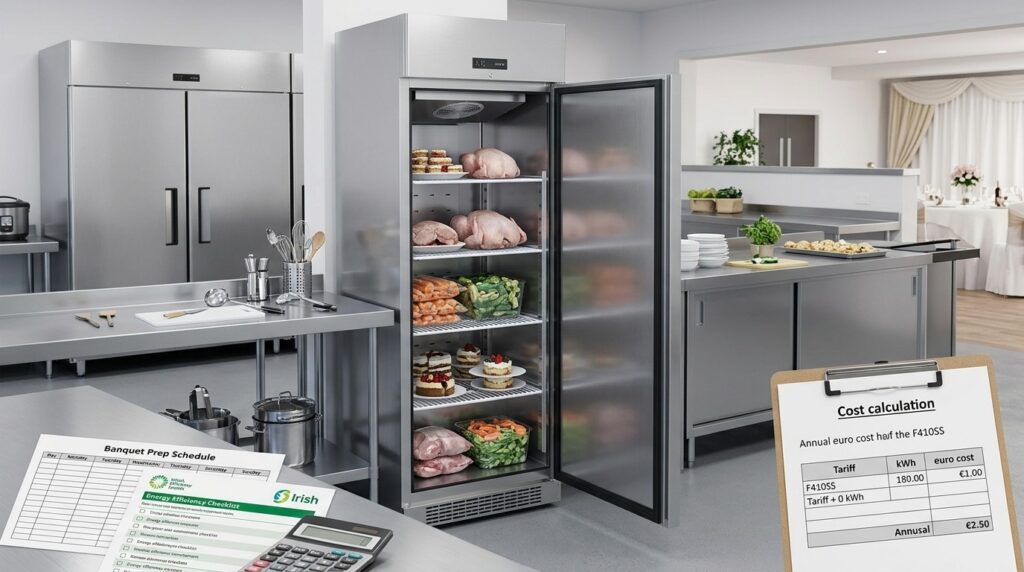
Explore energy-saving tips for the Unifrost F410SS in Irish hotel banqueting kitchens.
Unifrost F410SS Upright Freezer Energy Planning for Irish Hotel Banqueting Kitchens
You use the Unifrost F410SS when banqueting volume spikes and you need reliable frozen storage in a compact 600 mm × 600 mm footprint. The catch is that an overspill freezer can become an invisible running cost if it is sited poorly, packed badly, or left to drift out of spec.
This guide walks you through the practical checks and tradeoffs that matter in Irish hotel kitchens, including how to turn the F410SS energy label (kWh figures) into an annual euro cost using your tariff, how to size overspill capacity around weddings, conferences, and Christmas, and how to run the unit efficiently at typical -10 °C to -25 °C operation.
You will also get decision-focused advice on:
Positioning for ventilation and workflow so the freezer recovers temperature quickly after door openings
Stock zoning for banqueting prep versus service lines to cut open-door time
Simple maintenance routines that protect energy class performance and reduce breakdown risk before big events
Why the F410SS is Ideal for Irish Banqueting Kitchens
Banqueting kitchens need overspill freezing that is predictable, fast to access, and easy to keep organised under pressure. The Unifrost F410SS suits that job because it gives “400 L-class” storage in a compact 600 mm × 600 mm footprint, using a tall single-door format that’s straightforward for staff to work from.
From a food safety point of view, it aligns with standard frozen storage practice. Irish HACCP systems typically work around holding frozen food at -18 °C or colder, as reflected in FSAI guidance on frozen food storage temperatures. The key point is less about the badge on the door and more about how you site it, ventilate it, and use it during peak service. If those basics are missed, recovery time and running costs can creep up.
Why the F410SS works well as an “overspill” freezer in real hotel service
Hotel freezer demand is rarely steady. It spikes around weddings, conferences, tour groups, and seasonal trading. That’s where a single-door upright works as a practical buffer: you can place it near banqueting prep or in a nearby store and use it to take pressure off the main walk-in or larger uprights.
The day-to-day benefit is access speed. Staff can pull pre-portioned items, desserts, bread, ice cream tubs, garnish stock, or batch-cooked components without the “digging down” and lid-open dwell time that often makes chest freezers slow in a busy kitchen.
Why its format suits Irish banqueting layouts and storage limits
In many Irish hotels, the constraint isn’t just litres. It’s footprint, doorway widths, and finding space that doesn’t interfere with corridors, fire doors, or service routes. A 600 mm × 600 mm upright footprint is often easier to accommodate in older back-of-house areas and smaller satellite prep rooms than trying to squeeze in “one more big freezer”.
The stainless exterior and hygienic interior also suit the reality of banqueting. More people touch the unit, more trays and containers knock off it, and it gets more frequent wipe-downs between pushes. Surfaces that stand up to regular cleaning and busy handling make it easier to keep standards consistent when labour is tight.
Why it supports safer, calmer banqueting prep when you treat it as a system
The F410SS is specified with an approximate temperature range of -10 °C to -25 °C. In practice, most teams run overspill storage around the usual -18 °C target so product stays properly hard-frozen and stock rotation is easier to manage.
Where kitchens get caught out is workflow rather than setpoint: repeated door openings, loading warm product during a prep rush, and poor internal zoning can all pull temperatures up and push compressor run time higher.
If you position the unit to reduce unnecessary door openings and organise it so staff can lift full trays or batches in one go, you cut warm air ingress. That also makes temperature checks and exceptions easier to manage for chefs and maintenance. It’s the difference between an overspill freezer that quietly does its job and one that becomes a constant source of drift and rework during peak events.
Energy Planning for the Unifrost F410SS
Start with the two figures that let you cost it properly: the kWh per year on the energy label and your actual € per kWh from your bill. Convert that to an annual and weekly estimate, then decide if the F410SS should run year-round as overspill or only be powered up for peaks. After that, the savings come from basics that hold up in busy Irish kitchens: placement, loading discipline, and keeping door-open time down. Finally, sanity-check your estimate with a simple real-world measurement, because “it seems fine” can fall apart during a wedding week.
1. Get the two numbers that matter (kWh/annum and €/kWh)
For planning, skip the guesswork.
kWh/annum: take the annual energy consumption from the F410SS energy label. The energy class helps when you’re comparing models, but the kWh/annum figure is what you can turn into a euro cost.
€/kWh: use the unit rate from your Irish bill or supply contract, not a headline offer rate. Use ex VAT for a clean cost model, or inc VAT if you’re budgeting actual cash spend.
2. Convert the label figure into an annual and weekly running cost
Keep it simple so you can explain it to finance or engineering:
Annual running cost (€ / year) = label kWh/annum × your €/kWh
Weekly running cost (€ / week) = annual cost ÷ 52
If the freezer is mainly for banqueting peaks, run the numbers twice:
once at today’s unit rate
once at a “renewal” rate (a conservative higher €/kWh)
That gives you a sensible way to judge whether it’s worth paying more upfront for a lower-consumption alternative when you’re replacing older overspill storage.
3. Plan overspill use around events (not “sure it might be handy”)
In hotels, an overspill freezer earns its keep during weddings, conferences, and seasonal surges. If it’s being opened like a day-to-day service freezer, energy use goes up and temperature recovery suffers.
A layout that cuts door-open time:
Top zone: day-of-service pulls, clearly labelled “first out” items
Middle zone: banqueting components used across functions, grouped by date or event
Bottom zone: longer-hold backup stock and bulky packaging
Keep high-touch items near the front at a practical height. Avoid packing product tight to the back wall. You want air to move and temperatures to recover quickly after loading.
4. Set a sensible operating pattern (setpoint, loading, defrost)
Most energy savings are operational rather than technical.
Setpoint: don’t run colder than you need. The Food Safety Authority of Ireland notes frozen food should be stored at -18°C or colder in storage and distribution settings, which is a sensible baseline for HACCP routines in Ireland (FSAI temperature control guidance).
Loading discipline: don’t load warm product from prep straight into overspill storage. In banqueting, the efficient sequence is blast chill/freeze first, then transfer to the freezer. Warm loads drive compressor run time and can pull already-frozen stock up in temperature while the cabinet recovers.
Defrost and door seals: even if it’s “still freezing”, ice build-up and tired gaskets quietly increase energy use and reduce usable space. If it’s seasonal overspill, do a pre-peak reset: empty, clean, confirm the door closes cleanly, and make sure ventilation and the condenser area aren’t clogged with dust.
5. Benchmark real-world use and monitor like a hotel
Label-based costing is a planning tool. Real kitchens vary: hot prep areas, tight stores, poor ventilation, and heavy door use all change consumption.
If you can, measure actual consumption over a representative week using appropriate metering for your installation, then compare it to your planned weekly cost. Keep the monitoring routine light enough that it actually happens:
door closure and gasket condition (quick visual check)
cabinet not pushed hard against a wall
a temperature log that flags slow recovery before a busy week exposes it
Once you can put a weekly euro figure on “overspill capacity”, it becomes much easier to decide whether to add another upright, replace an older unit, or change how banqueting stock is portioned and staged.
Best Practices for Layout and Stocking
Decide what the freezer is for during the event, zone it by when you will need stock, and label it so staff are not hunting with the door open. Keep your most frequently pulled items in consistent grab zones at workable height, and load it so airflow is not choked by boxes and liners. A simple pull-down plan means you move stock once, not five times.
Before you commit high-value banqueting overspill, confirm it is holding safe frozen temperatures under real use. If it is drifting warm, you want to know early, because last-minute rework costs more than any kWh saving.
1. Build an event-first stock map (what, when, and who)
In Irish hotel banqueting, upright freezers get messy when too many teams treat them as a general store. Before a wedding or conference run, agree whether the cabinet is:
Banqueting overspill only, or
Mixed-use (banqueting plus breakfast, bar, etc.)
Then assign ownership for counts and standards. Without that, the banqueting team ends up competing for shelf space and you lose time at the open door.
Map stock by time window, not just product type. Keep T-48 to T-24 items (backup veg, pre-portioned proteins, dessert elements) where they are easy to see and audit. Put T-24 to service items in the fastest-to-reach zone so you are not unloading half the cabinet to find one tray.
2. Zone the interior to cut door-open time during peak pulls
An upright layout saves labour when it is predictable. Set up zones that match how your kitchen actually pulls stock:
Top: light, low-risk items (bread, pastry components)
Middle: main pull items for prep shifts
Bottom: heavy boxes and longer-hold stock
Create a dedicated service grab zone at chest height for anything that will be pulled repeatedly during prep (garnishes, portioned sides, plated dessert components). Keep the layout consistent from event to event so agency staff and runners can work without stopping to ask.
3. Load for airflow and recovery, not maximum fill
Overspill freezers struggle when they are packed like a skip. Avoid pushing stock hard against the back and sides, and do not block internal air paths with loose bags, overhanging cartons, or shelf liners that trap cold.
Practical habits that help:
Group like-with-like so staff can lift what they need without reshuffling.
Avoid dense stacks of GN pans or cartons that force people to drag items out to separate them.
Favour shallow, flat loads over tall piles. They hold more evenly, they are quicker to count, and they reduce the “door open while searching” behaviour that drives temperature swings.
4. Label, date, and stage pull-down stock so you touch it once
In banqueting peaks, the biggest waste is not the compressor. It is staff time and repeated door openings.
Label each item with:
Event name
Service date
Intended station (pass, veg, larder, pastry)
If you have a service lift or a satellite prep room, stage pull-down stock into lidded, stackable crates by station. Move whole crates, not individual packs. Counts are faster, time at the open door drops, and you get cleaner separation for allergens and raw versus ready-to-eat components.
5. Make temperature control part of the layout routine
Layout only works if the freezer is holding safe temperatures during busy periods. As a baseline, keep frozen food at -18°C or below, in line with FSAI guidance that food can remain frozen as long as it is still below -18°C.
https://www.fsai.ie/business-advice/running-a-food-business/caterers/flooding-of-a-food-business
Treat persistent warmer readings as an operational issue, not “just a busy week”. For peak prep, agree one simple rule: if you are portioning or sorting, do it outside the cabinet with the door closed, then reload in one go. That single habit usually does more for temperature stability and running costs than any clever rearrangement.
Positioning F410SS Freezers for Efficiency
Pick locations based on traffic and heat load first, then protect airflow around the cabinet and reduce door-open time with sensible stock zoning. Before delivery, confirm the electrical point, floor condition, clearances, and safe access routes, especially in older Irish hotels with tight corridors and service lifts. Finally, agree who owns temperature logging and basic checks so the freezer does not become an unmanaged overspill box that quietly wastes energy.
1. Map the real access pattern, not the org chart
In a banqueting hotel, overspill storage often fails when it is technically “near the kitchen” but awkward during weddings, conferences, and December peak.
Place the F410SS where it supports the highest-frequency pulls with the fewest steps. In practice, that is usually close to the banqueting prep area and on a short, straight run to portioning benches and the blast chilling flow, rather than beside the pass. If you rely on service lifts, prioritise a position that avoids staff having to prop the door while trolleys queue. A slightly longer walk is often cheaper than a chaotic pinch point.
2. Keep it out of heat and steam zones that drive the compressor
An upright overspill freezer only runs efficiently if it is not fighting the room all day.
Avoid siting it beside combi ovens, dishwash exits, potwash, hot holds, or in direct sun from a loading-bay door. The biggest day-to-day energy waste in working kitchens is warm, humid air being dragged into the cabinet repeatedly. It increases icing, slows recovery, and makes the compressor work harder. If the only available space is warm, treat it as a layout issue to solve with distance and shielding, not by lowering the setpoint and hoping for the best.
3. Protect ventilation and service access so it stays maintainable
Efficiency is not just the label. It is whether the unit can reject heat properly and be cleaned and serviced without being dragged out mid-season.
Leave practical access to clean around the unit and to check door gaskets, hinges, and the areas where dust and flour build up. Do not box the freezer into tight joinery or stack packaging tight to the cabinet sides. Restricted airflow and poor access are what push sites into “run it until it struggles” mode, usually discovered the day before a function. If you want placement that supports compliance-friendly routines, choose a spot that makes regular checks and records realistic. For quick-frozen foods, temperature monitoring requirements apply in relevant contexts under S.I. No. 370/1995.
4. Zone stock inside the freezer to cut door-open time
Overspill freezers often become a library of frozen surprises. That costs labour during prep and costs money in energy.
Give the easiest-to-reach shelves to the items you pull most often for banqueting, such as pre-portioned mains, veg garnishes, sauces, or backup breakfast items, depending on your menu. Put slow-moving stock and seasonal items higher or lower so staff are not holding the door while reading labels. If multiple teams use the unit, agree simple rules and tie them into your HACCP routine. A “who checked and when” discipline is easier to keep up when you already use standard records like the FSAI Safe Catering Pack Recording Form 2 (refrigeration).
5. Choose the right overspill location in multi-storey hotels
Multi-storey hotels get caught by a simple chain: distance increases door-open time, and door-open time increases temperature drift and icing.
If prep is on one level and function service is on another, place the F410SS where it reduces rework. That usually means nearer the prep and blast chilling flow, with planned pull-downs to smaller point-of-use freezers closer to service, rather than asking one upright to do everything. When placement is right, it is also much easier to compare running costs and make a sensible keep-or-replace decision on older units.
Maintenance Tips for Optimal Performance
To keep a Unifrost F410SS upright freezer dependable in a busy Irish hotel banqueting kitchen, focus on three things: temperature control you can trust, clear airflow so it can dump heat, and door discipline to reduce icing. Build the checks into HACCP and close-down so they still happen during wedding season and Christmas pressure. Slow pull-down, heavy icing or repeated temperature swings are early warnings. Deal with the cause before the next peak event finds it for you.
1. Confirm it’s holding a safe frozen temperature in real use
The setpoint is only part of the picture. Use a calibrated probe between packs (not in free air), compare it to the cabinet display, and log it at the same time each day. You’ll spot drift before it turns into stock loss.
After a power cut or a period of heavy door opening, re-check product temperature before you rely on it. For incident decisions, the FSAI guidance around frozen food remaining safe when held at or below -18°C is a useful reference point in an Irish kitchen context (Food Safety Authority of Ireland guidance).
2. Keep the condenser and ventilation paths clear
In hotels, overspill freezers end up beside dry stores, cardboard, linen cages, or a floury prep area. Dust and fluff build-up makes heat rejection harder, which means longer run times and poorer recovery.
Keep the intake and exhaust areas clear of boxes, cling film and packaging that creeps in behind units.
If access allows, clean the condenser area gently with a soft brush and vacuum.
Avoid bending fins, and don’t blast components with water.
3. Manage icing with planned defrosts and better door habits
Upright freezers hate long door openings. Warm, moist air gets pulled in during banqueting prep, and that moisture becomes ice. Ice reduces usable space and slows cooling.
Defrost before performance drops. In practice: pick a defrost window after a run of functions, move stock temporarily if needed, and make sure the cabinet is fully dry before putting it back into service.
4. Check the door seal, hinges, and closing action (where most losses start)
A freezer that doesn’t shut cleanly becomes a constant temperature and energy problem, and it’s easy to miss because it still sounds like it’s “working”. Check the gasket for splits, flattened corners and debris, and clean the mating surfaces so the magnetic seal can grip properly.
Also check the cabinet is level. If staff have to lift or slam the door, fix it early. Poor closing action leads to gasket damage, icing and longer recovery times right when you need the freezer most.
5. Load it like a banqueting freezer, not a cupboard
Airflow matters more than squeezing in one extra box. Don’t block internal air paths and avoid packing product hard against the back or sides.
If it’s being used as overspill, zone it by urgency:
Fast-grab items higher and towards the front.
Bulk or long-hold items lower and further back.
You’ll reduce door-open time during prep and late-night returns.
6. Use a maintenance rhythm both kitchen and maintenance can follow
Daily: log temperature, check the door closes fully, clear anything blocking airflow inside the cabinet.
Weekly: wipe the gasket and door frame, tidy the area around the freezer for ventilation, watch for unusual ice build-up.
Monthly (more often in dusty areas): clean the condenser area, check hinges and handle fixings, review logs for slow drift or recurring warm spikes.
If the freezer is critical for peak banqueting, agree ownership. Kitchen staff usually spot issues first. Maintenance can stop repeat problems by dealing with seals, ventilation and access for cleaning.
7. Treat repeated alarms or slow pull-down as faults, not “one-offs”
If recovery is consistently slow after loading, or frosting returns quickly after defrosting, assume a root cause: restricted ventilation, poor door sealing, loading practice, or the way the unit is being used during service. Fixing the basics is cheaper than writing off food, and it avoids the classic failure where the freezer limps along until the busiest weekend of the year.
When the routine is consistent, energy use becomes more predictable too, because the freezer is operating normally rather than fighting avoidable losses.
Connecting Unifrost Freezers to Broader Kitchen Planning
In an Irish hotel, an upright freezer like the F410SS works best as part of the site’s cold-chain and workflow plan, not as a handy “extra freezer”. Your food safety baseline needs to be consistent across banqueting, breakfast and functions. FSAI HACCP guidance expects frozen food control to be managed and verified like any other critical step, including holding food at safe temperatures and recording checks (FSAI HACCP guidance).
How you use the cabinet will depend on layout and trading patterns. Door openings, lift journeys and where portioning happens can affect temperature stability and labour time as much as any spec sheet.
Where the F410SS fits in a hotel freezer strategy
In many hotel banqueting setups, a tall single-door upright suits “overspill with control”. It gives you organised access close to production when volume spikes for wedding weeks or conference runs, without pushing everything back to the cold rooms.
Operationally, it can be easier than a chest freezer during service pressure because:
stock is visible and countable for ordering and HACCP checks
rotation is more straightforward
you can pull specific items without unloading half the cabinet
The real planning question is not “how many litres?”, it’s “what problem is this freezer solving?”:
True overspill: prioritise fast access for pre-portioned, labelled batches and quick stock checks.
Daily production freezer: treat it as a core asset, with tighter discipline on loading, cleaning and maintenance. Otherwise it turns into the kitchen’s miscellaneous freezer, and performance usually follows.
Positioning it across the hotel: banqueting, prep rooms and service lifts
Hotels lose more time to poor placement than to small differences between freezer models. If the F410SS is meant for banqueting overspill, put it where it reduces lift runs and repeated door-opening during build-up days, not where it happens to fit on delivery day.
A practical rule is to decide who “owns” it day to day:
If banqueting owns it, keep it within their prep footprint. Breakfast and bar overflow should be the exception, not the default.
If it’s shared, agree a simple zoning rule so staff are not searching while the door is open and warm air is flooding the cabinet.
Stock zoning inside the cabinet to reduce door-open time
You get the best day-to-day results when each shelf level is planned around a job, not just a food type. In banqueting, that often means zoning by access timing:
build-up stock (days before)
day-before pulls
day-of service items
Keep the most frequently accessed items at the most comfortable height. Put heavier, slower-moving items lower down. This is about temperature recovery as much as tidy shelving. Upright freezers are sensitive to warm air exchange, so poor organisation can show up quickly as soft product at the edges, slower pull-down and longer run time during peak weeks.
Connecting to other Unifrost solutions without overbuying
An upright freezer is for storage and access. It is not a replacement for process equipment if your real constraint is safe throughput or speed of chilling. If you are turning banqueting product quickly, “correct chilling process plus stable storage” is usually a better plan than adding storage alone.
In practice, that means making sure the freezer receives product that is already properly chilled, packaged and labelled. It reduces moisture and ice issues, keeps stock rotation cleaner, and helps the cabinet operate more consistently.
A second consideration is standardisation. If you keep a consistent “upright freezer class” across departments, you make it easier to:
train teams on one loading and cleaning routine
compare performance between areas
simplify support conversations with your service contractor
Making it engineer-friendly: shared responsibility and simple checks
Overspill freezers tend to fail at the worst possible time because they are the easiest to ignore until the busy weeks hit. The fix is shared ownership:
Kitchen teams: loading discipline, hygiene, clear labelling and not blocking internal airflow.
Engineering/maintenance: door seals, airflow around the unit, and keeping heat-exchange surfaces clean.
Agree what “not normal” looks like early (icing, damaged seals, persistent temperature alarms, doors not closing cleanly). That turns the freezer into a managed asset rather than a hidden risk that only shows itself at Christmas or during a big conference run.
FAQs: Unifrost F410SS upright freezer energy planning for Irish hotel kitchens
What temperature should a commercial upright freezer like the Unifrost F410SS be set to for safe frozen food storage in Irish kitchens?
For day to day frozen storage, set the cabinet so the product temperature stays at or below -18°C.
Practical approach in busy Irish hotel and banqueting kitchens:
Target setpoint: start around -20°C to give headroom for door openings and loading.
Verify with a probe: check core product temperature (not just the cabinet display), especially after deliveries and after large prep loads.
Overspill use: if the freezer is mainly opened in bursts (post blast chill, pre event pull downs), keep the setpoint stable rather than “chasing” colder settings. Colder setpoints can increase running cost without improving food safety once you are already holding at -18°C or below.
If you are using the F410SS in its typical operating range (approximately -10°C to -25°C), aim for consistent holding at -18°C or colder at product level as your key control point.
Why is my upright freezer (e.g. F410SS) not reaching or maintaining the set temperature?
Work through these checks in order, as most temperature issues are installation, loading, or maintenance related rather than “faulty from new”:
Confirm airflow clearance and room conditions: ensure the freezer has space for ventilation and is not pushed tight against walls or boxed in. In warm plant rooms or cramped stores, performance can suffer.
Check the door seal and closing: look for splits, gaps, or food packaging preventing a full close. A weak seal causes constant warm air ingress and frost build up.
Look for heavy frost or iced up internal surfaces: static cooled cabinets are sensitive to moisture. Too much frost reduces cooling and increases energy use. Defrost if needed and review door opening habits.
Loading and “warm stock”: large loads of fresh or not fully chilled items can pull the cabinet up for hours. For hotel banqueting, try to blast chill and harden product before transferring to overspill storage.
Stock blocking airflow: avoid packing cartons tight to the back and sides. Leave space around shelves/baskets so cold air can circulate.
Cleanliness: dust and grease on the condenser area (where applicable) reduces heat rejection and cooling capacity. Add condenser cleaning to your routine.
Controller and alarms: verify the setpoint, any high temperature alarm, and that the display is reading realistically by cross checking with an independent thermometer.
If those checks do not resolve it, gather the model and serial number, note the ambient temperature, and record a 24 hour temperature log. That information makes troubleshooting faster for service support.
What are the pre‑purchase checks for the F410SS?
Before ordering an F410SS for an Irish hotel kitchen or banqueting overspill store, confirm these practical points:
Footprint and access route: it is a 600 mm × 600 mm class upright, so measure doorways, service corridors, lift sizes (if going to another floor), and the final placement space including ventilation clearance.
Capacity suitability: it is commonly chosen as a compact “400 L class” freezer (about 361 L gross). Map the items you will hold (e.g. banqueting portions, breakfast backup, function desserts) and confirm this is enough for your peak weeks.
Installation location: avoid positioning beside ovens, dishwashers, or in direct sun. Choose a stable ambient area and allow for airflow so it can hold temperature efficiently.
Usage pattern match: the F410SS is ideal for overspill and medium duty storage. If you need rapid recovery with very frequent service line openings, consider whether you need additional freezer capacity or a different cabinet type.
Materials and cleaning: stainless exterior and ABS hygienic interior are well suited to hotel back of house cleaning routines. Confirm your team can access all contact points for wiping and defrosting.
Power and commissioning plan: ensure a suitable socket and that someone is responsible for initial checks, temperature verification, and adding it into HACCP logs from day one.
Next step: match the freezer to your hotel’s overspill plan
If you are planning overspill capacity for weddings, conferences, or Christmas peaks, it helps to step back and map where the freezer will sit, who opens it, and what stock cycles through it before you pick the final cabinet size.
For wider options beyond the F410SS footprint and duty level, see Explore Unifrost’s Commercial Fridges and then speak with a specialist about translating your event calendar and tariff into a realistic energy plan.
Related Unifrost guides
Compare models, maintenance advice and support information related to this topic.
Optimizing Irish Café and Deli Setups: Unifrost F410SS Upright Freezer and DCF Deli Counter Workflows
Optimize workflow in Irish cafés with Unifrost's F410SS freezer and DCF deli counter. Practical examples for efficient service.
Read guide
Unifrost Upright Freezer Temperature Controller: Wiring, Probe Replacement – Owner vs Engineer Guide for Irish Kitchens
Learn if Unifrost upright freezer probe replacements can be self-done, how wiring differs by model, and when to call an engineer in Irish kitchens.
Read guide
Adjusting Unifrost Upright Freezer Door Handles in Irish Kitchens
Guide for Irish kitchens on adjusting Unifrost upright freezer door handles to ensure proper sealing and energy efficiency.
Read guideCompare Unifrost freezer options on Caterboss
For current product options, pricing and availability, continue to Caterboss.