
Unifrost Cold Topper GN Pan Size, Depth & Divider Compatibility Guide for Irish Prep Lines
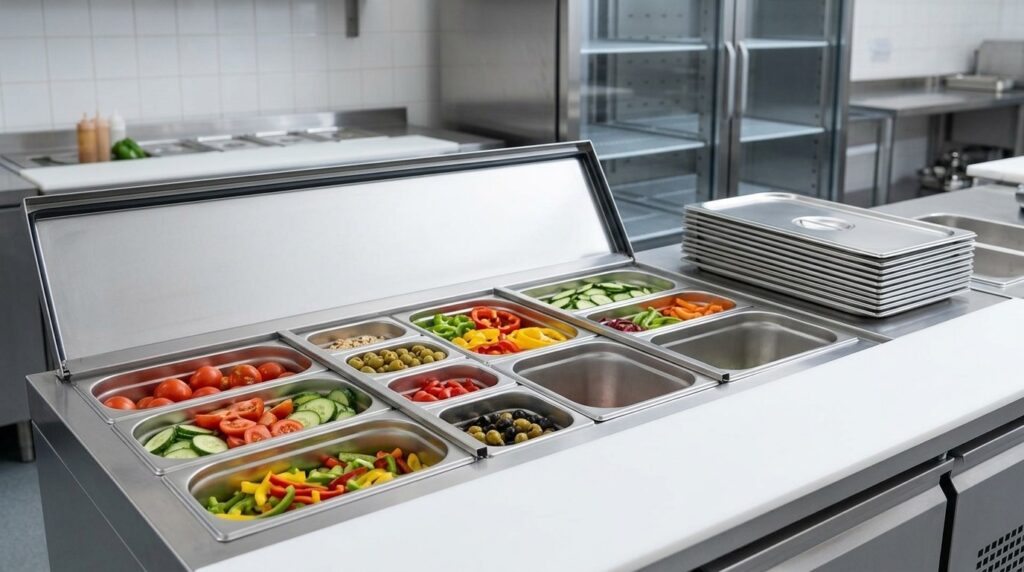
Explore GN pan compatibility for Unifrost cold toppers, ensuring efficient service in Irish hospitality.
Unifrost CTG & CTS Cold Topper GN Pan Size, Depth and Divider Compatibility Guide
You use a cold topper to keep toppings service-ready without slowing the line, but the wrong GN pan size, depth or divider setup creates gaps, warm spots and constant lid opening. This guide helps you match standard GN (gastro-norm) pans to Unifrost CTG and CTS cold toppers so your pizza, salad, deli or sandwich station runs faster and stays inside HACCP targets.
You will work through the practical checks that matter before you buy or retrofit pans, including:
Which GN pan sizes and common layouts fit CTG and CTS models, and what mixed-size combinations typically work under the factory lid.
What to assume about supply: the refrigerated well and cover usually come as the unit, while GN pans and GN lids are normally bought separately so you can choose sizes and depths.
How to choose pan depth for your menu, balancing portion capacity against cooling performance and recovery during busy Irish service.
When you need dividers, spacers or a consistent layout to stop pans drifting, tilting or leaving air gaps.
How to standardise GN pans across your Unifrost cold topper and other GN-based prep storage so staff can swap pans without re-portioning.
Why GN Pan Compatibility Matters for Irish Commercial Kitchens
GN compatibility matters because a cold topper is only as good as the pans you can load, swap, cover and portion at service pace, without gaps, wobble or workarounds. It also supports food safety control. The FSAI notes that chilled foods should be kept so the food itself is between 0°C and 5°C as part of temperature control in catering businesses (FSAI temperature control guidance).
The key point is that “it fits the GN footprint” is only the starting point. Pan depth, fill level, how often the cover is opened, and whether you leave spaces in the well can be the difference between stable holding temperatures and warm spots during a busy lunch or late-night rush.
Why standard GN pans make service faster on pizza, deli and salad lines
Unifrost CTG and CTS cold toppers are built around standard gastronorm pans. That keeps you flexible when menu items change, portion sizes shift, or you need to re-balance mise en place for service.
In practice:
You can run shallow pans for speed and visibility on a pizza line, then switch to deeper pans for salad or deli, as long as your cover still closes properly.
If your cold room, upright fridge, prep counter and topper all use GN pans, staff can move product from storage to the line (and back) without decanting. That saves labour and reduces handling on higher-risk chilled foods.
Why “does the lid close properly?” is the real compatibility test
Most compatibility issues show up mid-service. The cover will not sit down because pans are sitting proud, mixed sizes leave gaps, or a pan is slightly off-square on the rails. Even where the GN size is technically correct, poor seating leaves air gaps. Every time the lid is opened, warm kitchen air drops into the well, and that is when you need the fastest recovery.
It’s also worth planning for how these units are typically supplied. Cold toppers are generally sold as the refrigerated well plus lid or cover, with GN pans and pan lids bought separately. That is not a downside. It lets you choose the pan mix that suits your menu. It does mean you should confirm your intended layout will still seal and sit properly, especially if you plan to mix sizes like 1/3, 1/4 and 1/6 across the same run.
Why depth and fill discipline affect temperature stability and running costs
A cold topper is for holding already-chilled ingredients during service, not pulling product down from warm. Deep pans, overfilling, or heaping ingredients above the chilled zone makes it harder to keep consistent product temperature across the line. It also tends to increase compressor run time as the unit has to recover after repeated openings.
For day-to-day control on an Irish toppings line, keep it simple:
Pre-chill pans and product before loading.
Keep the lid closed whenever you can.
Avoid leaving empty GN spaces where warm air can drop into the well.
Once you have that discipline in place, you can make a more reliable call on which CTG or CTS layout suits your menu, and how many pans you can realistically run without fighting the cover or temperature stability.
Unifrost CTG and CTS Models and Their GN Pan Layouts
Unifrost CTG and CTS cold toppers are refrigerated countertop wells built to take GN (Gastronorm) pans in a fixed row. They are used to keep high-turn ingredients portioned and within reach during service.
When a listing talks about the “GN layout”, it is really telling you two things:
Which GN fraction the well is designed around (for example, GN 1/4).
How many pans fit across the opening under the supplied lid/cover.
GN sizes are standard, but the cut-outs, rails and lid on a specific topper are made for a particular arrangement. If you start mixing sizes, it only works properly when you use the right divider/support bars and the lid still closes without leaving gaps.
CTG/CTS model layouts (what fits across the well)
Across Irish commercial listings, these CTG/CTS units are commonly shown as GN 1/4 layouts, with the unit length determining how many GN 1/4 pans fit across:
Unifrost CTS1200: commonly listed as 5 × GN 1/4 pans (pans typically purchased separately)
Source: Caterboss CTS1200 product listing
Unifrost CTG1400: commonly listed as 6 × GN 1/4 pans
Source: Caterboss CTG1400 product listing
Unifrost CTS1400: commonly listed as 6 × GN 1/4 pans
Source: Caterboss CTS1400 product listing
Unifrost CTG1500: commonly listed as 6 × GN 1/4 pans
Source: Caterboss CTG1500 product listing
Practical note: online listings can carry over older text. If you are ordering a full set of pans and lids, confirm the pan count against the unit’s current documentation or the supplier spec.
Unifrost CTS1500: commonly listed as 7 × GN 1/4 pans
Source: Caterboss CTS1500 product listing
Unifrost CTG1800: commonly listed as 8 × GN 1/4 pans
Source: Caterboss CTG1800 product listing
What “compatibility” means if you mix GN sizes
If your CTG/CTS is specified as a GN 1/4 unit, treat that as the “native” opening pattern the rails and lid are designed for.
You can sometimes split a position into smaller fractions (for example, two GN 1/8 pans in place of one GN 1/4), but only if:
the pans are properly supported (so they do not tilt or drift), and
the lid/cover still closes cleanly.
In day-to-day use, you will know the layout is wrong when the lid does not sit down properly or you have gaps around pan rims. Those gaps let warm air in and you usually see it first at the end pans during a busy service.
Service reality: the layout only matters if the unit holds temperature under pressure
Cold toppers are for holding chilled ingredients during service, not for pulling product down from room temperature. Your pan layout needs to match your turnover and how consistently the lid is kept closed.
For chilled prep items like pizza toppings and salad ingredients, Unifrost CTG and CTS cold toppers are typically used around +2°C to +8°C.
Source: Unifrost CTG/CTS temperature range FAQ
Once you have the right pan count across the line, the practical decision is usually about pan depth and rotation: load smaller pans more often if you are fighting temperature creep, and keep backup stock in a proper storage fridge rather than trying to make the topper do both jobs.
Common Mistakes in Pan Utilisation
How you load GN pans in a cold topper matters more than most teams expect. Gaps between pans, “high spots”, or a lid that will not sit down properly all let warm air into the well. You usually see it first as toppings softening or drying at the surface and at the ends, then it shows up in your HACCP checks when service gets busy. Irish guidance is to keep chilled foods at 5°C or below, including during service holding, as set out by the Food Safety Authority of Ireland.
The usual mistakes are simple, but the knock-on cost is not:
Wrong pan depth: ingredients sit above the chilled zone, so the top layer warms fastest.
Overfilling: the lid can’t close cleanly, so the unit is constantly fighting air ingress.
Mixing GN sizes without spacers: pans drift, leaving gaps and uneven airflow.
Adding warm refills: dropping product in straight from ambient prep slows pull-down and pushes other pans out of temperature.
Leaving empty sections “just in case”: unused spaces leak cold and reduce recovery speed after each lid opening.
All of these slow temperature recovery during peak service, increase compressor run time, and can force you into moving product back to undercounter storage mid-shift to get control back.
Get the basics right first, then plan a GN layout that matches the length of your cold topper and the way you actually serve. A “one size fits all” pan plan rarely works across different lines or menus.
Compatible GN Pan Depths and Recommended Dividers
Compatible GN pan depths for Unifrost CTG/CTS cold toppers are the depths that sit fully into the refrigerated well and still let the cover close properly. That matters because these units are built for cold holding during service, not pulling down warm product quickly. Your best depth depends on turnover, how often the lid is opened, and whether pans sit level and stable on the rail.
A useful reality check: deeper pans are not automatically “better”. They often lead to overfilling and slower temperature recovery when the cover is being opened repeatedly.
GN pan depths that suit Irish prep lines
On busy Irish pizza, kebab, deli and salad counters you are usually balancing two competing needs:
Enough volume that you are not refilling constantly.
Shallow enough that food stays consistently cold from top to bottom through a rush.
In practice, many operators land on shallow-to-mid depths (often 65 mm or 100 mm) for high-use toppings, because smaller product mass is easier to keep in spec and rotate. Deeper pans can suit lower-turn items, but only if they still sit properly in the well and you are not expecting the topper to rapidly chill fresh stock.
If you are setting HACCP targets, focus on the food temperature in the pan, not just the controller reading. The FSAI notes chilled food should be kept between 0°C and 5°C in refrigeration. See: FSAI temperature control guidance.
Practical fill guidance (what actually keeps food cold)
There is no magic “safe fill line” that suits every kitchen, but the day-to-day rule is straightforward:
Do not heap above the pan rim.
Keep the cover closed whenever the line is not actively being used.
For high-volume toppings, split across two smaller pans and swap a fresh cold pan in from an undercounter fridge, rather than topping up a pan that has already warmed on the line.
This matters even more where the cold topper sits near a pizza oven, grill or pass, where radiant heat and constant lid opening will push temperatures up.
Divider and spacer use (stability and temperature consistency)
Dividers and spacer bars are not there to “make pans fit”. They help you:
Stop pans drifting or tilting on the rails.
Avoid gaps that let cold air spill, creating warm spots at the ends and corners.
Keep mixed GN fractions (for example 1/6 or 1/9) seated tightly under the cover.
CTG/CTS cold toppers are designed around standard GN pans, so mixed layouts can work well, but only if everything is properly supported and there are no open slots left mid-service.
Divider setups to avoid (because they create warm spots)
Two common issues cause most temperature complaints on prep lines:
Gaps or missing-pan spaces: an open slot is an air leak and a warm patch waiting to happen.
Raised or proud pans: if a pan sits even slightly above the rail line, heat gain increases and the cover becomes far less effective, especially in a hot kitchen.
If you want predictable holding, treat the well like a sealed system: tight fit, cover down, no voids.
Quick checks staff will follow
Keep it simple and consistent:
Probe a high-risk, high-turn topping at the start of service and again at peak.
Visually confirm the cover closes fully and pans are sitting level.
If temperatures creep up, the fix is usually workflow (lid discipline, smaller pans, faster rotation from a counter fridge), not turning the thermostat down and hoping for the best.
Once you settle on pan depths and a divider approach, you can standardise a GN layout that suits your CTG/CTS length and menu without fighting the cover and rails.
Best Practices for Irish Menu-Based GN Layouts
To set up GN pans in Unifrost CTG/CTS cold toppers for an Irish pizza, salad, deli or kebab line, start with service reality, not the menu sheet. Split ingredients into high-turn and low-turn, then choose GN sizes and depths based on what you need to get through your busiest 30 minutes without overfilling pans or leaving the lid open. Once you have a layout, trial it in a real service and take a few temperature checks. A layout that looks tidy at prep can fall apart when hands are in the well every 20 seconds.
1. Sort ingredients by service pressure (high-turn, medium-turn, garnish)
Build the GN layout around what gets hit hardest during a rush. If mozzarella, cooked chicken, taco mince, sliced tomatoes or mixed salad are being lifted constantly, they usually deserve more pan space. That reduces lid-open time, stop-start refills and the gaps that let the well warm up.
A practical way to decide is to watch one busy spell and note what runs low first. Put high-turn items into larger GN formats (often 1/3 or 1/2 within a mixed layout), medium-turn items smaller, and garnish items smallest so you are not binning wilted product at close.
2. Choose GN sizes that match portioning and restock speed
Standard GN compatibility is only useful if the pans suit how you portion and replenish. Pizza and kebab lines often run better with fewer, larger pans for core items, because the cover is opened less often. Salad and sandwich prep can suit more smaller pans, where range and allergen separation matter and you do not want too much stock sitting out at the line.
Sanity check it with one question: can one person restock that pan quickly without disrupting service? If topping up means leaving the lid open while someone goes digging in the walk-in, the pan is too large, too deep, or in the wrong spot on the line.
3. Pick GN depths that support temperature control during peak
Depth is a trade-off. Shallow pans usually recover temperature faster after repeated opening. Deep pans reduce refilling, but they also make it easier for staff to mound product above the chilled zone.
In Ireland, many operators set their HACCP routine around chilled food being held at 5°C or below in normal operation, in line with FSAI guidance on chilling and cold holding. In practice, choose the shallowest depth that survives your rush, then train a clear “fill line” so food is not heaped above the rim.
If you do need deeper pans for one or two very high-turn items, keep them where the cold holding is most stable on your counter. In real kitchens, edges and corners can be more exposed to warm air, heat sources and passing traffic.
4. Use mixed GN sizes, but make sure the lid closes cleanly every time
A mixed layout of 1/3, 1/6 and smaller pans can work well for Irish mixed menus, but only if everything sits level and the topper cover closes without rocking or leaving gaps. The operational standard is simple: the lid should shut easily, even when staff are moving fast and not lining pans up perfectly.
If you are using existing pans, do a dry-fit before you commit. Check GN rims sit square, pans do not wobble, and any individual pan lids do not interfere with the topper’s cover. This is also where you decide whether you will run individual GN lids during service, or rely on the topper cover and keep pan lids for storage and transfers.
5. Plan for daypart changes without rebuilding the full line
If you run lunch salads and evening pizza in the same footprint, plan two repeatable “modules” you can swap quickly. A lunch layout often needs more smaller pans for range and allergens. An evening pizza layout typically benefits from fewer, larger pans for speed and consistency.
Standardise where each ingredient lives. When positions change day to day, you get longer lid-open time, more spills into the well, and more temperature drift that comes back to bite you at HACCP check time.
6. Train the routine: pre-chill, lid discipline, quick checks
Cold toppers are holding equipment, not rapid chillers. Your day-to-day routine does the heavy lifting: pre-chill product and pans before loading, keep the cover closed whenever hands are not actively serving, and avoid leaving empty gaps where cold air spills and warm kitchen air drops in.
Keep HACCP checks realistic and repeatable. During peak, probe one high-turn pan and one low-turn pan, record the results, and act on trends rather than chasing a single odd reading. If temperatures are consistently hard to hold, fix layout and behaviour first, then look at equipment setup and where the unit sits on the line. That is also the point where the exact supported GN configuration of your specific topper matters.
Connecting GN Pans Across Unifrost Products
If you want GN pans to move between a cold topper, a prep counter and a saladette without re-portioning, you need a standard that works in your kitchen, not just on paper. Pick a small set of GN sizes and depths, check they sit properly in each unit, and then lock in a simple “load, cover, swap” routine that staff can follow under pressure.
1. Standardise GN sizes around your menu and service pace
Start with what actually moves quickly on your line. Pizza, kebab, deli and café setups in Ireland often run best when you repeat smaller GN pans for high-turn items (so you swap pans, not portions) and keep larger pans for base ingredients or bulk prep.
Unifrost cold toppers in the CTG/CTS range use standard GN pans rather than proprietary containers. GN pans are typically purchased separately, which is handy, but it also means you need to decide your own house standard for pan size, labels, lids and where each pan lives.
2. Get the depths right so pans transfer cleanly
Depth is where most “it fits” plans fall apart in day-to-day use. If your topper is set up for shallow service pans but your prep counter stores everything in deeper pans, you will end up transferring product at the pass, with more food sitting open and warm during changeovers.
For HACCP routines, choose depths that let you move food cold and covered. It is fine to batch-prep in deeper pans elsewhere, but your service well usually runs better with smaller, faster-turn pans that are swapped more often. The goal is fewer open transfers and less time at ambient. FSAI guidance is a useful reference point here: chilled food should be kept at 5°C or below in normal operation.
Source: https://www.fsai.ie/business-advice/food-safety-controls/temperature-control
3. Decide how you’ll cover pans, and keep it consistent
Pick one approach and make it easy for staff to do the right thing:
Individual GN lids on pans (strong for prep, storage and changeovers)
Rely on the cold topper’s main cover during service (fast access, but needs discipline)
A mix of both (only works if everyone understands when each applies)
If you use individual lids for storage, check they still allow pans to sit correctly in the well. You are looking for pans that don’t rock, tilt, or prevent the topper cover from closing properly.
4. Set a simple “swap plan” between stations
Write down, in plain language, how a pan moves through your day: where it’s prepped, where it’s chilled, when it goes to the line, and where it goes back to when the rush drops. This prevents the common takeaway and café habit of topping pans living on the line “just in case”.
Keep it practical:
Label shelves by GN size and depth so anyone can grab the right replacement
Keep a defined “next up” section in your prep counter or saladette
Treat the cold topper as service-only, not long-term storage
Standardising pan sizes only pays off when the replenishment rhythm and storage locations are just as consistent.
5. Train loading discipline and back it up with quick checks
Even a perfect GN plan fails if pans are loaded badly. Make these non-negotiable:
Pans seated properly on the supports
No overfilling (food should not sit proud of the rim)
Cover closed whenever you’re not actively serving
Keep checks simple and repeatable: one at opening, one mid-service, one at close-down, recorded as part of HACCP. If you notice warmer spots after changing your layout, treat it as a loading, airflow or lid-discipline issue first. On toppings lines, that is usually where the problem starts.
Once your standard sizes, depths and routine are agreed, it’s much easier to match CTG and CTS cold topper lengths to the GN layout you actually want to run in service.
FAQs on GN pan fit, depths and day to day use
What GN pan sizes fit in each Unifrost cold topper model?
Unifrost CTG and CTS cold toppers are built around standard GN footprints, so the safe way to confirm fit is to plan the well as a set of full-width GN “modules” (typically GN 1/3 or GN 1/4 across, depending on the unit’s rail set) rather than assuming a specific pan count from the model name.
Because exact pan-per-model layouts can vary by rail kit and revision, the practical approach is:
Measure the usable opening left-to-right and front-to-back (between the pan support rails), then map it to GN standards.
If you are ordering new pans, standardise on one “module size” (most prep lines use GN 1/3 or GN 1/4) and then choose depths to suit your menu.
If you already own pans, list them by GN size and depth and check they sit flat on the rails and allow the lid to close without fouling.
If you share your model (CTG1400, CTG1500, CTG1800, CTS1200, CTS1400, CTS1500) and what GN sizes you want to run (for example 1/3 and 1/6), Unifrost.ie can confirm the correct rail configuration to match your intended layout.
Are GN pans and lids included or sold separately with Unifrost toppers?
In most cases, Unifrost cold toppers are supplied as the refrigerated well plus the factory lid/cover, and GN pans and individual GN lids are purchased separately.
That is usually an advantage on an Irish toppings line because you can:
choose GN sizes that suit your menu (pizza, kebab, deli, salad)
choose GN depths that match your portioning and replenishment cycle
mix stainless vs polycarbonate pans depending on durability and visibility needs
If you are quoting a full setup, specify how many pans and what depths you need so everything arrives ready for service.
Can different GN pan sizes be mixed under the factory lid?
Yes, mixed GN sizes can work as long as they still make up a complete GN grid with no open gaps and nothing sits proud of the rail level.
Practical rules that prevent lid issues and warm spots:
Build mixed layouts using GN fractions that sum cleanly across the opening (for example, combinations of 1/3 with 1/6, or 1/4 with 1/8).
Avoid leaving “dead space”. Open gaps leak cold air and can lead to uneven product temperatures.
Keep pan rims fully supported on the rails. If a smaller pan needs an adaptor bar or spacer, use one.
Don’t overfill. For best holding performance, keep product below the pan rim so the lid closes properly and cold air can circulate.
Operating temperature for CTG/CTS in service: for food safety and quality, most operators target a chilled holding band around 0°C to +4°C at product level. Setpoints can vary with kitchen heat load, lid opening frequency and how full the pans are, so verify with a calibrated probe and log checks for HACCP, especially during busy periods.
Next step: match your cold topper to the rest of your prep line
If you are standardising pans across storage and service, it is worth planning your cold topper alongside the rest of your refrigeration so GN sizes can move from fridge to prep without re-portioning.
Browse Unifrost’s wider range of commercial refrigeration to build a consistent setup across your kitchen: Explore Commercial Fridges.
View Unifrost fridges at Caterboss
For current product options, pricing and availability, continue to Caterboss.