
Adjusting Unifrost Upright Freezer Door Handles in Irish Kitchens
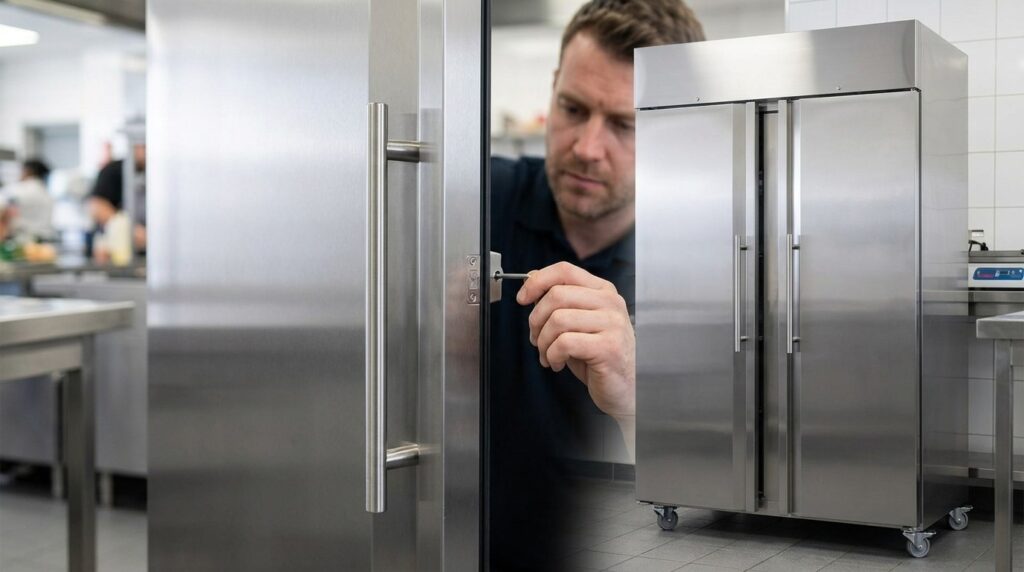
Guide for Irish kitchens on adjusting Unifrost upright freezer door handles to ensure proper sealing and energy efficiency.
Unifrost Upright Freezer Door Handle Adjustment: Fix Loose Handles, Latches and Poor Seals
If your Unifrost upright freezer door handle is loose, the latch does not pull the door in, or the door bounces back open, you risk warm air leaks, ice build up, and higher running costs. In a busy Irish kitchen, that quickly turns into wasted labour on defrosting, inconsistent storage temperatures, and avoidable call outs.
This guide walks you through the practical checks and adjustments that usually solve the problem on common Unifrost upright models such as the F410SS, F620SV, F1000SV, and F1300SV or F1310SV. You will learn how to tell whether the real issue is the handle and latch, hinge alignment, cabinet levelling, or a worn magnetic gasket, and which order to tackle them in so you do not chase symptoms.
You will also see when it is sensible to tighten and realign hardware in house versus when you should stop and bring in a refrigeration engineer, plus how to plan preventative checks and source field replaceable handles, hinges, and lock parts through Caterboss spares when damage is beyond adjustment.
Understanding Common Issues with Unifrost Upright Freezer Doors
Busy kitchens are hard on freezer doors. Most handle, latch and sealing problems come down to mechanical wear, the cabinet sitting slightly out of level, or hinges drifting out of alignment over time. When that happens, the door can look “shut” but the magnetic gasket is not sealing evenly, so the unit pulls in warm, moist air every time it runs.
That matters for food safety as well as running costs. Frozen food needs to stay properly frozen, and you should be working to the -18°C standard in your HACCP checks. If you want the reference point in black and white, the FSAI sets out frozen storage expectations for food businesses (see the FSAI guidance pages: https://www.fsai.ie/business-advice/running-a-food-business/caterers/flooding-of-a-food-business). The practical point is simple: a door that is not sealing properly makes temperature control harder, especially under heavy opening during service.
A “door problem” is rarely one single fault. It is usually a mix of levelling, hinge play, gasket condition and day-to-day handling. Fixing only the handle, for example, will not solve it if the cabinet is twisted or the gasket is flattened.
Handle and latch issues you’ll actually see on site
The common complaints are straightforward:
The handle feels loose or flexes when you pull it.
The latch no longer pulls the door in tight.
The lock turns, but the door can still spring back open.
In practice, these issues often start with repeated high-force openings at peak times, pulling from the end of the handle rather than square-on, or using the door as a lever when baskets or trays snag on the way out. Even a few millimetres of misalignment can mean the latch meets the strike, but the gasket never gets properly compressed.
Seal and hinge symptoms that get blamed on “a broken handle”
A dirty, torn or permanently flattened magnetic gasket will leak air even if the handle and lock feel fine. Typical signs include:
Uneven frost lines around the frame
Ice build-up heavier on one side or in one corner
A door that bounces back because it is meeting resistance before it seals
Hinge issues can feel like handle trouble because the first thing you notice is at the handle. If the cabinet is slightly twisted, the door can sag, the latch misses its strike point, and staff start slamming it to get it to catch. That quickly accelerates wear across hinges, latch and handle.
Why these problems increase ice build-up and running costs
If the latch is not pulling the door fully home, warm kitchen air gets drawn into the cabinet. The moisture in that air freezes onto the evaporator area and around the door. Over time you get reduced airflow, slower pull-down after openings, and longer compressor run time.
In Irish kitchens, humidity from dishwashing and cooking makes this worse. A marginal seal turns into a daily nuisance: heavier ice, more time clearing it, more temperature fluctuation during service, and the odd “mystery” alarm or inconsistent product condition.
Treat door closing and sealing as first-line maintenance. It is not cosmetic. It is one of the quickest ways to protect performance before you start chasing more complex faults.
First Steps to Diagnose Freezer Door Problems
Start with the simple mechanical checks, in order: cabinet level, seal contact all the way around, hinge movement and alignment, then the handle/latch pull-in. Do these checks with the cabinet stocked as normal. A loaded door can sit differently to an empty one, and you want to diagnose the real working condition, not a “perfect” empty-cabinet scenario.
Once you know what’s actually failing, you avoid overtightening fixings and masking the real issue, like a twisted cabinet or a damaged gasket.
1. Confirm the cabinet is level (and not twisted)
If an upright freezer is slightly racked, the door can look “nearly shut” but still leak at one corner. This is common on older tiled floors, uneven screed, or where regular wash-down has affected how the feet sit.
Check it like this:
Press gently on opposite front corners. If it rocks, the feet are not bearing evenly.
Look at the gap around the door. If the gap is wider at one end (top vs bottom), that often points to cabinet twist rather than a “bad handle”.
If the unit has been pulled out for cleaning recently, start with levelling before you blame the seal.
Practical note: if the freezer is tight to a wall or boxed in, it can end up wedged on a pipe, cable trunking, or a floor lip. That twist will fight the door seal no matter how much you adjust the handle.
2. Check the seal with a quick “paper test” around the perimeter
A good seal should grip evenly all the way around. Warm, moist kitchen air leaking in drives ice build-up around the door and increases running time. Basic maintenance guidance regularly flags replacing damaged seals as part of energy housekeeping, for example in the SEAI SME energy efficiency guide.
Do this check:
Close the door on a strip of paper (a receipt is fine) at the top, hinge side, handle side, and bottom.
Pull the paper. If it slides out easily in one area but grips elsewhere, you’re looking at uneven contact. That often comes back to levelling or hinge alignment.
Inspect the gasket for splits, hardening, sections pulled out of the retainer, or heavy ice that’s physically holding the gasket off the frame.
If the gasket is greasy (common near fryers or busy pass areas), clean and dry it before you judge it. A film of grease can stop the magnet gripping properly and make a sound seal look “weak”.
3. Spot hinge alignment issues: sag, rubbing, or uneven closing force
Hinge problems usually show up as movement or geometry issues, not just a draught at the seal.
Signs it’s mainly hinge alignment:
The door drops slightly as you open it, or you have to lift it to get it to close cleanly.
The door edge rubs the cabinet face, or you can see scrape marks near a bottom corner.
The seal feels tight at the top but loose at the bottom (or vice versa), even after cleaning the gasket.
If you’re at the “something’s sagging” stage, don’t compensate by cranking the handle tighter. You will usually just stress the latch and chew fixings.
4. Check the handle, latch, and lock pull-in last
Only move to the handle and latch once the unit is level and the seal and hinges look broadly right. A loose handle or latch can stop the door pulling fully into the magnetic gasket, especially when staff are closing it quickly during service.
What to look for:
The door meets the frame but “bounces” back open a few millimetres.
Excess play in the handle before it engages.
A latch/lock tongue scraping or sitting off-centre, which encourages staff to force it and loosens fixings further.
In shared kitchens, the lock often gets used as a door pull. That habit can loosen mountings even when the locking parts themselves are still fine.
5. Know when to stop and call an engineer
Call a refrigeration engineer if the door issue comes with any of the following:
Product temperatures rising or struggling to recover after openings
Heavy ice build-up around the door area or frame
The cabinet face deforming near hinge mounts
Stripped hinge fixings, sudden door drop, or a door that needs force to close
Forcing a misaligned door can crack liners or damage how the gasket seats, turning a simple adjustment into a bigger repair.
Once you’ve narrowed it down to level, seal contact, hinge alignment, or handle/latch pull-in, you can make a clean adjustment or order the right part without guessing.
Adjusting Your Freezer Door Handle and Latch
If the handle feels loose or the door won’t latch properly on a Unifrost upright freezer (F410SS, F620SV, F1000SV, F1300SV/F1310SV), check the basics first: cabinet levelling and door alignment. A freezer that’s slightly twisted on the floor can make a perfectly good latch feel unreliable. Once you know the cabinet is sitting square, tighten the handle fixings, inspect the latch/lock for wear or debris, and adjust the strike so the door pulls evenly onto the gasket. Finish by checking the seal, because a small air leak quickly becomes ice build-up and higher running costs.
1. Make it safe and take the load off the door
Do this at a quiet moment and let staff know the freezer is out of use for a few minutes.
Switch the unit off at the isolator (or unplug it if that’s your setup). Remove any heavy product from the door shelves so you’re not fighting the weight while you work. Avoid using the handle as a brace or “grab rail”. Tall uprights can flex if they’re pulled around by the door, and that turns a latch issue into a hinge and seal issue.
2. Check levelling first (often the real cause of “won’t latch”)
Before you touch the handle or strike, make sure the cabinet is sitting solidly.
With the door open, gently rock the unit. If it moves, adjust the levelling feet until it’s stable, then try the close again. In older buildings, basements, and kitchens with quarry tiles, small floor dips can throw a tall upright out of square enough to affect the latch.
3. Tighten the handle fixings (firm, not forced)
Loose handles are usually just fixings working loose over time from heavy daily use.
Open the door and locate the handle mounting points. Tighten evenly so the handle sits flat and doesn’t bind. Stop once it’s solid. If a screw starts spinning without tightening, you’re at risk of stripping the fixing and turning a quick job into a parts replacement.
4. Check the latch and lock for simple mechanical problems
If the handle is solid but the door still won’t stay shut, focus on the latch/lock engagement.
Look for obvious wear, a bent latch tongue, or a lock cam that isn’t travelling fully. Clean away any grease, crumbs, or ice around the latch area. Even a thin film of fat can stop the latch seating properly, and the usual next step in a busy kitchen is slamming the door, which only loosens things again.
5. Adjust the strike so the door pulls onto the gasket
If the latch is rubbing or only catching intermittently, the strike plate is usually slightly out of position.
Look for scuff marks to see where it’s contacting. Loosen the strike plate or receiver just enough to move it, nudge it in small increments, re-tighten, and test. You’re aiming for a close that’s firm but not aggressive, with even gasket compression. A millimetre or two is often the difference between “bounces open” and “stays shut”.
6. Test the seal (and confirm this isn’t a gasket or hinge issue)
Once it latches, confirm it’s actually sealing.
Close the door on a strip of paper and pull gently. If it slips out easily in one area but grips elsewhere, you still have an alignment or gasket issue. That’s not just a nuisance. It affects temperature stability, increases ice build-up, and pushes up running costs. SEAI notes that poor maintenance alone can increase refrigeration energy use by up to 10%: https://www.seai.ie/sites/default/files/publications/SME-Guide-to-Energy-Efficiency.pdf
7. When to stop and call an engineer (or order spares)
Bring in a refrigeration engineer if the door is dropping on the hinge side, the hinge area is loose, the cabinet looks twisted, or you can’t get a consistent seal after levelling and strike adjustment. Also stop if the lock action is grinding or sticking internally. Forcing it usually breaks parts at the worst possible time.
If a handle or lock is cracked, missing, or repeatedly working loose even after tightening, it’s generally more practical to replace it with correct spares supplied via Caterboss/Katerbay than to improvise fixings.
Once the handle and latch are sorted, take it as a useful clue about the bigger picture: cabinet levelling, hinge alignment, and gasket condition. These are the things that decide whether a freezer stays efficient and reliable in daily service.
When to Consult Professionals for Freezer Door Issues
The right response depends on whether you have a straightforward door hardware problem, or a refrigeration fault presenting as a “door issue”. In Ireland, there’s a clear line between basic mechanical checks you can do on-site and any work that involves the sealed system. The EPA guidance on F-gas qualifications is the reference point here. Tightening a handle is one thing. Anything that could involve leak checking, recovery or repairs to the refrigeration circuit is for certified personnel only.
Source: EPA guidance on training and qualifications for ODS and F-gases
A lot of “won’t stay shut” complaints are genuinely hinges, alignment or gaskets. But don’t ignore the possibility that cabinet twist, hinge wear, or icing from performance problems is the real driver.
The hard line: what you can do in-house vs what needs a qualified engineer
If the issue is limited to external door furniture, you can usually troubleshoot safely in-house:
Tighten a loose handle or latch hardware (without forcing threads).
Check the lock tongue or strike plate is not fouled with debris.
Clean the mating surfaces around the frame.
Re-level the cabinet so the door isn’t fighting gravity or a twisted footprint.
Once symptoms point to cooling performance, stop treating it as a “quick handle adjustment”. If you suspect refrigeration-side problems, book a qualified refrigeration engineer rather than risking downtime, stock loss, or non-compliant work.
Call a refrigeration engineer if any of these show up during a door/handle complaint
The freezer is slow to pull down, alarming, or product is soft even though the door appears to close.
Ice is building up rapidly inside, especially around the evaporator area, or returns quickly after a defrost.
The door “bounces” open from pressure, and cooling performance is also poor.
The frame is unusually warm, there’s heavy sweating/condensation, or it looks like more than a simple gasket problem.
Hinges are cracked, the door has dropped, the cabinet is deforming, or the unit has been stressed (for example, the door used as a lifting point).
The unit was moved recently and now trips electrics, runs hot at the condenser area, or struggles to hold temperature.
When a “simple adjustment” becomes a reliability and HACCP risk
In a busy Irish kitchen, a door that isn’t sealing cleanly is not just a nuisance. Warm air and moisture get pulled in, ice builds up, and run-times climb. That’s when you start seeing temperature drift during service, noisy fans, and stock problems in the warm spots of the cabinet.
If you’re keeping HACCP temperature records, repeated out-of-range readings that line up with door trouble are a reason to escalate early. A competent engineer can quickly separate a closure problem (hinges, levelling, gasket) from a performance problem. It also stops the usual spiral of staff pulling harder on the handle, which tends to accelerate hinge wear and misalignment.
What to tell the engineer (to avoid a second visit)
When you book the call-out, give enough detail for a first-time fix:
The unit model details from the rating plate.
Whether the door is lockable, and whether it is currently latching.
When the issue started, especially if it followed delivery, relocation, a deep clean, or a manual defrost.
Then share what you can see without tools:
Where the gasket isn’t making contact (top, bottom, hinge side, latch side).
Whether the door self-closes smoothly or needs to be pulled tight to latch.
Any visible ice pattern or condensation around the frame.
Those observations usually point quickly to levelling, hinge wear, gasket failure, or a refrigeration-side issue that’s showing up as a door complaint.
Decommissioning and disposal: when locks and latches need extra care
If you’re taking an upright freezer out of service, treat locks and latches as a safety item, not just scrap. Remove keys from circulation and make sure the door can’t latch shut again before it leaves site, particularly if it will sit in a shared yard or waste area.
If the unit is being collected for recycling and may still contain refrigerant, don’t allow anyone to cut pipework or open the refrigeration circuit on-site. Make the cabinet safe and accessible, and leave refrigerant handling to properly qualified personnel.
At that point, it’s worth stepping back and doing a few quick checks to confirm whether you’re dealing with a door-hardware nuisance or a bigger fault, starting with the simplest, lowest-risk observations.
Preventive Maintenance Tips for Unifrost Freezer Doors
Keep your Unifrost upright freezer doors closing and sealing properly by sticking to a simple routine: confirm the cabinet is level, tighten hinge and handle fixings, keep the latch and strike area clean, and only lubricate where metal parts bind. Make small adjustments early, then recheck the close and seal each time. One change, like levelling feet, can shift hinge alignment.
If you spot a bent hinge, cracked handle, or a lock that’s starting to jam, schedule a parts swap rather than forcing it mid-service. That’s how “the door won’t stay shut” calls start.
1. Set an inspection cadence that suits service pressure
In busy Irish kitchens, door hardware usually gives trouble from repeated hard use, not simply from age. You’ll get better results from short, regular checks than relying on an annual deep clean.
For Unifrost upright freezers, a practical rhythm is:
Weekly: quick visual check and wipe-down (seal contact, door closing, obvious looseness)
Monthly: “spanner check” on hinges, handles, latches, and lock fixings when the unit is quiet
Inspect sooner if the freezer is used constantly during prep, or if it sits on uneven flooring that can gradually twist the cabinet.
2. Keep the cabinet level so the door isn’t fighting gravity
A lot of door issues start at the floor. If the cabinet is leaning or rocking, the door can swing open, bounce, or start rubbing. Staff then pull harder on the handle, and fixings loosen.
Check levelling with the unit lightly loaded, and don’t store product in the door while you adjust.
Set the feet so the cabinet is stable with no rocking.
Confirm the door closes smoothly and stays shut without needing a “lift” or a shove to catch.
Make sure the cabinet isn’t being pushed out of square by a wall, kerb, or pipework. Clearance matters as much as levelling.
3. Check hinges for looseness and early wear before the seal suffers
Open the door halfway and lift gently at the handle side. If there’s play, or the door drops, you’re looking at hinge wear or loose fixings.
Tighten accessible hinge fasteners evenly and re-test the swing.
Watch for the door sitting low on the latch side. That often shows up first as a poor seal at the top corner.
Catching this early helps avoid moisture ingress and ice build-up, which then increases run time and turns a small door issue into a running-cost and performance problem.
4. Tighten handle, latch and lock fixings, and keep the strike area clean
Handles and latches loosen because they’re the only parts everyone grabs, often with wet hands or gloves. When a handle shifts, the latch geometry changes and the door can feel shut but not actually catch.
Standardise the routine:
Handle: no wobble, fixings snug
Latch and strike plate: clear of crumbs, ice, labels, and detergent residue
Lock: turns smoothly without force; the key should never be used like a lever
If you use the lock for access control in a shared kitchen, keep a simple key log. It reduces “mystery damage” from the wrong key being forced.
5. Lubricate sparingly, and only where it won’t cause contamination
Most door mechanisms need very little lubricant. Too much attracts dust and flour, then turns into sticky paste.
Use a food-safe lubricant sparingly on metal pivot points and moving latch parts only.
Wipe off excess.
Keep lubricant off the gasket and plastic surfaces.
Avoid spraying inside the cabinet.
After lubricating, open and close the door several times and confirm the latch engages cleanly every time.
6. Train staff: don’t lift or move the unit by the handle, and don’t slam doors
A lot of door damage is behavioural. Pulling a tall upright by the handle or door edge loads the hinges and can twist the cabinet. “Double slamming” finishes off loose fixings quickly.
If you need to reposition a freezer, plan it as a proper move with the right equipment, in line with Irish manual handling requirements that employers use mechanical means where practicable under the Safety, Health and Welfare at Work (General Application) Regulations 2007, Regulation 69.
Day to day, coach staff to close the door firmly once, and not to hang off the handle while chatting or plating. It’s basic stuff, but it saves seals, hardware, and service calls.
Energy Implications of Properly Adjusted Freezer Door Systems
A properly adjusted upright freezer door makes a direct difference to energy use and ice build-up.
When the door is level, hinges are aligned, and the handle or latch pulls the door fully closed, the magnetic gasket seals evenly. That stops warm, moist kitchen air being drawn into the cabinet. In practice, you’ll see:
Lower compressor run time because the freezer is no longer constantly trying to pull temperatures back down.
Less frost and ice on the evaporator and around the door frame, because you have less moisture getting in and freezing.
If the door isn’t achieving “positive closure” (it closes and seals by itself every time), the knock-on effects show up quickly in an Irish kitchen: heavier frost, doors getting harder to shut, and product temperatures drifting during busy service when the unit is opened more often. Uneven floors and doors being leaned on during a rush are common causes.
From a HACCP point of view, this is basic control and maintenance. A poor seal increases temperature instability and creates more defrost demand. Getting the door alignment back to square is usually a quicker, cheaper fix than living with icing and high run hours. It also helps you diagnose the real issue sooner if the problem is actually a damaged gasket or a hinge that’s starting to fail.
Connecting to the Unifrost ecosystem for reliable maintenance
The right fix depends on whether you’re dealing with normal door wear (handle, lock, strike plate, hinges) or a refrigeration problem that’s being made worse by a poor seal. Either way, it matters in Irish food businesses because stock protection and compliance both hinge on stable temperatures. The FSAI notes that freezers in food businesses should be maintained at -18°C or colder in its Temperature Control guidance.
The practical point is that a “small” door fault can look like a temperature fault. If the door is not pulling in tight, warm moist air gets in, you see more ice build-up, and the compressor ends up running longer than it should.
What Unifrost supports well on upright freezer doors (and why it matters day to day)
Unifrost upright freezers commonly used in Irish kitchens, including F1000SV / F1000SVOG, F1300SV / F1300SVNOG, F1310SV, F410SS / F410SSOG and F620SV, take plenty of abuse in service. Doors get yanked at peak, staff lean on handles while calling orders, and locks often end up being used for “access control” in shared kitchens.
Where it pays to stay within the Unifrost ecosystem is simple: these uprights have lockable doors and serviceable door components available as spares via Caterboss/Katerbay. That lets you treat door hardware as planned maintenance, instead of running a compromised seal for weeks and then wondering why the cabinet ices up.
Using Caterboss/Katerbay spares properly (so you fix it once)
The difference between a quick, clean fix and an ongoing “door won’t stay shut” problem is usually whether you replace the part that’s actually worn. Tightening a loose handle may solve a simple fixing issue, but repeat complaints are more often down to hinge wear, a worn latch interface, or tired lock components.
When ordering, keep it disciplined so you don’t end up with the wrong part:
Confirm the exact model from the rating plate (for example F410SS vs F410SSOG), then verify door handing and whether there’s a lock fitted before ordering through Caterboss/Katerbay.
If the door has started dropping, look at hinges and related fixings at the same time as the handle or lock. Swapping only the handle can still leave you needing to lift the door to get it to latch.
Replace fasteners that are rounded, stretched, or repeatedly loosening, especially on high-traffic routes (hotels, canteens, busy prep areas). Reusing problem fixings is a false economy.
When to adjust in-house vs when to call a refrigeration engineer
Basic handle and lock tightening is usually fine for in-house maintenance, as long as you’re not removing panels, interfering with electrics, or forcing the door against the cabinet.
Where operators get caught is using the lock as a pull point to overcome misalignment. That can bend latch parts, crack handle mounts, and turn a minor issue into a door that never seals properly.
Bring in a refrigeration engineer (or your service partner) if you’re seeing any of the following:
Heavy icing
Temperature drift
Sweating around the door frame
The door only closes when you physically lift it
Those symptoms can still start with alignment, but they can also point to failing hinges, a cabinet that’s out of square, or a unit under strain that needs a proper mechanical and refrigeration check.
Building a simple maintenance routine your staff will actually follow
In most Irish kitchens, door damage is not a one-off. It tends to come from the same patterns: overloading door racks, forcing the door past protruding stock, or dragging the cabinet during cleaning and not re-levelling it.
What works is a light routine that fits into opening checks and HACCP habits:
Quick visual check that the gasket is making even contact
A feel check that the latch engages cleanly without slamming
A simple rule: nobody moves the freezer by pulling the handle or the door edge
Once you’ve got that baseline, you’ll spot early signs of misalignment quickly, and you’ll be in a better place to act before “bouncing back open” becomes a temperature and ice-build problem.
FAQs on Unifrost upright freezer door handle adjustment and door closing issues
How can I tell if the problem is the door seal, hinge alignment, or the handle/latch on my freezer?
Use a quick split-check:
Seal (gasket) issue: Look for tears, hardened corners, or food debris. Do a paper test: close the door on a strip of paper at the top, sides, and bottom. If it slides out easily in one area, the seal is not gripping there.
Hinge or cabinet alignment issue: The door rubs the frame, sits high on one side, or you see an uneven gap around the perimeter. If the door swings open by itself, the cabinet is often out of level.
Handle/latch or lock issue: The gasket looks fine but the door needs a push to “catch”, or it pops back open after closing. You may feel play in the handle, or the latch/lock tongue does not fully engage.
If you can make the seal hold by manually pulling the door tighter at the handle side, the cause is usually latch/handle adjustment or hinge sag, not a failed gasket.
What should I check first when an upright freezer door is not closing or staying shut?
Start with the checks that fix most call-outs in busy kitchens:
Obstructions: Trays, shelf lips, packaging, or ice build-up preventing the door from closing fully.
Cabinet levelling: Confirm the unit is stable and not twisted. If it rocks, adjust the feet so the cabinet sits square.
Gasket cleanliness and contact: Wipe the gasket and the cabinet mating surface. Check for splits or flattened sections.
Handle and lock tightness: Grab the handle and try to move it up, down, and out. Any movement suggests fasteners have loosened.
Hinge play: With the door open, lift it gently from the handle side. If you feel noticeable vertical movement, the hinge fixings may be loose or worn.
Do levelling and a basic clean before adjusting hardware. A twisted cabinet or debris on the gasket can mimic a hinge or latch fault.
When should I call a refrigeration engineer instead of trying to adjust the door hardware myself?
Call a refrigeration engineer (or service support) when:
The door won’t seal even after levelling, cleaning the gasket, and checking for obstructions.
You see ice building up rapidly around the frame or the unit is struggling to hold temperature, which can indicate airflow/defrost or refrigeration-side issues rather than hardware.
Hinges are cracked, bent, or pulling out of the cabinet, or the door has dropped far enough to risk damaging the liner.
The lock/latch mechanism is jammed, seized, or the key turns but does not actuate correctly.
You suspect the cabinet is twisted from movement/impact or the door has been used as a lifting point.
If you do attempt minor adjustments, keep it to tightening accessible fasteners and levelling. Avoid forcing hinges or drilling new holes on a commercial cabinet.
How do I adjust or tighten the door handle and lock on a Unifrost upright freezer when it’s loose or not latching in a busy Irish kitchen?
For Unifrost upright freezer door handle adjustment, focus on two things: removing play in the handle and ensuring the latch/lock engages cleanly.
Make it safe: Move product away from the door, then work with dry hands and tools. If staff traffic is heavy, put the freezer temporarily “out of use” to stop the door being pulled mid-adjustment.
Check for looseness: Open the door and inspect the handle and lock area for visible movement.
Tighten the handle fixings:
Most commercial handles use through-bolts or screws accessible from the inside edge or the back of the handle trim.
Hold the handle square to the door and tighten evenly so it sits flat without twisting.
Confirm latch/lock engagement:
Close the door slowly and watch whether the latch meets the strike point cleanly.
If it only catches when you lift/pull the handle, you likely have door sag (hinge wear/loose hinge) or the latch alignment is out.
Reduce friction: Clean away grease and food residue around the lock and latch area. If permitted for your site, apply a small amount of food-safe silicone lubricant to moving latch parts. Avoid oil that can attract dirt.
Re-test: Close the door from a normal working distance. It should latch without needing a second push, and the gasket should grip uniformly.
If the handle still works loose quickly, the threads may be stripped or the handle/lock components may be worn. On Unifrost uprights such as F410SS/F620SV/F1000SV/F1300SV/F1310SV, field-replaceable handles, hinges, and lock parts are typically available via Caterboss spares.
What maintenance schedule should I follow to inspect and lubricate Unifrost upright freezer hinges, locks, and door mechanisms?
A simple schedule keeps door hardware reliable and helps protect the seal.
Daily (close down)
Wipe the gasket and frame where it contacts.
Quick visual check for packaging or ice stopping full closure.
Weekly
Check the door closes and latches first time without a shove.
Inspect handle tightness. If staff report “door popping open”, investigate immediately.
Monthly
Check cabinet levelling and that the unit doesn’t rock.
Inspect hinges for play by gently lifting the door at the handle side.
Clean around the lock and latch area.
Quarterly (or more often in high-use kitchens)
Re-torque accessible hinge and handle fixings.
Apply a light, food-safe silicone lubricant to hinge pivot points and latch moving parts if required. Wipe off excess so it does not attract grime.
Annually
Review gasket condition and door alignment as part of planned preventive maintenance. If handles, hinges, or lock parts are worn, replace rather than over-tightening.
Tip: add a quick “door check” to your HACCP or opening checklist. A freezer that does not latch cleanly is usually an early warning sign of higher running costs and ice build-up.
Next step: choose parts and upgrades that keep doors sealing properly
If your door is still not latching consistently after levelling and basic tightening, it is often quicker to match the right frozen storage cabinet or plan for replaceable door components that suit your service routine.
Browse Caterboss’s Frozen Storage category to compare commercial options and identify the most practical route for long-term door reliability in an Irish kitchen.
Related Unifrost guides
Compare models, maintenance advice and support information related to this topic.
Unifrost F410SS Upright Freezer: Energy Planning Guide for Irish Hotel Banqueting Kitchens
Explore energy-saving tips for the Unifrost F410SS in Irish hotel banqueting kitchens.
Read guide
Unifrost Upright Freezer Temperature Controller: Wiring, Probe Replacement – Owner vs Engineer Guide for Irish Kitchens
Learn if Unifrost upright freezer probe replacements can be self-done, how wiring differs by model, and when to call an engineer in Irish kitchens.
Read guide
Optimizing Irish Café and Deli Setups: Unifrost F410SS Upright Freezer and DCF Deli Counter Workflows
Optimize workflow in Irish cafés with Unifrost's F410SS freezer and DCF deli counter. Practical examples for efficient service.
Read guideCompare Unifrost freezer options on Caterboss
For current product options, pricing and availability, continue to Caterboss.