
Optimal Temperature Settings for Unifrost Saladette Prep Counters
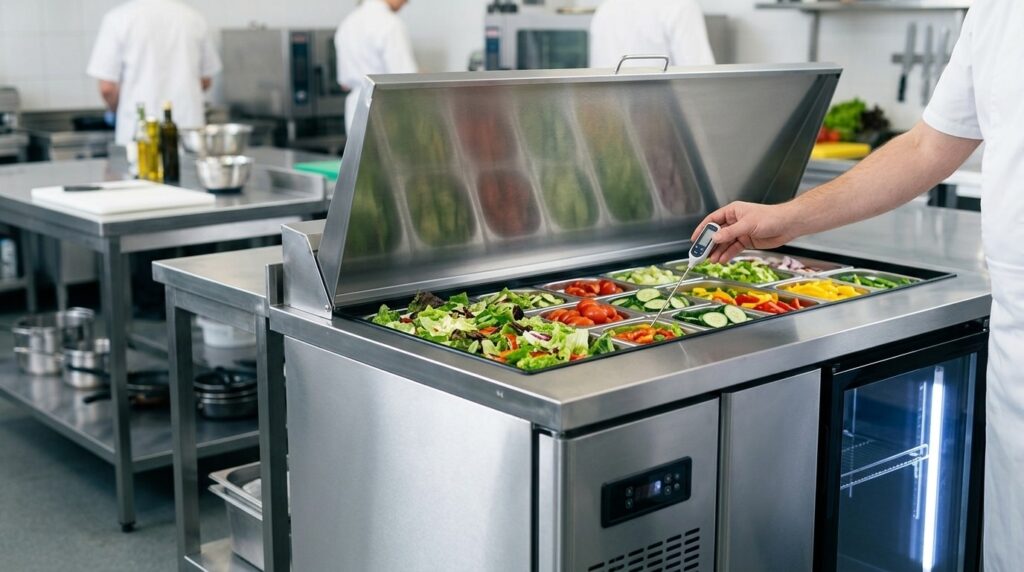
Learn how to set and maintain Unifrost saladette fridge temperatures for food safety in Irish kitchens. Ensure optimal performance.
Unifrost Saladette Temperature Settings: Setpoints, Checks and Troubleshooting for SA900GS and SA136G
If your Unifrost saladette is set too warm, you risk food safety failures and shorter shelf life. Set it too cold and you can freeze delicate ingredients, waste product, and make the unit work harder than it needs to.
This guide focuses on Unifrost SA136G and SA136GOG 3 door saladette counter fridges, and SA900GS and SA900GSOG 2 door saladette fridges. You will learn what temperature band to aim for in real kitchen use, what controller setpoint typically makes sense to hit that band, and how to adjust the digital thermostat and verify it with a probe reading. It also walks you through the operational checks that actually move the needle in Irish kitchens: ambient heat, door openings, loading GN pans without blocking airflow, seasonal tweaks, and the first troubleshooting steps to take when your saladette will not pull down or starts drifting above your target.
Ideal Temperature Range for Unifrost Saladettes
For Unifrost SA136G / SA136GOG and SA900GS / SA900GSOG saladette prep counters, your working aim during service is to keep food held between +2°C and +5°C.
The Food Safety Authority of Ireland advises setting refrigeration so the temperature of the food is between 0°C and 5°C, noting that a thermostat setting of around 3°C to 4°C typically achieves this in practice. See the FSAI’s guidance on temperature control for caterers: https://www.fsai.ie/business-advice/running-a-food-business/caterers/temperature-control
One important reality in a saladette is that the controller display is not the same thing as the warmest GN pan or the product sitting at the door edge. Set with a buffer, and confirm with a calibrated probe as part of your HACCP checks.
Why +2°C to +5°C is the practical “in-use” target on a saladette
A saladette is a service station as much as it is refrigeration. Doors are opened frequently, pans are swapped, and product often goes in warmer than ideal during prep. The result is predictable temperature lift in the top well and along the front lip.
If you’re keeping the food in the +2°C to +5°C band, you have breathing room when service gets busy and the unit doesn’t get a quiet hour to recover.
What to set the thermostat to on SA136G and SA900GS in Irish kitchen conditions
In most Irish kitchen conditions, operators typically land on a setpoint around 3°C to 4°C to keep food at or under 5°C in normal use.
If you’re repeatedly measuring over 5°C in the warmest pan positions, dropping the setpoint slightly can help, but only if the basics are right:
Airflow is clear (no blocked vents or overpacked storage).
GN pans are seated properly and not sitting proud of the rail.
Doors are not being left open during prep.
If those points are off, lowering the setpoint often just increases run time without fixing the warm spots.
When you may need to run colder than you expect
Where the saladette sits matters. If it’s beside a pizza oven, grill line, dishwasher pass, or in a bright front counter, you’ll see bigger swings between cabinet temperature and the food in the pans. In those setups, it’s normal to run a slightly colder setpoint than you would in a cooler kitchen.
The trade-off is product quality. Push too cold and you can start to damage delicate items (salad leaves are the usual casualty) or risk partial freezing in colder cabinet areas. The only reliable way to dial it in is probe checks in the warmest and coldest pan positions, then match your HACCP records to what the food is actually doing.
Setting and Adjusting Your Unifrost Saladette Thermostat
Set a sensible chilled setpoint, change it on the controller, then verify the food temperature with a calibrated probe. Adjust in small steps until ingredients hold safely through a normal Irish service. The number on the display is useful, but the warmest GN pan corner is what decides whether you are in control.
1. Start with a setpoint that supports 0 to 5 °C food temperature
For HACCP and Environmental Health checks, the target is the temperature of the food, not the air in the cabinet. The FSAI notes that fridges should be set to keep food between 0 °C and 5 °C, and that setting a fridge at 3 °C to 4 °C generally achieves this in practice (see the FSAI’s temperature control guidance).
For most cafés, delis, sandwich bars and pizzerias, 3 °C to 4 °C is a good starting point. If the kitchen is warm, the lids are opened constantly, or the unit sits beside the cooking line, you may need to set slightly colder so your food checks still come in at or below 5 °C.
2. Check what you are looking at on the display
Before changing anything, note what the controller is currently showing. On many commercial controllers, the normal display shows the current cabinet air temperature, and a quick press of the SET button briefly shows the setpoint.
If it is not clear which value you are seeing, avoid big changes. Take a photo of the controller, note the model details from the unit’s rating label, and match the correct instructions in your Unifrost documentation or via support.
3. Adjust the setpoint on the digital controller (small steps only)
Most saladette counters follow the same basic sequence: enter setpoint mode, adjust up/down, then save.
A common approach is:
Press and hold SET until the setpoint flashes
Use the up/down keys to change the temperature
Press SET again (or wait a few seconds) to save and exit
Change by 1 °C at a time. Large jumps can create nuisance alarms, increase icing risk in certain conditions, and make troubleshooting harder because you have changed too many variables at once.
4. Let it recover, then confirm with a probe where it runs warm
After you change the setpoint, give the unit time to pull down and stabilise. Keep lids closed as much as possible while you are checking, and then test it under your normal service pattern.
Use a calibrated probe thermometer and measure product temperature in the spots most likely to drift warm:
Top GN pans nearest the customer side
Shallow or low-fill pans
Pans that are frequently opened or not kept topped up
Record results as part of your HACCP checks. That record matters more than what the display happened to say at a quiet moment.
5. Fine-tune for service reality (heat load, openings, GN pan setup)
If your probe checks creep above 5 °C during peak periods, lower the setpoint by 1 °C and re-check once the unit has recovered.
If you are getting cold spots or partial freezing, raise the setpoint slightly, and also check the basics that usually cause uneven temperatures:
Overfilled pans blocking airflow
Vents obstructed inside the well
Lids left open during prep or service
Gaps where pans are missing, letting warm air spill into the well
Also be realistic about what a saladette is for. It is designed to hold pre-chilled ingredients during service, not to pull down warm prep quickly. Loading warm product will push temperatures up no matter what you set the controller to.
6. Set alarms after the setpoint is proven (if your controller has them)
If your controller supports high-temperature alarms, set them to prompt action, not constant beeping every time the lids are opened.
Once you know the unit holds temperature in normal use, an alarm set slightly above your target range can act as an early warning to check:
Lid/door closure
Pan coverage and loading
Condenser cleanliness
Whether warm product has been loaded
The goal is a stable setpoint backed up by a simple daily routine, especially on hot days when small issues show up fast.
Impact of Irish Kitchen Conditions on Saladette Performance
Irish kitchen conditions matter because they change the heat load the saladette has to deal with. In a warm prep area with frequent openings, the cabinet can take in heat faster than it can remove it, so the air temperature rises and the unit takes longer to recover.
That matters for day-to-day compliance. The FSAI temperature control guidance for caterers expects chilled food to be held at 0°C to 5°C, and notes that fridges set around 3°C to 4°C generally help achieve this. In practice, your best setpoint is site-specific. A quiet café prep line in winter can hold tighter than a pizza section beside a hot oven on a Saturday night, even on the same saladette.
Ambient heat, airflow and where the unit sits
In most Irish kitchens, the biggest swing in performance is not the thermostat. It’s what’s happening around the cabinet.
If a saladette is tight to a wall, squeezed into a servery with poor airflow, or parked beside a combi oven or other heat source, you’re making the refrigeration system work harder than it needs to. You’ll usually see it as:
slower pull-down after restocking
warmer top pans during service
longer compressor run time (and higher running costs)
If you’re regularly hovering near the top end of the safe band at peak trade, the fix is often ventilation and placement first, then setpoint.
Door openings, service pressure and recovery time
A saladette is a prep tool first and a storage fridge second. In a busy deli, sandwich bar or pizzeria, doors and drawers are opened constantly and may not be fully closed in the rush. Every opening lets cold air spill out and pulls warm, moist kitchen air in. The unit then has to cool that air again, and it takes time.
That’s why a cabinet can “look fine” at opening and struggle at lunch. Your risk period is peak trade, when the workload is highest and temperature checks are easiest to miss unless they’re built into the routine. If you’re tight on temperature at peak, don’t just chase a colder setpoint. Look at opening habits, restock timing, and whether you’re overloading the unit during service.
GN pans, lids and product level: where warm spots start
The top GN well is the most exposed part of a saladette, so small habits make a big difference.
Warm spots and uneven temperatures typically start when pans are under-filled, left uncovered, or heaped above the rim. Cold air can’t move properly across the surface and edges, and ingredients take longer to recover after each service hit.
The practical fixes are straightforward:
keep ingredients below the pan lip
use lids when you’re not actively building orders
don’t use the saladette as a drop-zone for warm deliveries or freshly cooked product
Once loading and workflow are right, the controller becomes fine-tuning rather than firefighting, and holding 0°C to 5°C becomes much more achievable in real Irish service conditions.
Best Practices for Loading GN Pans in Unifrost Saladettes
To keep temperatures steady in Unifrost saladettes (SA900GS/SA900GSOG and SA136G/SA136GOG), focus on two things: load cold product into cold pans, and don’t obstruct the airflow across the top rail. The rail is built to hold chilled ingredients during service, not to rapidly pull down warm prep. Keep the rail organised, cover it when you can, and confirm performance with a probe in the pan that gets the most use.
1. Pre-chill GN pans and ingredients before service
Load the rail with pre-chilled pans and product. If you build pans from ambient prep and drop them straight into the top, the rail will drift first, especially in busy kitchens with heat, footfall, and doors opening.
A practical routine that works well:
Build and chill pans in the main cabinet first (doors kept shut).
Move them to the top rail just before service.
2. Keep product below the pan rim
Avoid mounding product above the GN rim. Anything sitting proud of the pan is effectively in room air, so the top layer warms up even when the cabinet temperature looks fine.
Better approach in service:
Keep a flat, level fill.
Top up little and often during peak trade, rather than overloading at the start.
3. Protect airflow: pans seated properly, no “creative” inserts
Warm spots usually appear where airflow is restricted, often at the ends of the rail or where a pan is sitting skewed and creating a dead zone. Make sure pans sit correctly in their supports and avoid mixing in odd containers that disrupt the intended air path.
If you’re running a shorter mise en place:
Use fewer pans and keep the layout consistent.
Don’t pack the rail area with packaging, cloths, or utensils.
4. Use lids and covers when the rail isn’t being worked
Even with doors shut, the top rail takes heat from the kitchen environment, including ovens, grills and strong overhead lighting. During quiet spells, covering higher-risk items (dairy, sauces, cooked meats) helps reduce heat gain and slows temperature drift.
For service flow:
Group the “most opened” pans together so you’re not lifting lids across the whole rail repeatedly.
5. Lay out pans by risk and heat exposure, not just convenience
Put fast movers where your main prep hand naturally works, but be smart about heat sources. If one end of the saladette sits beside a pizza oven, toaster, or a sunny hatch, expect that area to work harder. Use that zone for higher turnover items and keep your most temperature-sensitive foods in the more stable part of the rail.
Your target is the food temperature, not the display reading. FSAI guidance is that chilled food should be kept between 0°C and 5°C in practice: https://www.fsai.ie/business-advice/running-a-food-business/caterers/temperature-control
6. Probe the warmest pan, then decide whether it’s loading or settings
If the controller display looks fine but food temperatures are creeping up, assume a loading or workflow issue first:
warm product going in
pans overfilled
lids left off during prep
slow turnover
Probe the top layer of the busiest pan, then compare it to a quieter pan at the far end. That quick check usually tells you whether you have a local warm spot (layout or airflow) or a broader issue (routine or settings).
Once your loading routine is consistent, any remaining temperature drift is much easier to address through controller settings and day-to-day operating habits.
Seasonal Adjustments for Unifrost Saladette Temperatures
Set a sensible baseline setpoint, then make small, measured changes when the kitchen gets hotter or service gets heavier. Check the actual food temperature with a calibrated probe rather than relying on the display alone. Before you chase colder numbers on the controller, reduce heat load and warm air ingress. Your HACCP target stays the same even when the room doesn’t.
1. Start from a realistic “in-use” target, not the factory number
In a working Irish kitchen, what matters is the product temperature in the GN pans and the base cabinet, not just the air sensor reading.
The FSAI advises keeping chilled food between 0°C and 5°C, and notes that setting a fridge to around 3°C to 4°C will generally achieve this for food inside, depending on conditions and loading (FSAI temperature control guidance).
Use 3°C to 4°C as a practical starting point in normal conditions, then verify what your ingredients are actually holding during service.
2. Check whether it’s “seasonal”, or an ambient and workflow issue
Most summer problems come down to one (or a mix) of these:
hotter kitchen ambient (ovens on longer, poor extraction, sun on the unit)
more frequent door openings during prep and service
loading warm product
restricted airflow at the condenser (unit pushed tight to a wall, blocked vents, dusty coil)
GN pans not seated correctly, breaking the cold air curtain over the well
Before changing settings, identify what has changed. If your kitchen runs hot for a few hours every day, plan for it. Pre-chill ingredients in a coldroom or upright fridge, then only load what you will realistically turn over during that service window.
3. Adjust in small steps, then wait and re-check at the busiest time
When ambient rises, you may need a slightly lower setpoint to keep food within your HACCP limit. Dropping the setpoint too far can create other issues: icing, slower recovery, wetter produce, and higher run time.
A workable routine:
Adjust in small increments (for example 1°C at a time).
Let the unit stabilise before deciding it “did nothing”.
Check food temperatures at the busiest point of service, not first thing in the morning.
If you are changing settings constantly, treat it as a sign to fix loading, airflow, cleaning, or placement rather than living on the controller buttons.
4. Reduce heat gain at the prep well (this is usually where warm spots start)
The prep well is exposed to the room, so it will show heat spikes first. You will get more stability by tightening the day-to-day habits than by forcing the controller colder:
Seat GN pans properly and keep them level.
Don’t overfill above the pan line.
Use lids where possible between peaks.
For constant open-top service (pizza, deli, salad bars), run smaller pans topped up more often rather than one deep pan left out all day.
Also be realistic about what the well can do. If staff are portioning warm chicken, leaving sauces to cool on the counter, or loading freshly prepped ingredients that are still above chill temperature, you are asking the saladette to do a blast chiller’s job. It will struggle, particularly on a busy summer service.
5. Probe-check during heat spikes, then standardise and document what works
Use a calibrated probe to check the core temperature of higher-risk items (cooked meats, dairy, prepared salads) during the hottest part of the day and again at close. If the display looks fine but a pan is drifting high, act on the probe result and adjust the operation first: smaller batches, lids on, fewer door openings. If needed, follow with a modest setpoint change.
If you do introduce a “summer” setting, write it into your routine so staff don’t guess. A simple note for summer vs winter, plus what to do on unusually hot days, avoids random tweaks and gives you cleaner HACCP records.
Recognising and Troubleshooting Temperature Issues
If your Unifrost saladette (SA900GS/SA900GSOG or SA136G/SA136GOG) isn’t holding temperature, the risk is simple: you drift outside safe chilled holding during service. Frequent door openings and constant prep heat load will expose weak airflow, poor sealing, or a dirty condenser very quickly.
FSAI guidance is that chilled food should be held between 0°C and 5°C. That matters because a controller display can look “near enough” while the front edge of the GN pans or the top pan rail runs warmer, especially in a busy, warm kitchen or when pans are uncovered or underfilled.
What “not holding temperature” looks like in real service
You usually feel it in operations before you see it on a readout:
Ingredients soften or “sweat” (cheese, cut veg, prepared toppings).
High-risk foods feel less firm (cooked chicken, dairy-based mixes).
You’re wasting more product at the end of the shift.
On the unit itself, watch for changes in behaviour rather than one-off readings: the compressor running almost constantly, slow recovery after a rush of door openings, or a noticeable increase in condensation, icing, or water pooling. If it’s gone from “occasional” to “every day”, treat it as a temperature control warning, not just cleaning.
Quick troubleshooting checks that fix most issues (before you touch settings)
Do these in order. Changing the setpoint can mask the real fault and push up running costs.
Verify food temperature with a sanitised, calibrated probe and record it in your HACCP checks. The display is not a substitute for product temperature in the pans. FSAI covers this in its temperature control guidance.
Check at least two spots: a likely warm pan at the front/top, and a colder area inside the base cabinet.
Check loading and airflow: make sure GN pans are properly seated, don’t heap product above the pan lip, and don’t block internal air paths. Saladettes lose temperature fast if they’re used like a “dump fridge” during a rush.
Check doors and drawers: inspect gaskets for tears and make sure doors close square. Cloths, labels, or packaging caught in the seal can create a constant warm air leak that you’ll never fix with settings.
Check ambient heat and ventilation: if the unit is tight to a wall, beside a pizza oven, or getting sun through a front window, it may be working in a higher ambient than your day-to-day setup allows. This typically shows up as slow pull-down after deliveries and warmer pans during the lunch peak.
Check the condenser condition: if it’s clogged with flour dust, grease, or lint, the system can’t reject heat properly and performance drops. In kitchens with pizza flour and fryer oil in the air, this can be a regular cleaning task, not an annual one.
When to stop using the pans and take immediate food safety actions
If a probe reading shows a pan above 5°C, treat it as a food safety issue first and a refrigeration issue second. Move high-risk ingredients (cooked meats, dairy, prepared salads) into a known-good fridge, close the unit to stabilise, and reduce the pan rail load until you’ve identified the cause.
Once you’ve ruled out loading, door sealing, airflow, ambient heat, and condenser cleanliness, you’re in a position to adjust the thermostat setpoint based on evidence rather than guessing.
Connecting Unifrost Temperature Settings to Wider Refrigeration Needs
Getting your Unifrost saladette temperature settings right is less about chasing a perfect number on the display and more about keeping your cold chain under control when service gets busy. In Ireland, your “target band” should start with food safety. The FSAI guidance is clear that chilled food should be kept at or below 5 °C (unless you have a different validated limit) to slow bacterial growth and support HACCP, as set out in the FSAI guidance on chilling and cold holding.
The practical point is that a saladette is a prep-first appliance. Because you are opening it constantly and loading pans during service, your setpoint usually needs to be tighter than your maximum safe food temperature to allow for warm spots in the pan rail and short bursts of heat from the kitchen.
Why saladette setpoints should match your kitchen’s cold chain, not a generic “+2 to +8”
A saladette sits at the busiest point of your cold chain. If intake, storage fridges and the prep line are not aligned, the saladette ends up trying to correct temperature abuse it was never designed for. You see that as rising product temperatures, wetter ingredients and more compressor run time.
What you are aiming for is simple:
The saladette does steady cold holding of ingredients that are already properly chilled.
Your upright fridge or coldroom does the pull-down and recovery after deliveries and bulk restocking.
That division of labour is what makes temperature control achievable in cafés, delis, sandwich bars and pizzerias where the lid is up and hands are in and out all day.
Planning the prep line so the saladette stays stable in Irish service conditions
The best setting is the one your workflow can actually maintain at peak pressure. These decisions usually matter more than fine-tuning the controller:
Keep it away from heat loads: cooklines, heat lamps and direct sun through front windows. High ambient temperature means longer run times and bigger swings.
Use it for “active” ingredients only: keep backup pans in a separate fridge so you are not asking the top rail to pull down warm refills mid-rush.
Treat the pan rail as holding, not chilling: if product is going in above safe temperature, you will chase your tail even with an aggressive setpoint.
From a compliance point of view, inspectors focus on food temperature and your corrective actions, not the exact number you chose on a display.
Consistency depends on loading, airflow, and how you use GN pans
Many saladette temperature issues are loading and airflow issues first. Overfilled pans, ingredients heaped above the pan lip, or blocked air returns create warm spots. That is why one pan can fail while the cabinet below looks fine.
If you are holding mixed-risk ingredients (cooked meats, dairy, ready-to-eat items), you will get better results by designing the pan layout around safe handling rather than trying to run “different temperatures” in different parts of the rail. In practice:
Use smaller, faster-turn pans for higher-risk ingredients.
Keep spares properly chilled in the cabinet or an upright fridge until needed.
Avoid blocking airflow and keep product below the pan lip where possible.
Temperature settings affect running costs and reliability across your wider refrigeration line-up
Every extra degree you drive down increases workload. In a working kitchen, that can mean more cycling, more risk of icing if airflow is compromised, and higher energy use. The knock-on effect is real too. If the prep counter is struggling, staff move product into other fridges “to be safe”, doors stay open longer, and suddenly your bottle coolers and storage fridges are working harder than they should.
A sensible approach is to set the saladette to hold compliant food temperatures in the warmest conditions you actually operate in, then use monitoring to prove it. Maintenance is part of that control. Dirty condenser fins, tired door gaskets and blocked air paths usually show up first as “can’t hold temperature”, not as an obvious breakdown.
Build a simple monitoring routine that supports HACCP without adding admin pain
The goal is quick evidence that chilled holding is under control and that staff know what to do when it is not. Rather than relying on the controller display:
Take at least one product temperature from a high-risk pan at your busiest time.
Take one cabinet/rail check when the kitchen is calmer.
Record what you did if anything is out of spec, in line with HACCP monitoring and corrective action as described in the FSAI’s HACCP-based food safety management guidance.
When you manage to “food temperature achieved during service”, the right saladette setpoint becomes clearer, and any changes you make on the controller are easier to justify and repeat across the team.
FAQs on Unifrost saladette temperature settings
What is the recommended temperature range for pizza and salad prep fridges in Irish kitchens?
For chilled prep ingredients in Irish kitchens, most operators aim to hold product between +2°C and +5°C.
In practice, many pizza and salad prep fridges (including saladette counters) are designed to work across roughly +2°C to +8°C, but +2°C to +5°C is the commercially useful target band for day-to-day service because it gives a buffer for busy periods, frequent door openings, and warmer kitchens.
Tip: set your controller so the food (not just the air) stays in-range. Check core or surface temperature of high-risk items (cooked meats, dairy) during peak service, and adjust the setpoint if the warmest pan is drifting above 5°C.
How do I calibrate the digital controller on my saladette fridge?
Calibration is about making sure the displayed temperature matches a trusted reading.
Stabilise the unit: load it as normal, close doors, and let it run for 30 to 60 minutes without heavy service.
Use a known-accurate probe thermometer: measure the temperature in a glass of water placed in the cabinet (this reduces “air swing” and gives a steadier reference).
Compare readings: note the controller display versus the probe reading after they’ve stabilised.
Apply an offset (if your controller supports it): many digital controllers have a probe/temperature offset parameter. If the display reads 3°C but the probe reads 5°C, you would typically apply a +2°C correction (wording varies by controller).
Recheck during service: verify again at peak times. If the cabinet holds correctly but the top ingredient rail or warmest pan runs warm, focus on loading and airflow rather than chasing the offset.
If you cannot find an offset setting, or the display is unstable, avoid “guessing” parameters. Record your readings and contact service support with the model (for example SA136G / SA136GOG or SA900GS / SA900GSOG) and a photo of the controller screen/menu.
What are the warning signs of temperature issues in saladette units?
Common signs your saladette is not holding temperature reliably include:
Ingredients in the warmest GN pan drifting above 5°C, especially during peak service.
Large swings on the display or frequent high-temp alarms.
Frosting/icing where it shouldn’t be, or heavy condensation inside the cabinet.
Long run times and the unit struggling to pull down after door openings.
Warm spots near doors or at the front edge of pans, even when the controller looks “correct”.
Practical first checks before calling service:
Door seals and door closing: wipe seals, check for gaps, and make sure doors self-close cleanly.
Airflow paths: do not overpack. Keep product below the load line (if marked) and avoid blocking internal vents.
GN pan discipline: keep pans lidded when possible and don’t leave pans half-empty during quiet periods (shallow product warms faster).
Condenser cleanliness and ventilation: ensure the unit has space to breathe and the condenser area is not clogged with dust or flour.
Independent temperature logging: use a probe thermometer to confirm whether it’s a display issue or a true cooling issue.
If temperatures are still out of range after these checks, note the conditions (ambient heat, door opening frequency, setpoint, alarm code if shown) and arrange a service call.
Next step: match the right prep fridge to your service
If you’re reviewing or upgrading your prep setup, take a look at the wider Unifrost range and compare formats beyond saladettes, including undercounter and upright options.
Browse Unifrost commercial fridges or get in touch for tailored advice based on your menu, service peak times, and kitchen conditions.
View Unifrost fridges at Caterboss
For current product options, pricing and availability, continue to Caterboss.