
Unifrost U-Series Ice Machines vs UB25-15 Compact Ice Maker: Choosing the Right Fit for Irish Venues
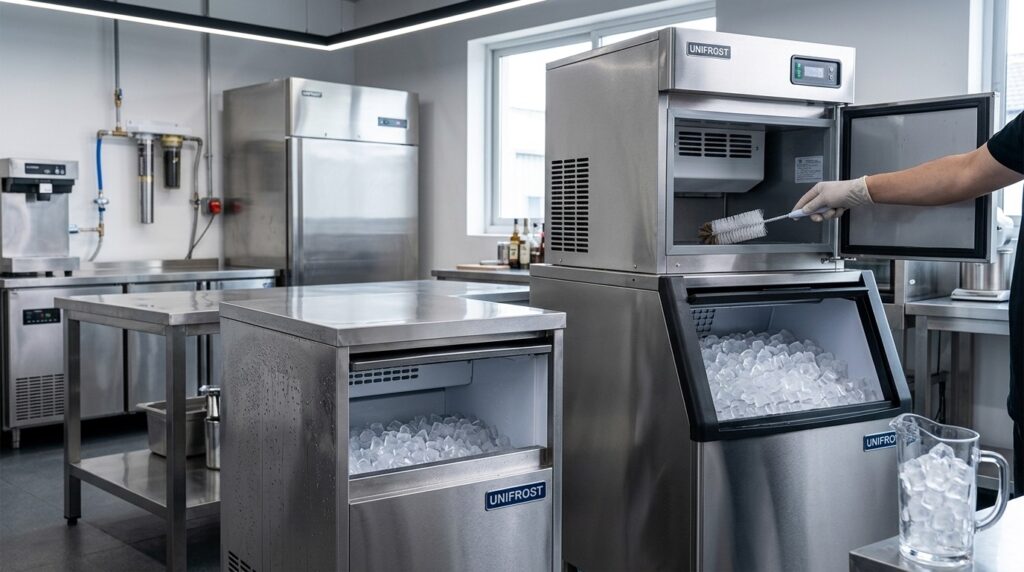
Explore which Unifrost ice machine fits your Irish venue needs, comparing U-Series and UB25-15 for efficiency and suitability.
Unifrost U‑Series Ice Machines vs UB25‑15 Compact Ice Maker: Choosing the Right Fit
You are choosing between a compact, self-contained ice maker (Unifrost UB25‑15) and higher-output Unifrost U‑Series cubers that suit heavier bar, restaurant, and hotel demand. The right choice affects drink speed, space behind the bar, installation complexity, and how much downtime risk you can tolerate in peak service.
This guide walks you through the practical checks that decide it: your realistic daily ice demand, whether an integrated bin is enough or you need a modular head unit with a separate storage bin (for example B175 or B375), and what each route means for ventilation, water feed and drainage, and day-to-day cleaning. You will also see how to think about running costs and total cost of ownership, and when it is worth stepping up from the UB25‑15 at roughly 25 kg per 24 hours to a larger U‑Series setup such as U40‑15, U165‑125, or U230‑175.
Core Differences Between U-Series and UB25-15
Choosing between the Unifrost U‑Series and the UB25‑15 comes down to two things: how much ice you actually need over 24 hours, and whether you need storage that can carry you through a rush.
The UB25‑15 is a compact, self-contained undercounter cuber aimed at light-to-moderate daily demand. It’s listed at around 25 kg per 24 hours with an integrated bin, which suits cafés and smaller bars that need a steady supply for drinks service rather than large peaks (UB25‑15 listing).
The U‑Series is a broader family. It covers larger undercounter machines and higher-output modular head-and-bin setups designed for busier bars, restaurants, and hotels. The practical difference with modular systems is that production and storage are separate, so you size the bin to match service reality. That matters when you need a buffer for a busy spell, not just a constant trickle.
Both options still depend on the basics: decent water quality, a cleaning routine staff will actually follow, and enough ventilation space around the unit.
How do U‑Series and UB25‑15 compare overall?
UB25‑15 is an “all-in-one” choice.
One undercounter unit makes the ice and stores it. Installation is simpler, and it suits tight back bars and small coffee stations where space is already spoken for.
U‑Series is a scaling choice.
You’re choosing the format that fits your operation: self-contained undercounter units where storage is built in, or modular heads paired with a separate bin when output and storage need to be sized for peak demand.
In day-to-day terms, the difference you’ll notice is buffer and recovery. A small integrated bin works well until you hit sustained demand. A correctly sized modular head-and-bin setup is built to cope with peaks with less monitoring mid-service.
UB25‑15 (compact undercounter)
This is the straightforward option when you want dependable cubes without giving up much footprint or adding a separate bin to the layout. It fits venues like:
cafés doing iced drinks
smaller pubs with limited cocktail volume
staff canteens
small restaurant bars with predictable demand
Because it’s self-contained, it’s also easier to manage hygienically: one unit to place, one bin to keep clean, and fewer “workarounds” like storing extra ice in unsuitable containers.
Unifrost U‑Series (larger undercounter and modular systems)
U‑Series suits higher-throughput drinks operations where running short causes immediate service problems, especially in busy bars, function-led hotels, and cocktail-heavy venues.
With modular systems, the separate bin is not about adding complexity. It’s about matching storage to how you trade. If ice supports cocktails, soft drinks, buckets, and general bar service, storage capacity becomes as important as daily production. The bin is what keeps you moving when the rush hits.
Which is best for you?
Pick UB25‑15 if you need reliable daily ice for drinks, you’re tight on undercounter space, and demand is mostly steady rather than peak-heavy.
Pick a U‑Series setup if you’re planning around peak periods, you run multiple service points, or you want to avoid ice becoming the bottleneck when the venue is busy.
Either way, build cleaning and handling into your HACCP from day one. Ice is a food and needs hygienic storage and handling (FSAI Guide to Good Hygiene Practice, Water and ice).
Agent stopped due to max iterations.
Day-to-Day Operational Considerations
Run any ice machine around three basics: hygiene, airflow, and water quality. Keep the bin and scoop clean, keep vents clear, and schedule cleaning and descaling before scale and biofilm make the decisions for you.
In day-to-day terms, treat the UB25-15 as a steady top-up machine that needs frequent, light-touch attention in tight counter spaces. Treat U‑Series modular machines as production equipment where filtration, servicing access, and downtime planning matter more. Before installation, confirm power and drainage. After installation, watch how often the machine runs flat-out, because that is where running cost and wear show up quickest. If you are on hard water or you run a busy summer service, shorten the cleaning interval rather than waiting for slow production or off-tasting ice.
1. Set a routine based on duty cycle (how hard it works each day)
With a compact unit like the UB25-15, most issues come from being pushed beyond light-duty use. If the bin is constantly empty mid-service, the machine will run longer, sound louder, and need more frequent cleaning. Warm, wet interiors are exactly where biofilm builds.
With U‑Series modular setups, the risk is often the opposite. They are typically sized so you stop thinking about ice during service, but that can hide problems. If the first sign of trouble is “the bin is full of questionable ice”, you have already left it too long. Make responsibility explicit: who checks the bin condition, who checks the filter head, and who logs cleans.
2. Keep daily hygiene tight (ice is food)
In Ireland, ice counts as food and needs the same controls as any ready-to-eat ingredient, including clean handling and a potable supply, as set out in the FSAI’s Guide to Good Hygiene Practice (see: https://www.fsai.ie/getattachment/f3efa69d-8010-4a7c-b093-7b53700bfb81/guide-to-good-hygiene-practice-cml-final-2014.pdf?lang=en-IE).
Use a dedicated scoop and store it clean, not buried in the ice.
Wipe the bin door and touch points daily, particularly on undercounter units behind the bar.
Avoid “topping up” with bagged ice unless you can control handling to the same standard. At minimum, keep it physically separate.
If the machine has been off or the venue has been closed for a few days, dump the first bin and start fresh.
Practically, UB25-15 units often sit in cramped counters, so they pick up airborne dust and grease faster. U‑Series head-and-bin setups tend to be in back-of-house areas, so the weak point is usually bin hygiene and scoop discipline rather than intake vents.
3. Plan cleaning, descaling, and filtration as a cost line
On compact machines like the UB25-15, scale usually shows up as slower harvests, smaller cubes, or odd noises. Because the unit is self-contained and often near customers, neglected cleaning becomes a product issue and a noise issue very quickly.
On U‑Series modular systems, problems can hide for longer because the bin capacity can cover dips in production. Filtration and a scheduled descale protect valves, pumps, and consistent output, especially in hard-water areas. Budget for cartridges, chemicals, and staff time the same way you budget for glasswasher chemicals: the cost is predictable, the failure is not.
Ireland-specific point: if your premises is under a boil water notice, follow public health advice and isolate equipment like ice machines. The FSAI highlights this risk in its cryptosporidium guidance (see: https://www.fsai.ie/getmedia/dee5142b-3860-4fd5-9249-2b1ee41831f5/cryptosporidium-leaflet.pdf?ext=.pdf).
4. Control running cost through installation, not guesswork
Without getting into model-specific kWh claims, day-to-day running cost is mainly driven by two things: how many hours the unit runs, and how hard the refrigeration system works because of ventilation and ambient temperature.
The UB25-15 is commonly installed undercounter, tight to side panels, and often beside hot kit like glasswashers or coffee equipment. Poor airflow is a common reason a “small” ice machine becomes an expensive and noisy one.
U‑Series modular units are often easier to give breathing space, but they still need clear intake and exhaust paths and a sensible location away from heat and grease. When you compare total cost of ownership, don’t just compare purchase price. Ask whether your site can actually support the machine without it running flat-out in summer conditions.
Power and isolation are day-to-day considerations too. Compact undercounter units are usually chosen where a straightforward plug-in setup near the bar makes sense. Larger production setups often need a more deliberate installation conversation around dedicated circuits, isolation, drainage, and access. Either way, if you rely on one machine for weekend trade, you want services that a technician can reach quickly without dismantling the back bar.
5. Plan servicing and downtime differently for UB25-15 versus U‑Series
If a UB25-15 goes down in July, the usual contingency is buying bagged ice, reducing ice-heavy menu items, or adjusting service. That is manageable in cafés and smaller bars, but it still adds labour and risk during peak trading.
With U‑Series, downtime planning is part of the spec. A breakdown can hit cocktail service, banqueting, ice buckets, and light prep use at once. The practical approach is to design in access, fit appropriate filtration, stick to routine servicing, and keep a plan that does not involve someone driving around at 6pm trying to source ice.
Once you are realistic about cleaning time, how the machine actually runs on your site, and the cost of being without ice, it becomes much easier to choose between a compact top-up machine and a modular production setup.
Recommendations for Different Venue Types
Work backwards from how you actually use ice on a busy service, not the spec sheet. Estimate demand by drink mix, peak trading window, and whether you’re also filling buckets or doing light prep. Then choose between a compact, self-contained undercounter unit (UB25‑15 class) for steady, lighter demand, or a higher-output U‑Series head with a separate bin for venues that get hit hard at weekends and on functions. Finally, check the basics on site: space, ventilation, plumbing, electrics, and what you’ll do if the machine goes down mid-service.
1. Match the machine to your peak service, not your quiet weekday
Cafés, delis, daytime trade
Ice use tends to be predictable: a run of iced coffees, soft drinks, maybe the odd small bucket. A compact UB25‑15 style machine often suits this because it keeps footprint and install simple, with an integrated bin and steady output. The key is whether your peak is a short lunch rush or a sustained afternoon.
Busy bars, cocktail venues, late-licence sites
Your risk isn’t “average daily demand”. It’s the 60–90 minute window where every order needs ice and the machine can’t recover fast enough. That’s where a U‑Series setup starts to make operational sense: more production headroom and, just as importantly, more storage via a separate bin.
Restaurants
Decide whether you’re drinks-led or food-led with light bar service. A smaller restaurant with standard soft drinks may live happily in the UB25‑15 category. If you’re running cocktails, lots of sparkling water, or frequent table buckets, you typically justify U‑Series capacity sooner than expected, because you’re drawing down storage quickly between recovery cycles.
Hotels and wedding venues
These usually skew towards U‑Series even if the main bar feels “moderate” midweek. Breakfast, banqueting, room service buckets, function spikes and multiple service points create a storage problem as much as a production problem. Modular head plus a correctly sized bin is often the more stable day-to-day setup.
2. Decide: compact undercounter unit, or modular head plus bin
Choose a UB25‑15 style compact unit when:
You need an undercounter footprint behind a tight bar or café counter.
You want the bin built in, with fewer parts to plan around.
Your trade is steady, and smaller storage won’t catch you out at peak.
Choose a U‑Series modular head plus bin when:
Storage and recovery matter more than hiding the machine under a counter.
You need to size the bin to how you trade, not to a fixed cabinet size.
You’d rather build in capacity for weekends and functions than constantly “manage” ice.
On mix-and-match, treat the head and bin as a system. Compatibility matters, but in real Irish sites the usual constraints are practical: footprint, overall height, lid access behind the bar, and where you can run the water feed and drain neatly. If you’re pairing a head with a bin size that isn’t the common “default” you see online, check clearances and fit before you commit. The expensive mistake is discovering a door swing, counter height, or access issue after delivery.
3. Stress-test the install and your downtime plan
Before you pick a model, confirm:
Water and drain: Where they’ll run, and whether the fall and access are realistic.
Ventilation and heat: Undercounter machines get boxed into joinery; modular setups often end up near glasswash or stores. Poor airflow reduces output and shortens component life.
Electrics: Smaller units may be easy on existing circuits; higher-output machines can need more planning. Decide this early in a fitout, because retrofitting electrics after the bar is finished is a slow, costly way to solve a predictable problem.
Finally, plan for what happens when it fails. If downtime is manageable, a compact UB25‑15 class machine can be a sensible, tidy solution and you can bridge a short gap with bought-in ice. If you’re a high-volume bar or a function-heavy venue, relying on one machine with limited storage is a service risk. In those cases, the case for U‑Series plus a properly sized bin is often about resilience and service flow, not just kilograms per day.
If you’re torn between the UB25‑15 category and a U‑Series system, it usually comes down to two questions: how spiky your peak demand is, and how painful an ice shortage would be during service. Browsing the Unifrost ice machine range with your peak-hour reality in mind will get you to the right format faster.
Integration with Unifrost’s Broader Support
How you “integrate” an ice machine depends on what you’re buying. A compact, self-contained UB25-15 behaves like a single appliance. A U‑Series head-and-bin setup becomes part of the bar fit-out, with more decisions around placement, access and ongoing servicing.
In Ireland, it also helps to treat ice as a food. The FSAI guidance on food safety controls is a useful anchor for what you need around contamination control, cleaning routines, water quality and traceability. The practical difference is simple: the UB25-15 is easier to manage end-to-end, while U‑Series installs tend to involve accessories, fit-out choices and a service plan you’ll notice day to day.
Accessories and add-ons you actually end up needing (and when)
With the UB25-15, “ecosystem” usually means keeping the installation straightforward and protecting the unit from Irish water conditions that drive scale, slow production and trigger call-outs. With U‑Series modular heads such as U165‑125 and U230‑175, it’s more about building a complete ice station that’s serviceable and robust under busy staff use.
Water filtration and scale control: Often the difference between predictable cleaning and recurring breakdowns in hard-water areas.
Basics that save hassle later: A correctly sized drain, a proper shut-off valve, and enough airflow around the unit so it doesn’t overheat in a tight counter space.
If you’re looking at U‑Series modular heads paired with storage bins such as B175 or B375, treat the head and bin as one system. The bin is not just “extra storage”. It changes how you manage peak demand, overflow and recovery after a rush. Mix-and-match can be possible within modular ranges, but confirm approved head-and-bin pairings for the exact models you’re considering rather than assuming every combination will fit and perform as expected.
Warranty, service, and planning for downtime in Irish trading conditions
In real trading, the key difference is not the wording on a warranty. It’s how exposed you are if the machine stops.
A UB25-15 failure can take a small café counter to zero ice, and because it has an integrated bin you don’t have much buffer. U‑Series installations usually give you more resilience because you can store more ice and ride out short interruptions. The trade-off is that when something goes wrong, you’ll want fast, correct servicing on a higher-output machine.
What makes that workable in practice:
Clear service access for an engineer
Isolation valves that actually isolate
A drain that can be reached and worked on without dismantling half the bar
A cleaning routine staff can follow without improvising
Documentation, compliance, and operator routines (the unglamorous bit)
Ice machines are easy to ignore because they often keep producing right up until hygiene or scale catches up with them. From a food safety point of view, your HACCP paperwork and cleaning logs need to match what’s happening on the floor. The FSAI’s HACCP-based approach is a solid reference for setting a routine that’s simple and auditable.
What “support” should look like in practice is straightforward:
The correct manual and cleaning guidance for your exact model
A consumables plan if you’re using filtration
A service contact you can reach during peak season
If you’re standardising equipment across multiple sites, consistent models and consistent consumables reduce training errors and reduce the risk of “we ran out of filters so we bypassed it”.
Upgrading later: what you can reuse, and what catches people out
Starting with a UB25-15 and upgrading later can make sense for new venues, seasonal trade, or bars building volume. You can often reuse basics like a nearby cold water feed and a suitable drain point. The usual catch is that a modular U‑Series head with a separate bin typically needs more space, better ventilation planning, and an installation that allows service access without shutting down the full counter.
The easiest way to future-proof is to think about where ice “lives” operationally:
Where staff scoop (and whether it encourages good habits)
Where meltwater goes
Where cleaning happens
Whether you need capacity for buckets, cocktail service and occasional food prep alongside drinks service
That view makes the trade-offs between a UB25-15 and a larger U‑Series head-and-bin system much clearer.
FAQs
How many kilos of ice per day does each Unifrost ice machine produce?
It depends on the model and whether it is a self-contained undercounter unit or a modular head with a separate bin.
UB25-15: produces roughly 25 kg per 24 hours and includes an integrated storage bin.
Unifrost U‑Series (for example U40‑15, U165‑125, U230‑175): these are positioned for significantly higher daily output than compact units, with the larger models typically used in high-volume bars, restaurants, and hotels.
If you are sizing for service, match output to your busiest day and then choose storage to cover peak periods. The quickest way to confirm exact figures is to check the model’s datasheet on Unifrost.ie before ordering.
What is the footprint and installation requirement for these ice machines?
Installation requirements differ mainly by format:
UB25-15 (compact, self-contained): designed for under-counter placement. You will still need airflow for ventilation, a cold water feed, and a reliable drain for meltwater and purge water. Plan access so the unit can be pulled forward for cleaning and servicing.
U‑Series modular heads (for example U165‑125 / U230‑175): require space for two components: the ice-making head plus a separate storage bin (often paired with bins such as B175 or B375). You also need service clearance around the head, plus straightforward access to the bin for sanitation.
Always confirm dimensions, required clearances, and ventilation type on the specific model sheet, as these vary across the range.
Are there any special power or water needs for each model?
Most issues on site come down to getting the basics right rather than anything “special”:
Power: confirm the voltage, phase, and maximum load on the rating plate and the model datasheet. Compact undercounter units are often suitable for standard commercial supplies, while higher-output modular systems may have different electrical requirements depending on model.
Water supply: provide a stable cold water feed and, ideally, a shut-off valve close to the unit.
Drainage: ensure the drain can handle continuous discharge and is routed correctly. Poor drainage is a common cause of callouts.
Water quality: if you are in a hard-water area, plan for appropriate filtration and scale control, as it directly affects cube quality, efficiency, and service intervals.
If you share your venue location and expected usage, Unifrost can help sanity-check utilities before installation.
Next step: confirm the right size for your venue
To shortlist the best fit between a compact unit like the UB25-15 and a higher-output U‑Series modular setup, start by comparing each model’s daily output, format (self-contained vs modular), and installation notes.
Browse the full range on Unifrost Ice Machines, or contact the Unifrost team with your busiest-day demand and available space for tailored guidance.
View Unifrost ice machines at Caterboss
For current product options, pricing and availability, continue to Caterboss.