
Unifrost Upright Freezer vs. Ice Storage Bin: Essential Guide for Irish Kitchens
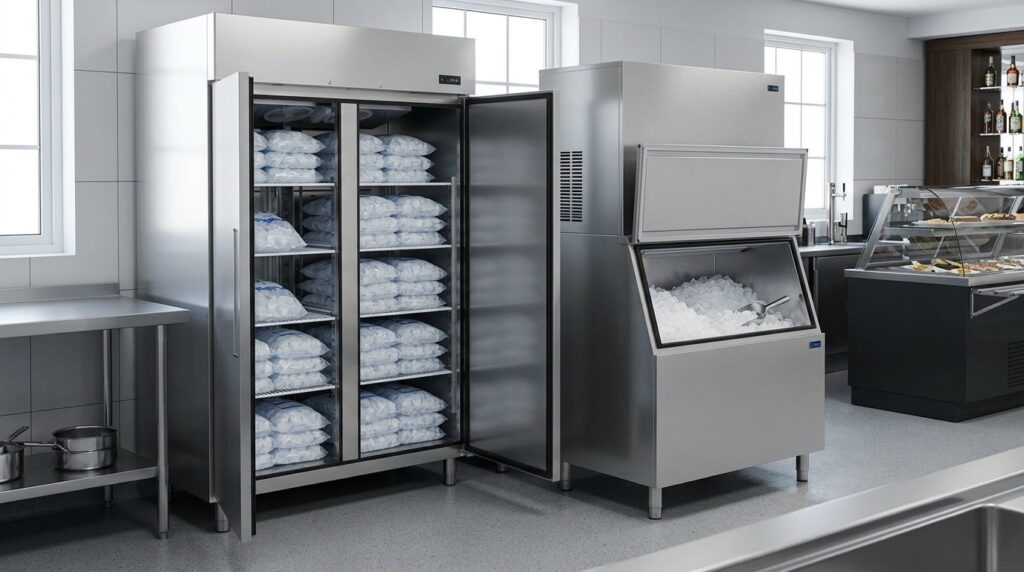
Compare Unifrost upright freezers with ice storage bins for effective ice management in Irish commercial kitchens.
Unifrost Upright Freezer vs Ice Storage Bin for Loose Ice: What Irish Operators Should Choose
If you serve drinks, run a bar pass, or depend on ice for food display, you need a storage setup that keeps ice clean, usable, and available at peak times. The wrong choice can mean clumped ice, extra melt waste, slow service, or a hygiene weak point in your HACCP routine.
On this page you compare when a Unifrost upright freezer (including models like F1000SV, F1300SV, F1310SV, F620SV and F410SS) makes sense for holding bagged reserve ice, versus when a Unifrost ice storage bin (B175, B275AIB, B375, UB25-15 and complete sets like U165-125+B175 and U230-175+B175) is the safer, more practical option for loose ice from an ice machine. You will work through the real checks buyers make: how you scoop and segregate drink ice, how fast you need access during service, where melt water goes, what cleaning routine is realistic, and whether using a freezer as an “ice bank” is genuine value or a false economy.
Why this topic matters in commercial use
Choosing between an upright freezer and a purpose-built ice storage bin matters because ice for drinks is treated as food. How you store it affects contamination risk, waste, and speed of service.
The FSAI Guide to Good Hygiene Practice for the catering sector is clear on the basics: protect food from contamination and manage controls through your HACCP system. That applies to loose ice just as much as it does to ready-to-eat garnishes.
Both options can work in Irish hospitality, but they suit different day-to-day realities:
Upright freezer: best for sealed bagged ice and backup stock.
Ice storage bin: best for loose service ice, where staff access, scooping and cleaning routines need to be easy to control.
Why operators get caught out with “just use a freezer”
In a busy Irish bar, restaurant or hotel, ice problems rarely announce themselves until the rush. The usual pattern is:
the door is opened constantly during peak service
ice starts to clump from warm air and handling
a scoop goes missing and someone reaches in with a glass or the wrong utensil
An upright freezer can be a sensible place to hold sealed bags of ice, especially if demand is spiky and you want a buffer. It is a weaker fit for loose ice for drinks because the moment you treat the freezer as an open food container, you introduce a high-touch handling point that is harder to supervise when you are flat out.
What the equipment choice changes day to day
This is not a theoretical choice. It changes four things that show up quickly in labour, waste, and HACCP checks:
Speed: how fast staff can get ice without taking shortcuts
Control: how exposed the ice is to handling and cross-contamination
Waste: how much you lose to melting, clumping, and “dump and refill”
Cleanability: how straightforward it is to empty, clean, sanitise and document the routine
Unifrost ice storage bins such as the B175, B275AIB, B375, and UB25-15 exist for that loose-ice workflow. They are built around scoop access and routine empty-clean-sanitise cycles, and they also pair with modular sets like U165-125+B175 and U230-175+B175 where you want production and storage to run as one station.
Why it matters for running costs and reliability in Ireland
Space is tight in many Irish venues, especially behind the bar or around a compact kitchen pass. Ambient conditions can also be challenging in summer, during events, or in smaller rooms with poor ventilation.
If you use the wrong format, you often pay twice: first in electricity, then again in labour and wasted ice. A freezer used as a “loose ice bank” invites constant door opening at the worst time, when temperature stability and recovery matter. In practice, a bin paired with an ice maker is usually the steadier day-to-day system for loose service ice, while an upright freezer is better treated as contingency space for sealed bags, bulk buys, and seasonal overflow.
Key differences between upright freezers and ice storage bins
An upright freezer and an ice storage bin do different jobs in an Irish bar or kitchen: freezing and holding stock versus holding service ice for quick, hygienic dispense. An upright freezer is designed to freeze and store mixed frozen goods. An ice storage bin is designed to hold loose ice with less melt, cleaner access, and proper drainage.
In practical terms, a Unifrost upright freezer (such as the F1000SV or F1300SV) suits sealed or bagged ice and overflow stock. It is not set up for repeated open scooping during a drinks rush. A Unifrost ice storage bin (such as the B175 or B375) is built around loose-ice workflow, with dedicated access and meltwater management that helps you keep service tidy and consistent.
Both can make sense in the same venue. The right choice comes down to whether you’re storing bagged ice as backup or dispensing loose ice for drinks under real service pressure.
Design and airflow: freezing cabinet vs insulated bin
Upright freezers (for example, Unifrost models in the F410SS, F620SV, F1000SV and F1300SV families) are general-purpose freezing cabinets. They’re designed to pull temperature down, recover after door openings, and keep a range of frozen foods stable. That’s why they often become shared space in a busy kitchen.
Ice storage bins (for example, Unifrost B175/B275AIB/B375 and bin sets like U165-125+B175 and U230-175+B175) are insulated storage bins for ready-made ice. They’re designed to reduce melting, keep ice separate from general food storage, and cope with frequent access during service without turning into a wet, frosty headache.
Hygiene and HACCP reality: ice needs its own routine
If you’re scooping loose ice for drinks, you’re handling a ready-to-eat food. Your HACCP needs to reflect that, including controlling contamination risks from hands, utensils, and whatever else is stored nearby. The Food Safety Authority of Ireland highlights the need to store utensils like ice scoops hygienically to avoid contaminating ice, which is far easier to manage with a dedicated bin than a shared freezer compartment (FSAI guidance for food businesses).
You can run an upright freezer cleanly, but once it becomes “the ice bank”, standards often slip in real service: staff reaching past other frozen goods, scoops going missing, open packaging, and more chance of cross-contamination. A bin keeps ice single-purpose, which is easier to train, easier to supervise, and easier to defend in an audit.
Melting, clumping and waste: what happens mid-shift
Loose ice kept in a freezer tends to clump and frost up with repeated door openings and warm air getting in, especially if the door is left open while staff fill buckets. The result is slower service and more waste, with people breaking ice apart or dumping the wet, partly melted stuff at the bottom.
A proper ice bin is designed to keep ice in a usable condition for dispense and to manage meltwater instead of letting it sit and refreeze into solid blocks. Day to day, that usually means less mess behind the bar and less time lost fighting the ice when trade is busy.
Which suits your venue: choose based on how you actually use ice
Decide first whether you need bagged contingency stock, loose dispense ice, or both.
Use a Unifrost upright freezer (such as the F1000SV/F1300SV/F410SS families) for bagged ice, event overflow and seasonal buffering, where stock stays sealed, labelled, and separate from service handling.
Use a Unifrost ice storage bin (such as B175/B375, or a complete set like U165-125+B175) when you’re dispensing loose ice for drinks and you need a consistent, auditable hygiene routine.
Use both when you have predictable peaks (weekends, functions, match days) and you want loose-ice service to stay clean and fast while keeping a separate “insurance policy” of bagged ice in the freezer.
Once you’re clear on the approach, the next decision is sizing: how much ice you need at peak, and how to balance production and storage so you’re not relying on shortcuts when service is under pressure.
Common considerations and pitfalls
The biggest mistake is using an upright freezer as if it were an ice storage bin. An upright freezer works well for sealed, bagged ice. It usually falls down quickly with loose “ready-to-eat” ice, showing up as clumping, wet ice, wasted stock and slower service when you hit a rush.
The bigger risk is hygiene and HACCP control. Ice that goes straight into drinks needs to be treated like food. That means controlled handling, a clean scoop routine, and a storage setup you can clean properly and stand over if you are inspected. If you find yourself improvising with buckets and “temporary” solutions, the cost shows up fast in staff workarounds, inconsistent portioning and more frequent runs for extra ice.
Most of the time, the fix is not “more cold”. It is matching the storage format to how you make, store and serve ice in your operation.
Upright freezer as a “loose ice box”: why it goes wrong
An upright freezer is fine for holding sealed bags. It is a poor place to store loose ice you are scooping into drinks all night.
The common failure points are practical and predictable:
Cross-contamination risk: hands move between food packaging, cartons, raw containers, bar tasks and then straight to an ice scoop or bucket. In a busy service, separation slips.
Hard to keep “service clean”: doors are open longer, items get shifted around, and buckets that were meant to be short-term become the permanent system.
Hard to defend in a HACCP plan: if the freezer is shared storage, it is difficult to show that the ice is protected and handled consistently as a ready-to-eat product under EU food hygiene rules, including where ice is in contact with food or drink (Regulation (EC) No 852/2004).
If loose ice is part of your normal service, you are usually better off with a purpose-designed bin and a clear scoop routine than trying to make an upright freezer behave like a dispensing station.
False economy: using a freezer as an “ice bank” beside a modular ice machine and bin
A common cost-saving attempt is buying a smaller bin and “topping up” with loose ice stored in an upright freezer. In practice, you end up paying twice:
the bin is still the only safe, workable point of service
the freezer becomes overflow that is slow to access and awkward to manage hygienically during a rush
If you are running a modular ice maker with a bin, keep the upright freezer for sealed bagged ice only, not loose top-up. Where you need extra capacity for events, storing additional bagged ice in an upright freezer and decanting in a controlled way is far easier to manage than treating the freezer itself as the service dispenser.
Ambient heat and ventilation: the quiet cause of soft, wet, wasteful ice
A lot of “bad ice” complaints are installation and environment issues rather than a machine fault. When an ice maker or bin is squeezed into a hot back bar, a tight store room, or parked beside a glasswasher, you typically see faster melt, bridging and clumping. That then drives more frequent refilling and handling, which increases hygiene risk.
One practical misunderstanding causes most of the pain: an ice bin is designed to hold ice and slow melt, not freeze it again. If production is behind demand, or the room is warm, the bin becomes a churn of wet ice and top-ups rather than stable storage. Bin sizing is a workflow decision as much as a capacity decision.
Routine pitfalls that cause hygiene failures in Irish bars and kitchens
Most problems are process gaps that show up under pressure. A simple standard usually prevents them:
No shared scoops and no hands-in-ice habits
A designated clean scoop stored outside the ice (not buried in it)
Properly labelled, food-safe containers if you decant ice
A documented clean-down frequency that fits your trading pattern, as part of your HACCP-based controls (HSE food safety guidance)
When these basics are in place, the choice becomes clearer: upright freezers for bagged ice storage, purpose-built bins for loose service ice.
Best practices for choosing and using ice storage equipment
Choose your ice storage based on how you serve drinks, not just how much ice you get through. In most Irish venues you are deciding between:
Sealed bagged ice in an upright freezer (for example Unifrost F1000SV, F1300SV, F1310SV, F410SS, F620SV ranges), or
Loose, drink-ready ice in a dedicated bin under an ice maker (for example Unifrost B175, B275AIB, B375, UB25-15 and modular sets like U165-125+B175 and U230-175+B175).
Start by mapping when you need ice, then site the equipment so staff can work quickly without creating a hygiene headache. Finally, keep the HACCP routine simple: scoops, lids, labelling and cleaning. Ice is food, and poor handling is what usually causes issues.
1. Map your ice demand to service pressure and workflow
Plan around your busiest 60 to 120 minutes, not an average day. In Irish bars it is often a Friday night surge; in hotels it can be breakfast plus banqueting; in cafés it might be steady iced-coffee demand that quietly drains you all day.
Next, map where the ice is used:
If most ice goes over the bar, storage needs to be at the bar.
If it is split between bar, floor and kitchen pass, you either need a central bin with a clean transfer routine, or a bar bin with sealed backup elsewhere.
2. Choose the format based on whether ice stays sealed or is ready to serve
If you mainly use bought-in bagged ice and keep it sealed until service, an upright freezer is a practical storage option because you are holding packaged product.
If you need loose ice ready to scoop into a glass, a dedicated ice bin paired with an ice maker is usually the better fit. It is built for day-to-day access and more controlled handling.
Avoid using an upright freezer as a “loose ice well” for drinks. Uprights are great for frozen food and sealed product, but they are not designed around scoop access, segregation and the handling controls you will want under HACCP. If you do store loose ice in a freezer, treat it as a higher-risk handling point and manage it tightly.
3. Site the unit properly in compact Irish back-of-house spaces
Bad siting causes most “ice is clumping” and “the unit can’t cope” complaints. Put the bin or ice maker where staff can work cleanly and fast:
Don’t site it beside splash zones (glass wash), waste areas, or where staff must reach over open food.
Keep lids closed between uses. This matches FSAI expectations that ice-making equipment is in a clean, well maintained area and kept closed when not in use, even where the guidance is aimed at other food operations (FSAI guidance for small meat manufacturing plants).
Treat water supply and drainage as part of the buying decision, not a later problem for the installer. Ice is food, so the feed water is part of your controls. Use a potable supply and manage risk if you are on a private source, as set out in the (FSAI water supply checklist).
4. Put a HACCP-friendly handling and cleaning routine in place from day one
Assign ownership by shift and keep it simple enough that it still happens on a busy night. The basics make the difference:
Use a dedicated ice scoop and store it outside the ice in a clean holder, not buried in the bin.
Label scoop and any transfer bucket “ice only”. Don’t let them become a general-purpose container.
Keep the bin lid closed between uses. Open-lid bins pick up contamination from traffic and splash.
Clean and sanitise ice-contact parts to your HACCP schedule and follow the manufacturer’s instructions. Scale and biofilm are common issues in hospitality water systems.
If you close for a few days (seasonal trading or midweek shutdown), empty, clean, dry, and restart properly rather than serving held ice.
Your ice machine is also part of a water system. Poorly controlled water systems are a recognised route for Legionella risk, which is why Irish workplace guidance focuses on control measures and maintenance (HSA guidance on legionellosis).
5. Plan for “busy nights” and “quiet weeks” using both formats sensibly
For many Irish venues, the best setup is a mix:
A bin for clean loose ice during service, plus
An upright freezer as contingency for sealed bagged ice when you get a heatwave, a big match day, or a function that runs long.
If you are seasonal, avoid running a small bin flat-out and “making up the rest” by storing loose ice in a freezer. Size your bin and modular set to your normal peak, then use the upright freezer for extra sealed bags during the short periods you genuinely hit max load. It generally reduces melted, clumped ice and cuts the staff time spent breaking ice and hunting for space.
Once those basics are in place, it becomes much easier to choose between what an upright freezer is designed to do and what an ice storage bin is designed to do during day-to-day drink service.
Recommendations for specific Irish business contexts
What suits you depends on service pressure, who handles the ice, and whether you are storing sealed bagged ice or scooping loose ice for drinks. In Ireland, it helps to treat ice as a ready-to-eat food and apply the same temperature control and handling discipline you use elsewhere, as set out in the FSAI temperature control guidance for food businesses.
In practice, many venues land on a two-part setup:
Upright freezer for sealed backup stock (bagged ice)
Ice machine plus a dedicated ice storage bin for day-to-day loose ice
That split works because workflow and hygiene risks are different.
Busy wet-led bar, late-licence venue, or cocktail-focused operation
In high-volume bar service, loose ice is a frontline ingredient, not “storage”. A dedicated ice storage bin (for example B175/B175OG or B375/B375OG, or a complete set like U165-125+B175 or U230-175+B175) is usually more workable than scooping from an upright freezer. It keeps ice access separate from food stock, reduces door-open time, and avoids the familiar Saturday-night problem of staff reaching past food to get ice.
An upright freezer still earns its place behind the bar, but mainly as resilience. Keeping sealed bagged ice in an upright such as F410SS/F410SSOG, F620SV, or larger models like F1000SV/F1000SVOG and F1300SV/F1300SVNOG gives you cover for a compressor fault, a busy match day, or a hot weekend. If the freezer becomes your main source of service ice, expect more clumping, more “ice snow”, and more waste from repeated openings, especially if the same freezer is also taking deliveries and holding frozen food.
Hotel bar plus banqueting, functions, and room service
Hotels get caught by peaks: breakfast, conference breaks, weddings, and late bar trade can stack demand in the same day. Plan your normal loose-ice supply around an ice machine and bin set (often a modular head paired with a bin like B175, or a complete set such as U230-175+B175). Then use an upright freezer for contingency bagged ice so you are not betting a function on one piece of kit.
Layout matters as much as capacity. Position the loose-ice bin so staff are not crossing the main kitchen pass or raw-prep areas to fill buckets for banqueting. It reduces cross-contamination risk, cuts spills, and keeps lid-open time down. If you have multiple service points, one well-placed bin often beats “ice stored wherever it fits” in a back kitchen freezer, because the latter encourages shortcuts that are hard to police across departments.
Café, deli, and daytime food-led venue with moderate cold-drink trade
If ice is mainly for a small number of soft drinks, iced coffees, or occasional display chilling, a simpler setup can be the right call. Many cafés manage well with an upright freezer holding sealed bagged ice for top-ups, particularly where space is tight and staffing is light. It also avoids introducing a loose-ice handling station that then needs its own cleaning routine, scoop control, and clear separation from food prep.
Once you are regularly scooping loose ice for customer drinks, the balance shifts. A compact bin option such as UB25-15, or a smaller bin like B175 where it suits your footprint, can make service more consistent and reduce labour during rushes. The practical test is straightforward: if you cannot keep the freezer door closed and the ice sealed between uses, you will spend more time dealing with melt, clumps, and hygiene controls than the “cheap” solution is worth.
Restaurant with a strong dinner peak and a small bar section
Restaurants often underestimate ice because the bar is not the core revenue line, until a busy Friday exposes the gap. If your bar is mainly pre-dinner and after-dinner, an upright freezer with bagged ice can work as backup. Relying on it for loose ice during peak service usually creates two problems: staff conflict with frozen-food access, and inconsistent ice quality from frequent door openings.
A sensible middle ground is an ice machine and bin for service ice, plus an upright freezer for sealed reserve stock and any non-drinks ice you want to keep separate. In Unifrost terms, that might mean a bin-led solution (B175/B275AIB/B375, depending on throughput and footprint) paired with an upright like F410SS/F410SSOG for sealed bags and general frozen storage, so you are not forcing one cabinet to do three jobs.
Seasonal coastal venues, beer gardens, and operators who scale up fast
Seasonal Irish businesses tend to swing between “too quiet to justify a large ice setup” and “we cannot keep up”. For that pattern, it is usually better value to size day-to-day around a realistic bin setup, then use an upright freezer as a buffer for sealed bagged ice during peak weeks, rather than over-spec a bin that sits half-used for months.
Keep it controlled with one simple rule the whole team can follow: loose ice for drinks comes only from the bin, and sealed bagged ice lives in the freezer and is opened only to replenish a clean, labelled internal container. That avoids the upright freezer turning into an open-access ice chest, which is where hygiene and waste problems usually start. This is also where it pays to compare upright freezers and purpose-built ice storage bins properly, because the trade-offs are about workflow and handling as much as volume.
How this decision fits into the broader Unifrost ecosystem
This choice depends on what ice is in your operation.
If you handle ice loose, scoop it, and move quickly during service, you are dealing with a food-handling workflow.
If you mainly keep bagged ice as backup stock, it behaves more like any other frozen product.
FSAI guidance treats ice as a foodstuff in a food premises. That pushes most busy bars towards purpose-built ice production and storage, rather than trying to make a freezer do a job it was not designed for. In practice, layout, staffing and peak pressure decide what works, not just the cabinet temperature.
Think of ice as a small “system”, not a single box
In Unifrost terms you are usually building one of two setups:
Loose service ice for drinks: an ice maker plus a storage bin. That is where Unifrost ice storage bins (for example B175 / B175OG, B275AIB, B375 / B375OG) or modular sets like U165-125+B175 and U230-175+B175 fit.
Bagged ice or contingency stock: an upright freezer can make sense, for example models listed in the Unifrost range such as F1000SV / F1000SVOG, F1300SV / F1300SVNOG, F1310SV, F410SS / F410SSOG, or F620SV.
The practical difference is simple: an upright freezer is primarily a storage tool. A bin is a handling tool. A bin sits where staff actually work, supports a consistent scoop routine, and is easier to manage hygienically during a rush. Freezers, under pressure, tend to become “door open, hands in, shuffle product”, which is where standards slip.
Where ice sits alongside your wider refrigeration plan
Ice adds pressure on space, heat and access. You feel this most in Irish bars and hotels with tight back-of-house and warmer plant areas.
If your bottle coolers, undercounters and upright freezers are already working hard, ice becomes as much a recovery and workflow issue as a capacity one. Every extra door opening and every poorly ventilated corner slows pull-down and increases waste.
A sensible rule of thumb:
Keep the upright freezer for what it is good at: sealed, bagged product with clear stock rotation.
Keep loose service ice in a bin matched to an ice maker, so the drinks station stays fast and controlled.
Using an upright freezer as the main loose-ice hopper can look cheaper at the start, but it often shows up later as clumping, inconsistent cubes, slower service and more cleaning, because the process becomes “scoop from wherever there’s ice”.
Water, filtration and maintenance: the tie-in people miss
Once you go down the ice maker plus bin route, you are also managing a water-fed appliance, not just a cold box. Your HACCP checks should reflect that ice is consumed and handled at the point of service. FSAI good hygiene practice guidance specifically covers water and ice in food premises (see Guide to Good Hygiene Practice, section on water/ice: https://www.fsai.ie/getattachment/f3efa69d-8010-4a7c-b093-7b53700bfb81/guide-to-good-hygiene-practice-cml-final-2014.pdf?lang=en-IE).
Filtration is part of that decision. In many Irish premises it is less about “better” ice and more about reducing scale and protecting reliability, particularly in hard-water areas or where pipework is older. It also makes cleaning more predictable because you are not constantly battling mineral build-up.
How this choice affects compliance and staff routines
If staff scoop loose ice for drinks, the routine needs to be workable at 10pm on a Saturday, not just written nicely in a folder.
FSAI guidance notes that the ice scoop should not be left in contact with the ice (example reference: https://www.fsai.ie/getmedia/8aa688dd-ebba-40d6-aa3e-51f62048be32/11246-fsai-small-meat-manufacturing-plants-fa17-accessible_1.pdf?ext=.pdf). That is far easier to implement consistently with a bin setup and a defined scoop holder or a dedicated clean storage point beside the station.
This is also where false economy appears. If you rely on an upright freezer for loose ice, you typically end up with mixed-use storage, more hand contact, more risk of cross-contamination, and poorer visibility of turnover, even if the freezer is holding temperature. A dedicated bin keeps ice handling separate from frozen food storage, which simplifies training, supervision and audit days.
With that wider context, the day-to-day differences between storing bagged ice in an upright freezer and holding loose service ice in a storage bin are much easier to judge in real kitchens and real bars.
FAQs: Upright freezers vs ice storage bins for loose ice
Can I use a standard freezer to store all the ice my bar or restaurant needs?
You can store bagged ice in a commercial upright freezer, but it is rarely the best way to manage loose ice for drinks service.
Service speed: ice is usually needed at the bar, not in the back-of-house freezer.
Hygiene control: freezers are built for frozen food, not for frequent access with a scoop during service.
Waste: opening a freezer repeatedly and storing loose ice in non-purpose containers often leads to clumping, frost build-up and more discard.
A freezer is a good overflow buffer for sealed bags. For loose, food-contact ice, a purpose ice storage bin is usually the safer and smoother day-to-day option.
How much ice production and storage capacity do I really need for a busy hospitality venue?
Size it from your peak hour, not your quiet day.
Practical ways to estimate demand:
Start with your busiest service window (often 2 to 4 hours) and list the drinks that use ice.
Use simple working numbers: many venues find 1 to 1.5 kg of ice per cocktail service is a reasonable planning allowance, while soft drinks and spirits are typically lower.
Add contingency for warm weather, events and machine downtime (a common target is 20% to 30%).
Then match that to equipment roles:
Ice maker output covers the ongoing daily need.
Ice bin storage covers the peak draw-off at the bar.
Upright freezer space is best reserved for emergency backup bagged ice, especially for weekends and seasonal spikes.
If you regularly run out mid-service, you usually need more storage at the point of use (a larger bin) as much as you need more daily production.
What are the hygiene and food safety rules for ice used in drinks in Ireland?
In Ireland, ice served in drinks is treated as a food. That means your handling and storage need to follow the same food safety and HACCP basics you apply to ready-to-eat items.
Key controls that typically matter in inspections:
Dedicated scoop and holder: never use a glass as a scoop. Store the scoop off the ice in a clean, dedicated place.
Keep ice protected: minimise hand contact and protect from splash, dust and cross-contamination.
Clean, documented routines: keep a simple log for cleaning and sanitising of your ice equipment and contact parts.
Separate food and ice practices: avoid storing loose ice beside open food, raw items or strong-odour products.
If you need to hold loose ice for drinks, a purpose-built ice bin is normally easier to keep consistently compliant than improvising loose-ice storage inside a freezer.
Next step: match your ice storage to your service style
If you are deciding between keeping bagged ice in an upright freezer or managing loose ice in a dedicated bin, compare the layouts that fit your bar or kitchen workflow first, then pick the equipment that supports that routine.
Browse Unifrost Ice Storage Bins for loose-ice holding, and Unifrost Upright Freezers for frozen storage and backup bagged ice.
Related Unifrost guides
Compare models, maintenance advice and support information related to this topic.
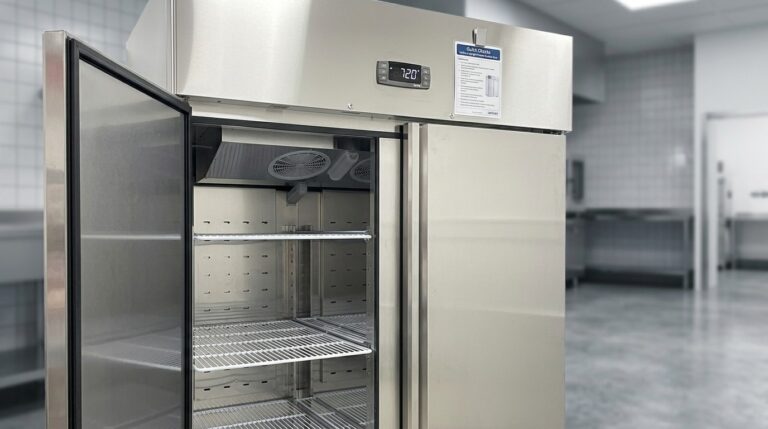
Unifrost Upright Freezer Temperature Controller: New Owner Quick Checks Guide
Essential quick checks for new Unifrost upright freezer owners in Ireland to ensure optimal temperature control.
Read guide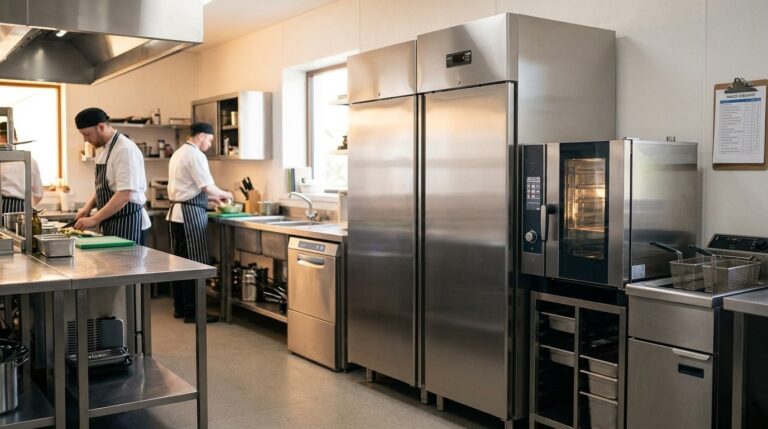
Unifrost F410SS Upright Freezer in Hot Kitchens: Ventilation & Troubleshooting Guide
Optimize your Unifrost F410SS upright freezer in hot Irish kitchens. Learn about ventilation, GN layout, and troubleshooting.
Read guideView Unifrost products on Caterboss
For current product options, pricing and availability, continue to Caterboss.