
Optimizing Irish Café and Deli Setups: Unifrost F410SS Upright Freezer and DCF Deli Counter Workflows
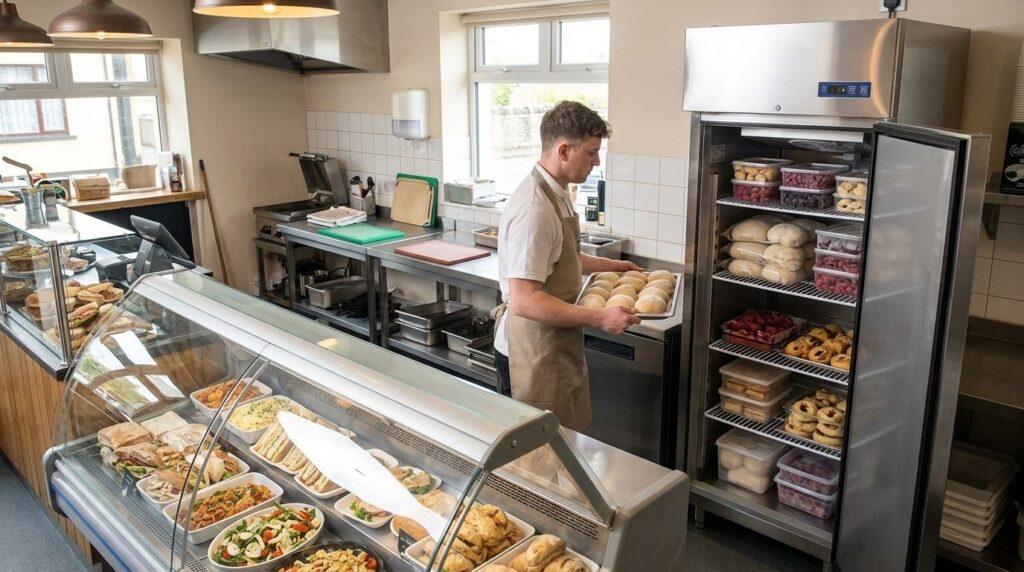
Optimize workflow in Irish cafés with Unifrost's F410SS freezer and DCF deli counter. Practical examples for efficient service.
Unifrost F410SS Upright Freezer and DCF Deli Counter Workflow Examples for Irish Cafés and Delis
You use the Unifrost F410SS upright freezer to hold frozen stock and the Unifrost DCF serve-over deli counter range to sell chilled items at speed, but the value is in how you run them together. Done well, you cut steps, reduce door openings, protect product quality, and keep HACCP checks simple during busy service.
This guide focuses on the practical decisions you make on a real café or deli line, including:
Where to position the F410SS relative to the DCF counter and prep area in a tight Irish footprint, and what tradeoffs you make between speed, heat sources, and staff access.
How to organise frozen stock in the upright freezer so replenishment is quick and you do not compromise temperature stability.
Example daily workflows for morning prep, lunch peak, and close-down, including batch moves from frozen storage to front-of-house display and what to record for HACCP.
Common workflow mistakes when combining a tall back-of-house freezer with a long front-of-house counter, and the checks that help you avoid waste, cross-contamination, and service bottlenecks.
Understanding the F410SS Upright Freezer and DCF Deli Counter
The Unifrost F410SS is a commercial upright freezer suited to back-of-house frozen storage where you need organised stock and quick grab-and-go access during service. The Unifrost DCF deli counter range (including DCF1300 and DCF1600) is a serve-over chilled display for front-of-house presentation and fast counter service in delis, cafés, and bakeries.
Used together, they support a simple workflow: keep bulk stock frozen in the freezer, pull what you need in controlled batches, and display only what will sell in the next service window. The important point is that a serve-over counter is designed for repeated short openings and customer-facing presentation, not as your main storage fridge. It performs best with disciplined loading and regular replenishment.
What the F410SS is for in day-to-day café and deli use
In most operations, the F410SS earns its floor space as the “frozen buffer” just off the line. It’s there to keep product properly held, easy to find, and quick to retrieve without turning a prep table into a thawing zone.
It suits service-line freezer jobs such as portioned bakery, prepped fillings held frozen, desserts, and backup stock that’s drawn down daily. Where operators get caught is trying to make one upright do both bulk storage and constant service access. If the door is opening every few minutes at lunch, temperature stability and recovery are doing extra work when you can least afford it.
What the DCF deli counter is for (and what it is not)
A DCF serve-over counter is front-of-house kit for chilled display and speed at the point of sale. It’s for items that benefit from visibility and quick serving, for example sandwiches, salads, desserts, cooked meats, and bakery lines.
What it’s not: a “parking bay” for extra trays or a substitute for proper cold storage behind the scenes. Serve-over counters are more sensitive to day-to-day habits than a back-of-house cabinet. Overfilling, blocking airflow, or leaving products stacked beyond the intended display area will usually show up as uneven temperatures and a scruffier-looking counter during busy periods.
Irish food safety context that affects both units
Your freezer and deli counter sit on opposite ends of the same HACCP routine: keep food out of the danger zone while still serving at pace. For chilled foods, many Irish operators work to holding at 5°C or below, in line with FSAI guidance on chilling food safely.
Practically, that means:
The freezer protects shelf life and product quality, and gives you control over what comes out and when.
The deli counter needs active management during service because it’s opened repeatedly and is affected by loading, replenishment, and time on display.
If you treat the DCF as display-and-serve, and keep your real storage capacity in back-of-house refrigeration or freezing, it’s easier to keep temperatures consistent and paperwork realistic.
The key distinction when pairing them in one operation
Most cafés and delis get better results when the freezer is set up for fast retrieval, and the deli counter is set up for fast replenishment, not long holding:
Use the F410SS for organised frozen stock and controlled pull-outs for prep or top-ups, so staff aren’t rummaging mid-rush.
Use the DCF counter for a curated, sales-led range with planned top-ups, so it stays presentable and holds temperature under pressure.
Keep those roles clear and your service line gets simpler: fewer steps, fewer long door openings, and fewer “we’ll just leave it there for now” moments that come back to bite you at audit time.
Setting Up Efficient Workflows
If you’re running a busy Irish café or deli, the quickest way to lose time (and temperature control) is using the upright freezer as “live service” storage. A cleaner setup is to make the Unifrost DCF serve-over the face of service, and use the Unifrost F410SS upright freezer to support planned prep and restocking with short, controlled door openings.
1. Map the service line around what customers actually buy
Treat the DCF as your selling and serving zone, and design everything else to keep staff in front of it during peak trade. In a typical Irish café-deli setup (sandwiches, salads, bakery, grab-and-go), you want a flow that lets staff serve, wrap, take payment, and hand off without stepping away from the counter.
If you have a lunchtime spike, set up for two roles at the counter:
Server: stays on the DCF, portioning and serving.
Runner/prep support: handles wrap, restock, slicing and fetching stock.
That separation reduces the “just one quick run to the freezer” habit, which is where service speed and temperature discipline usually unravel.
2. Position the F410SS to cut steps without turning it into a bottleneck
You want the freezer close enough for planned prep and restocking, but not so close that it’s opened during every second order. In tight Irish units where floor space is the constraint, focus on three practical checks:
Staff-side access: keep it on the staff side of the line, never where the customer queue blocks it.
Door swing clearance: make sure the door can open fully without taking out the DCF work zone or trapping someone behind it.
Not beside the serve opening: place it nearer the prep bench that feeds the counter, so frozen items are handled in prep windows rather than mid-service.
The goal is simple: short walks are good, frequent door openings are not.
3. Organise frozen stock in the F410SS for “open, pick, close”
The best freezer layout is the one that stops people searching. Set it up for service priority, not supplier order:
Put high-frequency items at hand height.
Store backup stock higher or lower.
Keep raw items and ready-to-eat items clearly separated, and separate allergens so there’s less risk of cross-contact when someone is moving quickly.
Label shelves and boxes so a newer staff member can find the right item without leaving the door open “while they think”.
If staff have to guess, they will over-pull stock and the door will stay open longer than it needs to.
4. Batch-prep and transfer stock so the DCF recovers temperature properly
A serve-over counter sells better when it looks full, but it runs better when you stock it little and often, rather than overloading it and hoping it holds temperature.
Build restocks into the day:
Pre-open
Pre-lunch
Mid-afternoon
Short top-up during peak (only if needed, and done quickly)
Use smaller trays or inserts so you can swap product fast and get lids/shutters closed again. The practical risk to avoid is “bench drift”, where food sits out during service because someone got pulled back to the queue.
For chilled food control, many Irish operators reference the FSAI temperature control guidance, commonly applied as keeping chilled food at or below 5°C as part of HACCP controls:
https://www.fsai.ie/food-businesses/haccp/temperature-control
5. Make HACCP checks fit how the team actually works
If checks feel like paperwork, they’ll be skipped at the exact time you most need them. Tie them to moments that already happen in the shift:
DCF: open, peak, close
Freezer: open and close, plus after deliveries or heavy loading
Keep one simple record (paper or digital) for both units:
Time and initials
DCF temperature check and corrective action (if needed)
F410SS temperature check and corrective action (if needed)
Notes on stock transfers or discards
Cleaning done (spills, seals, sneeze-guard areas) and any maintenance issues
Allergen handling also needs to stay consistent between display and service, particularly in open or semi-open counter work. The FSAI allergen guidance is a solid reference point for how you present and communicate allergen information:
https://www.fsai.ie/food-businesses/allergen-information
Once your layout, stock system and checks are consistent, you’ll quickly see whether temperature issues are coming from the environment and loading, or from habits like long door openings and unplanned restocking.
Morning Prep Workflow
Run your morning prep so you verify temperature control before you touch stock, and so the freezer and serve-over counter are doing their job during the busiest part of the day. If anything is out of temperature, treat it as a food safety issue first and a waste issue second.
1. Confirm both units are on, clean and holding temperature before you handle food
Arrive early enough for the DCF serve-over counter to pull down to operating temperature before you load it. Loading chilled food into a counter that has not stabilised is a common way to create a HACCP problem by late morning.
Before you start opening doors repeatedly, do a quick functional check:
F410SS: door closing cleanly, seals intact, no ice build-up stopping full closure
DCF: wells, air inlets and service glass clean and unobstructed
If you use probe thermometers, make sure they are clean, available, and checked in line with your own calibration routine.
Use the same temperature standards your HACCP plan is built on. The Food Safety Authority of Ireland summarises the food “danger zone” as 5°C to 63°C. Your goal during set-up is to keep ready-to-eat chilled food out of that range and minimise time at room temperature. (FSAI: temperature control and danger zone)
2. Check yesterday’s HACCP notes before you decide what to use today
Look at the previous close-down records before you move stock. A note like “counter running warm during peak” or “freezer door left ajar” should make you more cautious about what you load and when you recheck temperatures.
Keep this step focused. You are trying to confirm:
Was temperature control acceptable?
Is any stock on hold or flagged?
Is any corrective action still open (move stock, reduce load, call service)?
If you use a digital HACCP app, name the equipment clearly (for example, “F410SS service freezer” and “DCF FOH deli counter”) so checks cannot be logged against the wrong unit.
When you do record checks, write them so they are useful later: who checked, time, unit ID, reading, and what you did if something was off. That is what turns paperwork into protection.
3. Stage the F410SS for speed: fewer door openings, fewer decisions
Treat the F410SS as a service-line freezer, not a storage cupboard you rummage through. The aim is simple: shorter openings and quicker picks, so the cabinet recovers temperature faster.
A practical layout:
One “today” zone at eye level for items you will actually pull during prep and top-ups
Bulk and slow-moving stock lower down or to the back
If you have a second freezer elsewhere, keep unopened cases and back-up trays there, and leave the F410SS for working stock only
Avoid decanting that removes traceability. If you split packs, keep the original label details with the food or transfer the key information to the inner container.
4. Batch prep in controlled runs, not constant one-off trips
Do not build a routine that depends on repeated freezer trips all morning. Instead, plan short batch pulls: take what you need for the next prep run, close the door, and get on with it.
For many delis the safest rhythm is:
Pull a small batch from the F410SS
Prep immediately
Move finished product straight into proper refrigerated storage, or into a pre-chilled section of the DCF only when it is ready for sale
If your team is tight, it often helps to split roles during the build-up: one person prepping, one person serving. It reduces crossovers, missed labels, and “how long was that sitting there?” moments.
If anything needs thawing, follow your established safe method and timings. “It’ll thaw faster on the counter” is usually how temperature control slips without anyone noticing until later.
5. Pre-chill and load the DCF counter to protect product temperature
A serve-over counter is for holding chilled food for display and service, not for pulling product down from warm. Pre-chill first, keep lids/doors closed during set-up as much as you can, and load in smaller batches so the unit can hold temperature.
Load based on service flow:
Put fastest-moving items closest to where staff serve from
Keep higher-risk raw items strictly separated from ready-to-eat foods in storage and handling, even if “it looks tidy” when grouped together
Labelling needs to work at 1pm when it is busy. Prioritise allergen info and prep date/time so staff are not guessing under pressure.
6. Final pre-open check and set the day’s logging rhythm
Do a last check the way you actually trade. If the DCF is loaded, check temperatures at the point of use, not only at the back panel.
Keep morning logging tight so it gets done:
Time, staff initials, and unit ID (F410SS and DCF)
Cabinet/display reading and probe check (if you use one)
Any corrective action (reduced load, moved stock, discarded item, called service)
Anything unusual (power blip, door left open, heavy condensation)
Once this routine is consistent, the rest of the day runs with fewer door openings, fewer interruptions, and fewer judgement calls when the lunch rush hits.
Busy Lunch Service Workflow
Run peak lunch by using the DCF as your “today’s line” and the F410SS as reserve. The goal is simple: fewer door and lid openings, faster picks, and less temperature drift.
Keep the DCF stocked with only fast movers for the next service window. Treat the freezer like a store room you visit on purpose, not a place everyone dips into during the rush. Pre-portion, label, and stage frozen components before service, then top up in small, planned batches.
1. Set roles and “touch points” before the queue hits
You will get through a busy lunch quicker if everyone is not circling the same cold equipment.
One person serves at the DCF. Their job is speed and portion control.
One person supports. They fetch from the F410SS, restock packaging, handle allergen queries, and keep the line moving.
Agree your two cold “touch points” for the lunch period:
DCF: chilled, ready-to-serve items only
F410SS: frozen reserve and pre-portioned components
Keep tools (tongs, scoops, labels, wipes) at the workstation, not in the cold unit. Searching for kit with a door open is one of the quickest ways to lose temperature control.
2. Build a lunch-ready DCF display that sells fast and stays cold
A serve-over counter performs best at lunch when it is stocked for speed, not for choice.
Irish guidance is clear that high-risk foods should be kept at 5°C or below (see the FSAI Guide to Good Hygiene Practice). In practice, that means:
Do not pile product high “for the look”. It slows recovery and creates warm pockets.
Do not park items on the counter edge while assembling orders.
Load the counter with product that is already properly chilled.
Layout matters. Put the highest-volume items closest to where the server stands, and push slower lines further along. If you are seeing condensation, fogging, or obvious warm spots, it usually comes back to overfilling, too much open-lid time, or loading product that is too warm.
3. Run a timed freezer top-up routine using the F410SS (not constant door-opening)
A freezer stays more stable when you use it in batches.
Set a top-up rhythm during peak, for example every 20 to 30 minutes, or earlier when a key line is close to empty. That cuts down on constant door openings and avoids the classic problem of two staff opening the door back-to-back.
When you move frozen components towards service:
Take small, labelled batches only.
Put them straight into the correct storage point, not “temporarily” on a counter.
Avoid turning the DCF into a thawing or holding area. It makes timing harder to prove in your HACCP routine and it tends to damage food quality under pressure.
4. Keep service fast without cross-contamination or allergen slips
Most lunch mistakes come from line design, not bad intent.
Keep a clean separation between any raw handling and ready-to-eat assembly. If you do any raw prep at lunch, keep it away from the DCF service position.
For allergens, it is usually safer to have the support person handle allergen questions and special builds, so the main server is not constantly changing gloves, tools, and pace mid-queue.
If a customer raises a quality or safety concern, capture the basics immediately:
product name
time served
prep label or batch info used
displayed DCF temperature (if available on the unit)
what corrective action you took
That gives you something concrete to follow up with, instead of trying to reconstruct events after the rush.
5. Do mid-service micro-checks that protect temperature and margins
Peak lunch is not the time for full paperwork, but it is the time for quick checks that stop small drift turning into waste.
Do a fast check:
once during the rush (DCF and freezer)
once just after peak
If the DCF has crept up:
pause restocking for a few minutes
reduce open-lid time
consolidate pans so air can circulate
restart service flow only when the unit has recovered
If the freezer is slow to pull back or frosting heavily, shorten door-open time further and leave non-essential fetching until after peak.
Handled this way, lunch becomes predictable. That is what lets you tighten the layout, cut steps, and keep temperature control without slowing service.
Evening Close-Down Routine
Close-down is about two things: keeping food safe, and setting tomorrow’s shift up so you are not fighting the equipment at 08:30. For a Unifrost DCF serve-over counter and a Unifrost F410SS upright freezer, that means clearing food out of the counter quickly, cleaning properly, logging temperatures, and leaving both units organised and running as your SOP requires.
If you cannot confirm food has been held safely, your HACCP plan should steer you towards disposal rather than “chance it”. The paperwork will not protect you from a food safety issue.
1. Stop service and get high-risk food out of the DCF first
Once the last orders are done, stop topping up the DCF and close any lids or covers where your set-up allows. Prioritise high-risk foods (cooked meats, dairy, prepared salads, etc.) and move them back to suitable refrigerated storage instead of leaving them in a warmer front-of-house environment.
For Irish food businesses, chilled food should be held so the food itself stays between 0°C and 5°C. In practice, many operators set fridges to around 3°C to 4°C to achieve that, per the FSAI temperature control guidance. If you cannot verify the food stayed under control, treat it as non-compliant and remove it from sale.
2. Clear, label, and transfer stock without wrecking traceability
Work one end of the DCF to the other so nothing gets missed. Consolidate only where it is safe and makes sense, but avoid tipping “old into new”. It blurs batch control, shelf-life, and traceability, and that is exactly what comes back to bite during an inspection or complaint.
This is also where allergen control either holds up or falls apart. For non-prepacked foods in Ireland, allergen information must be provided in writing at the point of presentation, sale, or supply, and it must clearly relate to the specific food, per the FSAI allergens advice for businesses. Make sure your close-down labels and day-dot system match what was on display, including allergen call-outs.
3. Clean, then sanitise the DCF as it’s actually used in service
Remove trays, utensils and loose debris first. Then clean, then sanitise. Sanitiser does not work properly on greasy or dirty surfaces.
Hit the usual problem spots: inner edges where tongs get rested, the lip around the glass, and anywhere sauces drip and dry. If components are removable, wash and sanitise them, then let them air-dry fully before reassembly. Trapping moisture overnight is an easy way to invite smells and bacterial growth.
4. Check, log, and leave the DCF set up to hold temperature overnight
Before you leave, take a reading that reflects food safety, not just what the cabinet display says. The FSAI temperature control guidance supports using a calibrated probe thermometer and recording the results as part of HACCP monitoring.
If the DCF stays running overnight, leave it clean, correctly assembled, and not overfilled so airflow is not blocked. If your SOP is to power down a display counter overnight, only do it once you have confirmed there is no food left inside, and that the unit can be restarted and stabilised well before service.
5. Reset the Unifrost F410SS for a fast morning (without warming it up)
With the F410SS, close-down is mostly about reducing door-open time tomorrow. Repack anything opened during service, remove empty boxes, and put fast-moving items at the front so staff are not digging around with the door open.
Frozen foods should be maintained at -18°C or colder, per the FSAI temperature control guidance. If you are seeing door-closing issues (product protruding, shelves not seated, ice build-up interfering with storage), fix it at close. It is cheaper than losing time and temperature during the morning rush.
6. Final walk-by: prevent the overnight headache
Finish with a quick check focused on what tends to fail or slow you down:
DCF: no food left inside unless your SOP allows it, then cleaned, sanitised, and reassembled correctly.
F410SS: door fully closed and sealing; stock stored properly with nothing obstructing shelves or airflow.
Record end-of-day temperatures and any corrective actions in the same log your HACCP plan relies on.
Do this consistently and you will spend less time firefighting tomorrow, and more time running a service line that keeps temperature, reduces waste, and holds up under pressure.
Practical Takeaways for Irish Cafés and Delis
If you’re using an upright freezer (like the Unifrost F410SS) alongside a serve-over deli counter (like the Unifrost DCF), the win is simple: separate service stock from display stock. The freezer supports fast picks and quick replenishment. The deli counter stays focused on presentation and steady temperature during the rush.
Where operators run into trouble is treating the serve-over as storage and cramming it full. Overpacking restricts airflow, slows pull-down after the lids are opened, and makes it harder to stay consistent during lunch peaks and warm days. That’s exactly when temperature control is under the most pressure.
When the F410SS should be service-line, and when it should be backup storage
In most cafés and delis, an upright freezer earns its place on the line when it holds fast-moving frozen items that repeatedly interrupt service if they’re kept “out the back”, for example chips, wedges, portioned proteins, pastry, or pre-portioned soup bases. You’re reducing steps and keeping door-open time short, which helps temperature stability and keeps the queue moving.
It’s better as backup storage when it’s loaded with deep stock that only needs to be touched once or twice a day. If staff are constantly rummaging for the right box, you pay for it in longer door openings, more temperature swing, and slower service.
A practical split that works for many small teams is:
Grab stock from the freezer
Present and serve from the deli counter
Store bulk stock elsewhere (cold room or a larger upright if you have it)
That reduces conflict between prep, service, and replenishment.
DCF deli counter set-up that protects temperature during real service pressure
Run the deli counter as a display and service unit, not as a way to chill product down. Put food into the counter already chilled, and replenish little and often from refrigerated storage. That way, the counter is not being asked to pull warm trays back down to safe temperature while customers are queueing.
For Irish guidance, the Food Safety Authority of Ireland states that refrigerated food should be maintained at 0–5°C and frozen foods at -18°C in its advice on maintaining food temperatures. In practice, that’s why the “batch, replenish, close up, move on” routine usually matters more than squeezing in one extra tray.
Organising frozen stock so staff can serve quickly without compromising control
The freezer set-up that improves speed and temperature control is the unglamorous one:
Fixed shelf positions for key lines
Labelled bins
A clear “service stock” zone so staff are not searching with the door open
If you’re running sandwiches and salads from the deli counter while also serving hot food, keep allergen-sensitive or ready-to-eat components sealed and clearly separated. It reduces mix-ups and helps keep the hand-off between freezer, prep, and counter under control in a tight workspace.
A sensible HACCP logging routine that does not create admin pain
You don’t need more paperwork. You need fewer gaps. For many small Irish teams, a workable routine is:
Log at opening, mid-service, and close
Add an exception note when something unusual happens (heavy restock, power trip, door left ajar)
Keep the record practical:
Time
Unit (freezer or deli counter)
Displayed temperature and a probe temperature from one representative product
Any corrective action
Initials
Do that consistently and you’ll have usable information if you ever need to investigate a quality issue, without turning checks into a daily time sink.
What typically causes downtime when these two units are used together
Most avoidable downtime comes from workflow rather than faults:
Poor positioning that forces staff to cross the customer path to reach the freezer
Overfilling the deli counter so it struggles to recover
No staging spot for replenishment, so trays sit at room temperature during a rush
Tighten the layout and the replenishment rhythm and you reduce door openings, steps, and last-minute decisions. That’s what keeps service moving and makes temperature control easier to maintain day to day.
Integrating with the Unifrost Ecosystem
What works best depends on how hard your service is pushed, and how limited your space is. In Ireland, temperature control is non-negotiable. The FSAI guidance on temperature control and chilling is a solid baseline when you’re deciding what belongs in a serve-over counter versus what should stay in back-of-house frozen storage.
The key point is simple: an upright freezer like the F410SS and a deli serve-over counter like the DCF do different jobs. In most sites, one “good unit” won’t replace a joined-up setup across storage, prep and display.
How the F410SS and DCF fit with other Unifrost formats (and why it matters)
Think of the F410SS as your controlled, back-of-house frozen store. It protects product quality and keeps the service line stocked. The DCF is your front-of-house selling and portioning point, where speed, presentation and safe holding all matter.
Once you treat them as two separate control points, it’s easier to add the right supporting unit rather than forcing one cabinet to do everything.
A common pattern in Irish cafés and delis looks like this:
Upright freezer (F410SS) for bulk frozen backup and service-line refills, so staff aren’t digging through deliveries mid-rush.
Serve-over counter (DCF1300 or DCF1600) for high-visibility chilled items where quick service matters as much as temperature.
A separate prep fridge or undercounter chilled storage beside the sandwich bench, so the deli counter isn’t doing double duty as your only cold holding.
That setup reduces unnecessary door openings on the freezer, keeps the deli counter focused on selling, and gives you a proper home for “not for display” items like backup salad tubs, spare proteins, or sealed allergens.
When to run an F410SS on the line and add a second freezer for backup
If you’re deciding between one freezer for everything versus a service-line freezer plus a second backup cabinet elsewhere, the real question is what happens when you’re busy, or when something fails.
A two-freezer approach usually makes sense if any of these are true:
your lunch rush regularly empties core frozen items
you can’t receive deliveries outside peak service
you batch prep and rely on frozen inputs
losing one cabinet would take multiple menu items off sale
One cabinet can work in a quieter café with a tight menu. It tends to become a bottleneck once delivery volume increases, seasonality kicks in, or you add another daypart.
Linking workflow to food safety and HACCP without adding admin
A joined-up setup is easier to manage if you decide what you’re checking, when you’re checking it, and who owns it. For small teams, HACCP logging works best when it matches how the line actually runs, not how a folder wants it to run.
For an F410SS plus a DCF counter, a sensible minimum is:
one check at open
one check during peak trading
one check at close
a short note on what you did if something is off
If you’re audited or questioned, the value isn’t “perfect graphs”. It’s being able to show routine monitoring, and a clear corrective action when temperature, door seals, loading practice, or stock rotation slipped.
Allergen handling in a DCF counter and what to capture if a customer complains
Once you use a DCF as a serve-over counter, allergen discipline and traceability become part of front-of-house service. A common operational mistake is using the display as mixed storage, which increases cross-contact risk through shared utensils, drips, or rushed restocking.
If a customer raises a safety or quality complaint about food served from the counter, capture:
product name, and batch or delivery identifier (if available)
time of sale
staff member on service
what the item was stored beside in the display
your most recent recorded temperature check for the counter
That’s far more useful than debating whether the cabinet “felt cold”, and it lets you follow up properly against your HACCP records and supplier paperwork.
Using the ecosystem to protect margin (not just to add more cold storage)
A serve-over counter earns its keep when it’s easy to shop, easy to serve from, and easy to rotate. That’s hard to do if it’s overcrowded or treated as a backup store.
Practically, the workflow is:
keep bulky, slow-moving or case-sized stock in the upright freezer
move only what you expect to sell in a defined window into chilled holding for the counter
You avoid turning the display into a dumping ground, and you reduce how long the counter stays open while staff hunt for backups.
Where Unifrost support and range choice helps day-to-day reliability
A lot of problems blamed on “the fridge” come back to placement, loading habits, or cleaning routines. The practical approach is to choose the right format for each job, then back it with routines staff will actually follow, plus access to the right manuals and operating guidance so settings, cleaning and basic checks stay consistent.
If you standardise on a small number of Unifrost formats across storage and display, training is simpler, troubleshooting is quicker, and day-to-day operation is less dependent on one person knowing “the way we do it”. That’s what keeps service moving when the pressure is on.
FAQs for Irish café and deli workflows (F410SS and DCF)
How can I optimize space around the F410SS in a small deli?
Treat it as a service-line “pick point”: position the F410SS just outside the customer line but within 1 to 2 steps of the prep/assembly spot, so staff are not crossing the deli counter path.
Leave functional clearance, not wasted clearance: allow enough room to fully open the door and pull baskets/shelves without twisting. If space is tight, plan the door swing so it opens into a staff-only zone, not into the aisle.
Build a simple “landing zone” beside it: a small stainless shelf or trolley next to the freezer lets staff pull a short batch (e.g., frozen portions, backup bread, desserts) and close the door quickly.
Use vertical organisation to reduce door-open time: label shelves by menu task (“sandwich proteins”, “bakery”, “grab-and-go”) and keep the fastest movers at waist height.
Avoid heat and traffic pinch points: keep it away from hot equipment, direct sunlight, and the main customer queue to prevent temperature swings and accidental door openings.
What temperature settings are ideal for a DCF deli counter in Ireland?
For a serve-over deli counter, the goal is consistent chilled holding, not rapid chilling.
Target product temperature: aim to keep food at 5°C or below in line with typical Irish chilled-food controls.
Setpoint vs reality: the number on the controller is not the same as the warmest spot in the well. Validate with a calibrated probe in the product (or between packs) at opening, mid-service, and before close.
Pre-chill before loading: bring the DCF down to temperature before service, and only load pre-chilled foods. Do not use the counter to cool down warm trays.
Mind the “display line”: do not overfill above the load line or block air vents, as this is a common reason counters struggle to hold safe temperatures during a rush.
Service habits matter: keep pans covered where possible, rotate smaller pans more often, and minimise time with the front glass open (if applicable) during replenishment.
How often should I perform HACCP checks on Unifrost units?
Set your HACCP frequency based on risk and service intensity, then standardise it so staff can do it quickly and consistently.
Minimum practical routine for cafés and delis:
Opening check (daily): record the displayed temperature and verify with a quick probe check on a reference item (especially for the DCF counter).
Mid-shift check (daily): during busiest service window for the DCF, and during a quieter moment for the F410SS.
Closing check (daily): confirm units recovered after service and doors are sealing properly.
After any “event”: log an additional check after power interruptions, unusually heavy loading, long door-open periods, or any maintenance/cleaning that could affect performance.
What to record so it’s useful: time, unit ID/location (“F410SS BOH” or “DCF FOH”), reading method (display vs probe), product checked, corrective action taken, and staff initials.
Energy-saving tip that also supports HACCP: fewer and shorter door openings makes temperatures more stable. Use small-batch replenishment and a nearby landing shelf/trolley so the F410SS door can be closed promptly, and keep the DCF stocked in shallower top-up pans rather than overloading the well.
Next step: match the right Unifrost setup to your menu and space
If you are planning a new counter layout or refining an existing one, review Unifrost’s wider refrigeration options and accessories so your front-of-house display and back-of-house storage stay aligned with your menu, peak times, and HACCP routine.
Use Unifrost.ie as your planning hub to shortlist the right unit types for your café or deli, then move to pricing and lead times only when you are ready.
Related Unifrost guides
Compare models, maintenance advice and support information related to this topic.
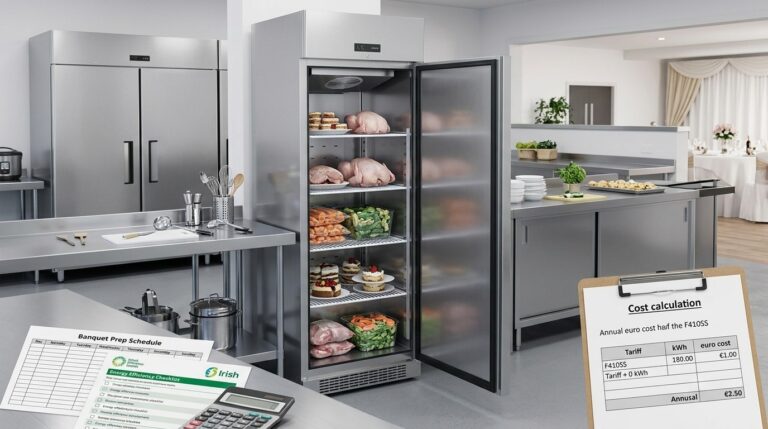
Unifrost F410SS Upright Freezer: Energy Planning Guide for Irish Hotel Banqueting Kitchens
Explore energy-saving tips for the Unifrost F410SS in Irish hotel banqueting kitchens.
Read guide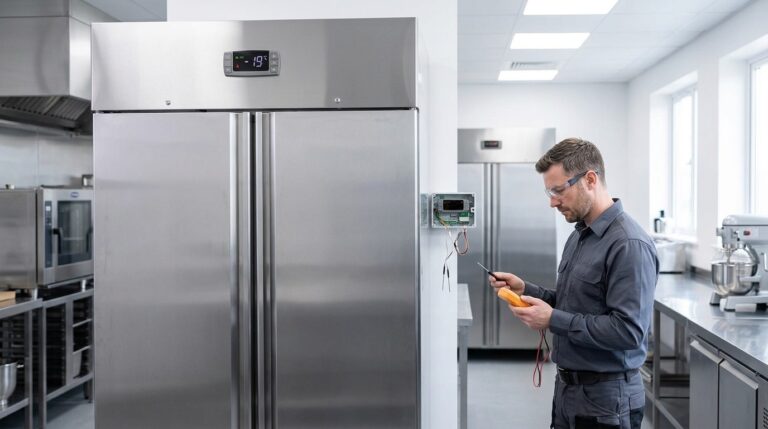
Unifrost Upright Freezer Temperature Controller: Wiring, Probe Replacement – Owner vs Engineer Guide for Irish Kitchens
Learn if Unifrost upright freezer probe replacements can be self-done, how wiring differs by model, and when to call an engineer in Irish kitchens.
Read guide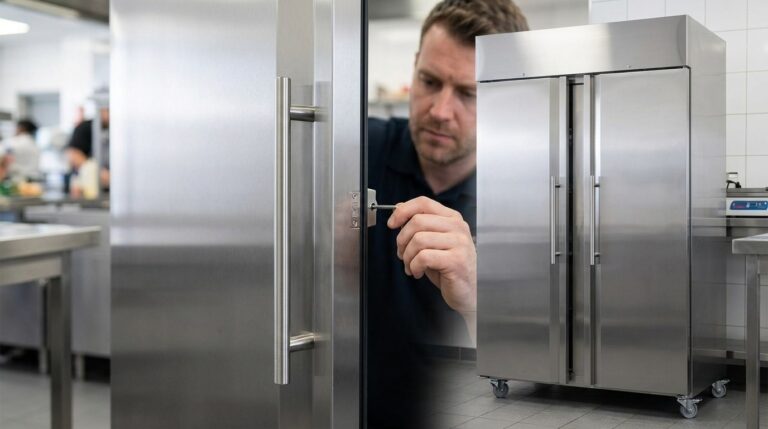
Adjusting Unifrost Upright Freezer Door Handles in Irish Kitchens
Guide for Irish kitchens on adjusting Unifrost upright freezer door handles to ensure proper sealing and energy efficiency.
Read guideCompare Unifrost freezer options on Caterboss
For current product options, pricing and availability, continue to Caterboss.