
Unifrost Undercounter Fridge Freezer Replacement Shelves, Runners, GN Racking Parts Guide
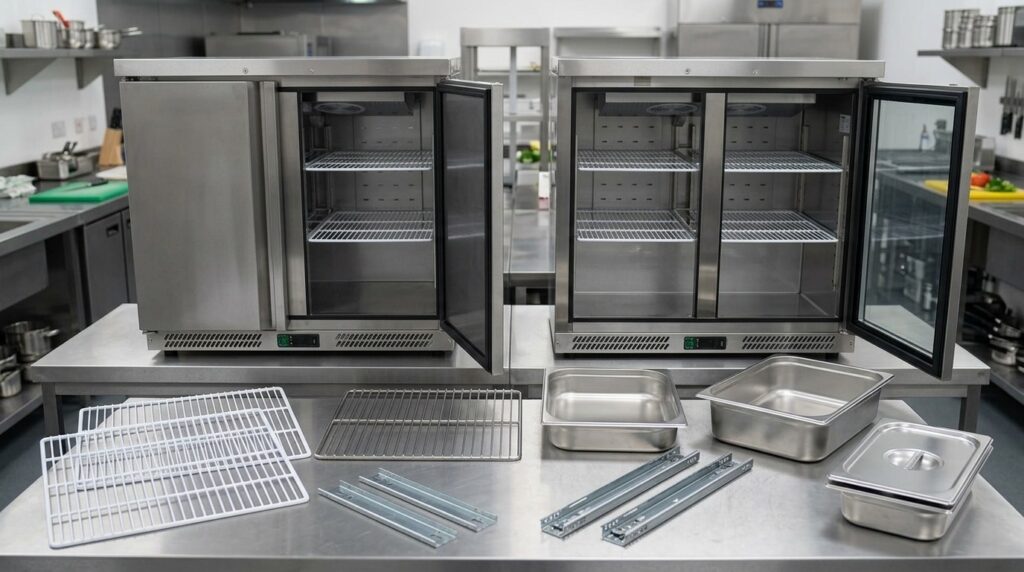
Guide to Unifrost undercounter fridge/freezer replacement parts, including shelves and GN racking in Ireland.
Unifrost Undercounter Replacement Shelves, Runners and GN Racking Parts Guide
If your Unifrost undercounter fridge or freezer is missing shelves, has bent runners, or you want to switch to GN pan storage, you need to match the right parts to the exact cabinet you run. Ordering the wrong shelf size or runner type costs you time, reduces usable capacity, and can hurt airflow and temperature consistency.
This guide walks you through the practical checks you make before you buy for Unifrost R200SN / R200SNOG, R200SV / R200SVNOG and F200SN / F200SNOG units: how to confirm model details, identify whether you have wire shelves, GN runners or a mix, and what measurements to take when parts are missing. You will also see the tradeoffs between full GN racking and flat shelving, how mixing pans and shelves affects loading and airflow, and what to look for when choosing genuine or OEM replacement parts in Ireland. Finally, you will get install and maintenance tips so new shelves and runners last longer and do not jam, rust, or damage the cabinet liners.
Understanding Compatibility with Unifrost Models
Compatibility depends on the exact Unifrost undercounter model and the racking it was supplied with. “Undercounter” describes the footprint, not the internal shelf and runner system. In Irish kitchens, getting the right racking matters for day-to-day workflow, cleanability, and inspection routines. The FSAI’s HACCP guidance is clear that equipment needs to be maintained in a condition that supports safe food handling. Practically, two cabinets that look similar can take different shelves, runner sets, or GN supports, and the wrong parts often lead to pans that don’t sit properly or shelving that restricts airflow.
R200SN and R200SV: “what fits” comes down to the internal supports
For Unifrost R200SN and R200SV undercounter fridges (including “OG” variants), replacement shelves and runners need to match the mounting points already inside the cabinet. Some units are set up for wire shelves on shelf clips, while others are set up for runner-style supports, but you cannot assume one R200 variant shares the same side rails as another just because the door and external size look the same.
A useful way to frame it is:
Replacing like-for-like: same shelf type, same fixing points, quickest and least hassle.
Changing how you use the cabinet: for example, moving from general storage to GN pan storage for faster service. That can work, but only if the cabinet has the right internal rail system.
F200SN: racking affects airflow, icing, and temperature recovery
On Unifrost F200SN undercounter freezers (and “OG” variants), shelves, baskets, and runners are not just storage add-ons. They affect airflow and how quickly the cabinet recovers temperature after repeated door openings during service, which is where freezers tend to struggle first.
Overloading, blocking the back wall, or fitting racking that encourages product to sit tight against airflow paths can make icing and temperature swings more likely. It’s not that you “can’t” store GN pans in a freezer. It’s that the racking and loading routine need to suit how the cabinet moves cold air.
Shelves vs GN runners vs baskets: what each suits in an undercounter
Wire shelves: flexible for mixed stock and packaged items. Easy to re-space, but less structured for prep.
GN runners: best for high-churn prep and portion control. Pans slide in and out quickly, and staff can keep a consistent layout during busy periods.
Baskets (mainly freezers): handy for bagged product and smaller items, but they can also turn into “pile and forget” storage unless labelling and rotation are tight.
Mixing types can work if it doesn’t create dead zones where cold air can’t circulate and you can still clean properly around corners and supports.
A compatibility check that works before you order parts
To avoid buying “nearly right” shelves and runners, use a quick, practical check:
Confirm the exact model code from the rating plate (R200SN vs R200SV vs F200SN, and whether it’s an OG/NOG variant).
Identify what you have now: wire shelves with clips, fixed side rails for runners, or baskets.
Check the internal side walls for fitted vertical rails, punched mounting positions, or brackets that indicate runner compatibility.
Measure the usable internal width and depth of what you’re replacing, and note how it’s retained (clips, hooks, slides).
Decide whether you’re replacing missing parts or changing the working setup (prep-pan GN storage versus general storage).
Converting from shelves to GN pan runners: when it’s realistic (and when it isn’t)
Converting an R200SN/R200SV from wire shelves to GN runners can be straightforward if the cabinet already has the correct side rail system and you’re simply adding runner sets. It gets awkward when the cabinet only has shelf clip positions and no runner rail infrastructure, because you may need additional, model-specific parts to create a stable and cleanable runner setup.
For the F200SN freezer, do an extra reality check. GN runners can speed up service, but only if:
pans won’t obstruct airflow,
doors won’t be held open for long periods,
and the cabinet isn’t already working in a hot, tight spot (beside a cooker line, under a busy pass, or in a cramped alcove).
In those locations, a simpler racking layout that supports quick grabs without overfilling is often the more reliable choice.
What to do if you’re not sure what your unit was supplied with
A lot of “missing shelves” situations come from cabinets being moved between sites and clips, runners, or supports being left behind during de-install. If you’re unsure what’s missing, look for unused mounting points and wear marks on the side walls. Then match that against what you’re seeing day-to-day: pans that rock, shelves that won’t sit level, or runners that stick after cleaning usually point to a mismatch or incomplete setup.
Once you’ve confirmed the model code and the internal mounting style, you can identify the right parts without guesswork and avoid downtime caused by returns and re-ordering.
Identifying Parts for Replacement
To identify the correct replacement shelves, runners, or GN racking for a Unifrost undercounter fridge or freezer in Ireland, work from the unit’s rating plate first, then confirm what fitting system is actually in the cabinet, and only then measure. Most wrong orders come from guessing based on “it’s a 200-litre undercounter” rather than matching the exact model and mounting points.
If anything is bent, corroded, or no longer cleanable, treat it as a food safety maintenance job rather than a “make it do for now” fix. The FSAI’s good hygiene practice guidance is clear that equipment should be kept clean and in good repair: https://www.fsai.ie/getattachment/f3efa69d-8010-4a7c-b093-7b53700bfb81/guide-to-good-hygiene-practice-cml-final-2014.pdf?lang=en-IE
1. Confirm the exact Unifrost model and serial from the rating plate
Check the rating plate and write down the full model code and the serial number exactly as shown (for example: R200SN, R200SNOG, R200SV, R200SVNOG, F200SN, F200SNOG).
On undercounter units, the plate is commonly found:
Inside the cabinet wall
On the door frame area
On the rear service area
Don’t skip suffixes. A small code difference can mean different internal fittings, and that’s how “nearly right” shelves and runner sets turn up.
2. Confirm the fitting type in the cabinet (not just what’s sitting on it)
Open the unit and identify the support system:
Wire shelves: usually sit on clips or side supports.
GN runners/rails: fixed rails designed for gastronorm trays to slide in and out.
Baskets: more common in some freezer set-ups, depending on configuration.
Make a quick count of what you have versus what should be there. In busy kitchens, shelves often get swapped between units during service and go missing for weeks. Confirm the full set before you order.
3. Take clear photos so you can match parts quickly
Photos reduce back-and-forth, especially if the unit has been changed over time (for example, moved from shelves to GN runners, or running a mix).
Take photos in good light and include a tape measure in at least one shot:
Rating plate showing model and serial
One full internal photo showing both side walls
Close-ups of mounting points where runners or shelf supports attach
Close-up of any damaged clip, rail end, or runner
4. Measure the shelf or runner and the mounting points
Measure the part you’re replacing, not just the open space in the cabinet.
For shelves:
Shelf width and depth
Any lip/edge shape that affects how it sits
Whether it uses specific clips or brackets
For GN runners:
Runner length
Centre-to-centre spacing between fixing points (where relevant)
How many runner levels you’re using day to day
Also check how the cabinet is set up to take fittings: fixed rails, removable clips, or pre-punched positions along the side walls. These details matter more than a rough “fits a 1/1 GN” assumption.
5. Sanity-check how the unit is used (to stop repeat failures)
Before re-ordering like-for-like, check whether the current setup suits the workload.
Common issues that cause bent supports and temperature problems:
Loading heavy GN pans on light shelf setups
Mixing shelves and GN trays in a way that restricts airflow
Overcrowding the cabinet so air can’t circulate properly (leading to warm spots or icing)
In practice:
Choose GN runners when you need fast tray-in, tray-out prep and service.
Choose wire shelving when you need flexible storage for mixed containers and packaging.
With the model/serial, clear photos, and accurate measurements, you can match the correct shelf, runner, or GN racking with far less risk of ordering the wrong kit.
Purchasing Genuine Parts in Ireland
For shelves, runners and GN racking, order against your exact Unifrost model and serial number. “Near enough” parts often don’t sit square, can snag under load, and may interfere with airflow once the unit is busy. Irish HACCP expectations also rely on equipment being kept maintained and fit for purpose, including storage and handling equipment, as set out in the FSAI’s guidance on HACCP-based procedures and prerequisite programmes.
In practice, the buying route comes down to urgency. If you need to stay trading, you might source faster locally. If you can plan the job, it’s usually worth waiting for the correct OEM part and confirming compatibility first.
Where Irish operators typically source Unifrost shelves, runners and GN racking
For the Unifrost undercounter models in scope (R200SN, R200SNOG, R200SV, R200SVNOG, F200SN, F200SNOG), the most reliable route is to source through Caterboss so the parts match the cabinet’s fixing points and original accessory options. This is especially relevant if you’re moving between wire shelves and GN runners, or if the interior has been mixed over time and you want a consistent setup for service.
If you use a local refrigeration contractor for call-outs, they can also be a good channel for OEM parts. They can confirm fitment on-site and flag the real causes of repeat issues, such as bent supports, cracked shelf clips, worn runner sockets, or door alignment problems that worsen icing. The trade-off is time: if they arrive without the right part identified, you can lose a visit. Having the model, serial, and clear photos ready still matters.
“Universal” shelves and runners can work for light-duty storage, but they’re the riskiest option in a busy kitchen. You’re guessing clearances, load rating, and how the shelf sits relative to the evaporator cover and door seal. In high-turnover cafés, takeaways, and hotel prep areas, that guesswork usually shows up as unstable GN pans, damaged runners, hot spots, or more icing and defrost disruption.
What to provide when ordering, so you don’t buy parts twice
To get the correct shelves, runners or GN racking first time, send:
Model number (for example R200SN or F200SN)
Serial number from the rating plate
Clear photos of the current interior, showing the shelf support points and any rails/clips
One measurement of the internal width and depth you’re trying to fit
Also tell the supplier whether you’re replacing like-for-like or changing the layout (for example, switching from wire shelves to GN runners). Conversions often need extra brackets or rails, even when the cabinet looks identical from the outside.
Genuine versus “will fit” parts: what changes in day-to-day use
Genuine/OEM shelves and runners are mainly about predictable handling under pressure. Shelves seat properly, GN pans sit square, and you avoid rattling and wear when staff are moving fast. Fit also affects performance: a poorly positioned shelf can disrupt airflow and create uneven temperatures, which tends to show up as warm spots in one area and icing building up in another.
If you’re near the coast, dealing with high humidity, or using strong cleaning chemicals, ask about corrosion resistance and cleaning compatibility before you buy. A cheaper shelf that pits, rusts or sheds coating becomes a hygiene and labour problem quickly.
Keeping downtime and cost under control when you’re mid-service
If a shelf or runner fails during trading, prioritise a safe, stable interior over maximum capacity. Running one shelf down for a few days is usually less risky than overloading a compromised runner set and ending up with a collapse, damaged stock, or a food safety incident.
In busy pubs, fast-casual kitchens and contract catering, shelves and runners are effectively consumables. Where you have multiple similar undercounter units, standardising the internal layout makes life easier. You can keep one spare shelf and a set of supports on hand, and avoid emergency sourcing when the kitchen is already under pressure.
With sourcing sorted, the next step is identifying the exact part you need based on what’s currently fitted and what’s missing.
GN Pans and Shelves Usage
What works best depends on what you’re storing, how often the door is opened, and how tight your service rush is. GN pans on runners and wire shelves behave differently because they change how air moves inside a compact undercounter cabinet.
The Food Safety Authority of Ireland guidance on temperature control is clear on the basics: if you overload a fridge or put warm food into it, cabinet temperature rises. The same practical rule applies when an undercounter is packed with deep pans or tightly wrapped trays. Your aim is simple: keep air moving around the load so the unit can recover quickly after openings.
When GN runners make sense (and when they cause trouble)
GN runners are worth it when you’re in and out of pans all service, for example on a pass, prep line, or a busy takeaway section. They speed up changeovers, reduce decanting, and give staff a defined place to put pans so you’re less likely to find product “temporarily” sitting on the cabinet floor.
They can cause trouble when deep GN pans are packed tight, lidded hard down, or pushed in so close that airflow is restricted. In a freezer, that restriction often shows up as heavier icing and slower recovery after door openings because the unit is trying to shift cold air around a blocked load.
When wire shelves are the safer day-to-day option
Wire shelves are the more forgiving choice for mixed stock and varied pack sizes, which is common in pubs, smaller hotels, and cafés. The open structure supports more even circulation around wrapped trays, gastronorm containers, dairy, and prepped veg, reducing the risk of warm pockets in corners and along the back.
They also make day-to-day cleaning and checks easier. If you’re doing routine inspections for spills, leaks, and packaging failures, wire shelves help you spot problems quickly and keep your HACCP routine realistic in a busy kitchen.
Mixing GN pans and wire shelves without killing airflow
Mixing can work well in an undercounter, but only if you treat airflow as non-negotiable. The usual problem setup is full-width pans on runners plus extra boxes or spare pans wedged above. That turns the cabinet into a tight drawer system with limited space for air to circulate.
A practical approach is to keep one “service layer” on runners for your most-used items, then use wire shelving above or below for lighter or awkward-shaped stock where circulation and visibility matter. If you notice product freezing at the back of a fridge, or soft stock near the door in a freezer, it’s often a loading pattern issue before it’s a control fault.
Practical loading rules that reduce temperature swings and icing
Leave clear gaps around pans and packs, especially at the back and sides, so air can circulate and recover quickly after door openings.
Don’t overfill pans or compress product against the sides. Dense loads chill unevenly and can drive temperature swings.
Keep heavier items low and stable. Don’t let pans sit on bent runners or worn supports, as it leads to jams and poor door closing.
Avoid putting hot food straight into an undercounter. Portion it down and cool it quickly first. Small cabinets don’t have the buffer of a larger upright.
What “poor airflow” looks like in a busy Irish kitchen
In fridges, early signs include persistent condensation in one area, inconsistent probe readings between top and bottom, and product that seems fine when you open the door but warms quickly during service. In freezers, you’ll often see frost building faster in certain corners, drawers sticking, or packaging picking up surface ice as the cabinet runs longer to compensate.
If the symptoms started after switching from wire shelves to GN runners, or after removing shelves to fit taller pans, treat it as a configuration issue first. Restoring spacing and improving how the cabinet is loaded is often the quickest fix.
Getting airflow right is half the battle. The other half is ordering the correct shelves or runners for your specific Unifrost undercounter, which starts with confirming exactly what configuration your cabinet was supplied to take.
Installation and Maintenance Tips
Fit the right runner system for your cabinet, level the unit so shelves sit square, and load it in a way that keeps airflow moving. Then clean and inspect little-and-often so runners do not bind, clips do not crack, and icing does not turn into forced damage. These checks also sit neatly inside your normal HACCP routine.
1. Level the cabinet and give it breathing space before you fit anything
If an undercounter is rocking, twisted, or jammed tight into a void, shelves and runners take the strain. In a busy café or pub, that usually shows up as sticky shelves, runners popping off their mounts, or doors that need a shove to close.
Level the unit on its feet or castors so the door closes cleanly and shelves sit square.
Keep the ventilation space the manufacturer expects around the cabinet and grille areas.
Poor airflow typically means higher cabinet temperatures and more condensation and icing. That, in turn, makes runners harder to move and more likely to be forced and bent.
2. Choose a storage setup that matches your service (wire shelves vs GN runners)
Before you start fitting parts, decide how the section will be used day-to-day:
GN-first: pans sit on runners for fast prep access and portion control.
Shelf-first: wire shelves for mixed storage, cartons, tubs, and boxed stock.
Mixing both can work, but only if you keep clear air paths and avoid blocking the back wall and any fan area. Undercounter units depend on airflow to pull temperature back quickly after frequent door openings.
If you are fitting replacement runners, make sure left and right sides are correctly paired and fully seated on their mounting points. Half-seated runners flex under load, which is when clips crack and racking starts to distort.
3. Load for airflow and longevity (most “failures” are loading issues)
Runner and shelf damage is often caused by rushed loading rather than faulty parts.
Keep heavy items low.
Avoid point loads, for example one heavy pot on a single wire shelf.
Do not use shelves or runners as a lever to free tight pans.
Leave space around containers and pans so cold air can circulate. When cabinets are packed tight, frost and ice build faster, and staff end up forcing pans and shelves. That is when runners twist and shelf edges get damaged. For food safety handling and storage routines, keep your approach aligned with FSAI guidance on HACCP-based food safety management procedures.
4. Clean runners and shelves to prevent binding and corrosion
Undercounters sit low and pick up grit, sugar, salt and spillages quickly, especially beside a coffee station, bar service area, or pot wash.
A practical routine:
Remove shelves and runners for deep cleaning.
Wash with a food-safe detergent, rinse, and dry fully before refitting.
Avoid leaving moisture sitting in clips and mounting points.
Avoid aggressive scouring pads on coated wire, and do not let chlorine-heavy products sit on metal parts. In real Irish kitchens, that combination speeds up pitting and rust, particularly in coastal areas and around strong warewashing chemicals. If you routinely run shelves through the dishwasher, keep an eye out for coating blisters or flaking and replace parts early. Once the coating breaks, corrosion tends to follow.
5. Inspect for wear, then fix the cause (not just the broken part)
If shelves start dropping, runners flex, or GN pans stop seating square, treat it as an early warning.
Check for:
cracked shelf clips
bent uprights or racking
missing mounting screws
ice build-up forcing parts out of alignment
If icing keeps coming back, swapping runners will not solve it on its own. Look at door gaskets, how long doors are held open during service, and whether warm food is being put into the cabinet. These habits shorten the life of fittings and can undermine temperature control. Keep your checks aligned with FSAI temperature control expectations for chilled food safety.
Getting these basics right makes it easier to identify what has actually failed, what is missing, and what you need to order for your specific Unifrost cabinet.
Connecting with Unifrost Support Resources
If you want a quick fix on shelves, runners, and GN racking, treat it as parts identification, not trial and error. The Food Safety Authority of Ireland’s Guide to Good Hygiene Practice is clear that equipment should be kept in good repair, and in a busy kitchen that usually means getting the right part first time.
What you need depends on the exact undercounter model code and what the cabinet shipped with. A shelf or runner that looks “near enough” can sit at the wrong height, interfere with loading GN pans, or put pressure on the door seal. That shows up later as slower temperature recovery during service.
What Unifrost support resources actually help with
For undercounter spares, you are usually trying to do one of three things:
Confirm compatibility (shelf vs runners vs GN racking, and what “GN compatible” means in day-to-day use).
Identify the correct part reference so you can order once and move on.
Stop a repeat failure (bent runners, broken shelf clips, corrosion, or icing caused by poor airflow and overloading).
The right manual should confirm the part name or reference and the correct fitting position. That is how you avoid parts that physically fit but don’t hold up in a working Irish kitchen.
If you are sourcing parts through Caterboss, these resources also help you separate “can wait” from “needs doing now”. A missing shelf clip is a small fix, but it prevents shelves tilting and spills. Loose or corroded runners are different. They can lead to unstable loads, door damage, poorer sealing, and temperature drift.
Manuals, parts lists and diagrams: where to look and what they’re used for
For shelves and runners, the two most useful items are:
The user manual for cleaning, loading, and safe handling.
Any exploded diagram or parts list to match the exact shelf, rail, clip, or runner set.
Even within the same cabinet family, revisions happen. Use the document that matches your rating plate details, not a product photo you found online.
If you cannot find a model-specific parts diagram immediately, search Unifrost.ie by the model code (for example, “R200SN manual” or “F200SN parts”) and save the PDF locally. Keep it with your HACCP paperwork and maintenance file. When something breaks on a weekend shift, having the correct document to hand reduces Monday-morning downtime.
What to have ready before you contact support or order parts
The difference between one email and three is the quality of the info you send. Have this ready:
Model code and serial number from the rating plate (don’t rely on a delivery docket description).
Whether it’s a fridge or freezer, and solid door or glass door (suffixes like “OG” matter).
Clear photos of the interior side walls where runners mount, shelf supports, and the door closing edge.
How you load it: wire shelves, boxed product, GN pans, or mixed storage.
Measurements of what you’re replacing (shelf width/depth, usable distance between side supports, and the shelf spacing you need to keep).
Measurements matter in Irish kitchens where prep space is tight. If you change shelf spacing to suit GN pans but you still need boxed dairy or dessert trays, you can lose usable capacity even though you’ve “added more shelves”.
Troubleshooting before you blame the shelves (common undercounter issues)
A lot of “runner problems” are really loading or airflow problems.
If GN pans or shelves are pushed tight to the back wall, or the cabinet is packed after a delivery, you can see warm spots, slower pull-down, or freezer icing. That icing then makes shelves feel like they’re sticking or sitting skewed.
Check the basics as well:
The cabinet is level (a slight lean makes shelves slide and sit oddly).
The door gasket seals properly (poor sealing pulls moisture into freezers and speeds up icing).
The cabinet has enough breathing space for ventilation.
Support notes are useful here because they help you fix the cause, not just replace the symptom.
When to escalate to parts identification instead of trial-and-error ordering
Move to proper identification when:
The cabinet is critical during peak service (pub food, café lunch, hotel breakfast).
You need proper GN compatibility, not “close enough”.
The unit is in a high-corrosion environment (coastal sites, heavy chemical cleaning, fish handling).
In those situations, the wrong shelf or runner is more than an annoyance. It can lead to unstable loads, door damage, poorer temperature control, and extra call-outs.
With the model details, photos, and measurements above, you can usually confirm the exact shelf, runner, GN rail, or fixing clip you need, and what will and won’t interchange across the Unifrost R200 and F200 undercounter models.
FAQs: Unifrost undercounter shelves, runners and GN racking
How do I find the right replacement shelves or runners for my Unifrost undercounter fridge?
Start by confirming the exact model code on your rating plate (for this range it will typically be one of R200SN, R200SNOG, R200SV, R200SVNOG, F200SN, F200SNOG). Then:
Identify what you’re replacing: wire shelf, shelf clips, side runners, or full GN racking. A quick phone photo of the cabinet sidewall and the existing supports helps avoid mismatches.
Check the fixing style: some supports are left/right handed and some sets are sold as a pair.
Measure before ordering if the original part is missing: internal width, usable depth, and the spacing between support points.
If you’re unsure, send the model/serial details plus photos of the interior to your parts supplier and ask them to confirm compatibility before you buy.
Are GN pans compatible with Unifrost undercounter fridges?
They can be, but it depends on what racking is fitted in your cabinet.
If your unit has GN runners/rails, you can usually load GN containers directly onto the runners.
If it has flat wire shelves, GN pans may not sit securely without a compatible GN support kit.
The simplest check is practical: if you can place an empty GN pan in the cabinet without rocking or fouling the door seal, and you can still maintain clear airflow around it, it’s a suitable setup. If not, you’ll need the correct GN runner set for your specific model.
Where can I buy genuine Unifrost spare parts in Ireland?
For genuine or OEM-compatible Unifrost shelves, runners and racking in Ireland, use a specialist catering equipment supplier that can match parts to your model and serial details.
When ordering, have ready:
Model code (for example R200SN or F200SN)
Serial number from the rating plate
A photo of the cabinet interior and the part you need (or what’s missing)
That information is usually enough for the supplier to confirm the correct shelf or runner set and avoid incorrect “universal” parts that don’t line up or corrode prematurely.
Next step: choose the right undercounter base unit
If you’re comparing models or replacing an older unit entirely, it can be easier to start with a cabinet that matches how you actually store food day to day, whether that’s wire shelving or GN pan racking.
Browse Caterboss’s current range of undercounter fridges to compare Unifrost options and then match accessories and spares to the exact model you choose.
Compare Unifrost freezer options on Caterboss
For current product options, pricing and availability, continue to Caterboss.