
Guide to Unifrost Upright Freezer Mixed GN Pan and Wire Basket Layout
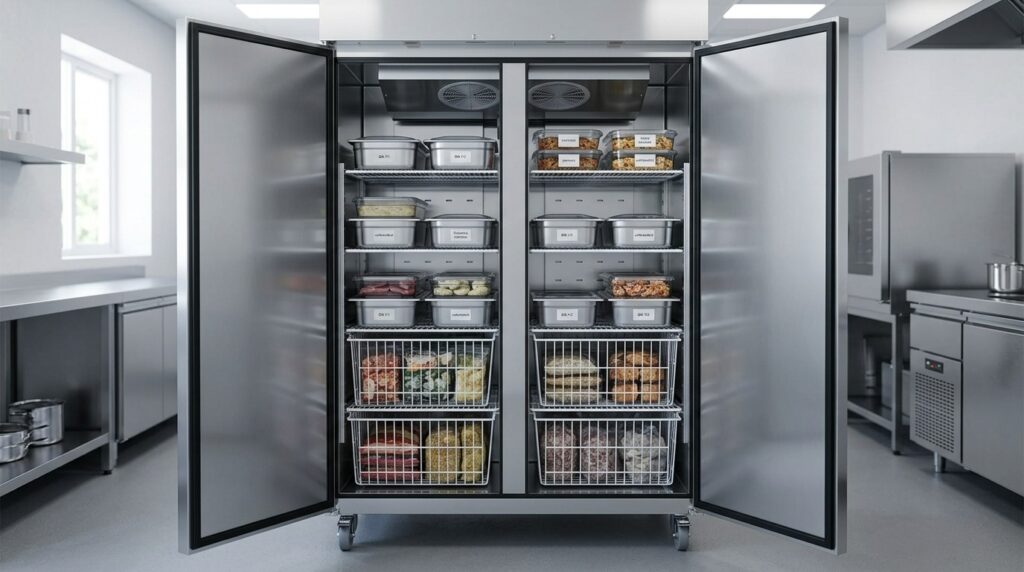
Discover optimal GN pan and wire basket layouts in Unifrost upright freezers for Irish kitchens. Boost storage efficiency and workflow.
Unifrost Upright Freezers: Mixed GN Pan and Wire Basket Layout Guide
You use an upright freezer to protect stock value and keep service moving, but the wrong mix of GN pans, shelves, and wire baskets quickly costs you space, slows picking, and creates temperature and food safety risks. This guide helps you configure a practical mixed layout in Unifrost upright freezers, including common Irish choices like the F1000SV, F1300SV range, F1310SV, F410SS, and F620SV.
You will work through the real decisions that matter before you buy accessories or reshuffle stock:
Choose what lives in GN pans vs baskets based on portioning, picking speed, and contamination control.
Check GN compatibility and stability so mixed pan sizes do not tip, snag, or block door closure.
Balance capacity with airflow so packed shelves and deep pans do not create warm spots or longer pull down times.
Set a repeatable zoning plan for raw, ready to eat, allergens, and high value items.
Decide when to add or retrofit accessories like extra shelves, runners, and baskets supplied via Caterboss, and what to ask for when quoting.
By the end, you have a layout you can implement immediately, plus a shortlist of checks to confirm before you commit to a specific Unifrost upright model or a mixed GN and basket kit.
Why GN Pan and Wire Basket Layouts Matter
A mixed GN pan and wire basket layout matters because it affects three things you feel every day: how quickly staff can pick product, how well the cabinet recovers temperature after door openings, and how much stock you can actually access without losing it at the back.
It also feeds into your food safety routines. Under HACCP, you are expected to keep chilled and frozen foods within safe limits as part of your food safety management system, and that depends on day-to-day handling as much as the set temperature. See the Food Safety Authority of Ireland (FSAI) principles of HACCP/principles-of-haccp). More “storage” is not always better if pans, boxes, or overfilled baskets block airflow, create warm spots, or slow your team down in service.
Service speed and labour: the freezer should match your workflow
In many Irish kitchens, the upright freezer is right where prep meets service: cafés pulling pastries and portions, pub kitchens working carvery and evening trade, takeaways flying through chips and breaded lines.
GN pans suit portioning, repeatability, and clear labelling. Staff can lift, decant, cover, and get the door shut again.
Wire baskets suit sealed, grab-and-go items like chips, veg, and breaded products where you do not want stacks collapsing or bags wedged behind trays.
The mixed approach works because you use pans where accuracy and traceability matter, and baskets where speed matters, without turning every shelf into a rummage.
Food safety and stock control: separation only works if the layout makes it easy
If you are separating allergens, raw, and ready-to-eat items, the container system is what makes the rule stick on a busy Friday.
Lidded GN pans reduce spills and cross-contact risk, and they are straightforward to label with product name, prep date, and use-by.
Baskets are fine for sealed packs, but they can encourage overfilling and mixed batches unless you allocate them by product type and keep them shallow enough for proper rotation (FIFO).
The practical question with an upright freezer is not “how many GN” on paper. It is whether your shelves and baskets make separation, labelling, and rotation simple enough that it happens consistently.
Temperature stability and running costs: airflow is the hidden constraint
Freezers perform best when cold air can circulate around product and return freely to the evaporator. Layout choices can undermine that:
pans crammed tight edge-to-edge
product stacked above the pan lip
baskets stuffed to the back or packed solid
All of these slow temperature recovery after door openings. In real terms, that can mean longer compressor run time and more frost management.
Treat layout as part of the install and day-to-day operating plan, not just an accessory choice. The right mix of pans and baskets helps you hold steadier conditions during service, protect product quality, and reduce the risk of temperature excursions. If you are comparing cabinet options, focus on whether the shelf and basket configuration suits your menu and service pattern, not just the headline capacity.
Key Considerations for Effective Layouts
Start by deciding what belongs in GN pans versus wire baskets, based on portioning, picking speed, and how often the door is opened during service. Then set shelf heights and zones so you are not blocking airflow, and so raw, allergen and ready-to-eat items stay separated in day-to-day use. Finally, put a labelling and rotation routine in place that still works at peak, not just on a quiet Tuesday. If you change the internal fit-out, be realistic about loading. Overpacked uprights are a common cause of warm spots and avoidable stock loss.
1. Choose GN compatibility based on what you actually store (not what you hope to store)
Upright freezers often get bought on the assumption they will run like a full gastronorm rack. In practice, “GN-compatible” usually means you can use GN pans on shelves or runners, not that every cabinet behaves like a dedicated GN trolley system.
For a mixed layout:
Use GN pans for items you portion and pull repeatedly: pre-portioned proteins, sauces, pastry sheets, chopped veg blocks.
Use wire baskets for awkward packs and volume lines: chips, boxed goods, frozen desserts, bread.
That choice is about speed and control. Baskets are quicker for grab-and-go. GN pans are better when you need consistent portions and clear stock visibility.
Decide early whether you are running a freezer-only set of GN pans and lids. Sharing with the hot kitchen sounds efficient, but it often breaks down in real service: lids go missing, pans come back dented, labels change, and the freezer turns into a dumping ground.
2. Zone the cabinet for food safety and service flow before you start moving shelves
Before you chase capacity, set zones that staff can follow under pressure. The Food Safety Authority of Ireland highlights that separating raw and ready-to-eat food is essential to prevent cross-contamination, including drip contamination from raw foods onto ready-to-eat items (FSAI guidance on cross-contamination).
A practical zoning approach for a mixed GN and basket freezer:
Busy restaurant pass: keep baskets at mid-height for fast movers (chips, bread, garnish). Keep GN pans of pre-portioned mise en place on upper shelves where they are easy to see and less likely to be crushed.
Cafés and delis: prioritise baskets for retail packs and baked goods, and keep one or two GN shelves for batch-prep so portion cost stays under control.
Hotels and higher-volume kitchens: use a simple “top-down” hygiene logic: ready-to-eat and cooked items above, raw items below. Keep allergen-heavy stock in one clearly labelled area so it does not migrate.
If you cannot maintain separation because the freezer is always full, that is rarely a layout problem. It is a capacity problem. In practice, it often means adding a second upright or shifting bulk lines to a separate storage area.
3. Set shelf spacing for stability and airflow, especially with deep pans and baskets
Adjustable shelving is what makes a mixed layout workable. Set shelf heights around the tallest item in each zone, then leave enough clearance for air to circulate. Lids, overfilled pans, and sagging baskets are the usual airflow killers.
Deep GN pans can work well, but they are often where problems start:
Keep pans sitting flat and stable on the shelf.
Avoid filling above the rim or pushing pans tight to the back wall.
Do not stack pans unless you have a setup designed for it.
Make sure baskets do not sag into the airflow path.
A quick reality check is door-open recovery. If the door is opening constantly during service, an overpacked cabinet will swing in temperature far more than one with sensible spacing, even if the controller setting is identical.
4. Lock in labelling, rotation, and a “back to layout” discipline
A layout only holds if stock goes back to the same place after prep and service. Use large, readable labels on GN pans and basket loads, and standardise what gets written. At minimum: product name, prep or freeze date, and who prepped it so issues can be traced quickly.
If you freeze certain raw products, EU labelling rules require a “Frozen on …” date for frozen meat, frozen meat preparations and frozen unprocessed fishery products, as outlined in the FSAI summary of freezing date labelling requirements. Even where that specific rule does not apply, consistent dating and rotation reduces waste and stops the “mystery tubs” building up at the back.
Keep the system maintainable. If your “perfect” layout relies on one person remembering where everything goes, it is not a layout. It is a memory test, and it will unravel within a fortnight.
Common Mistakes and How to Avoid Them
A mixed layout of GN pans and wire baskets can work well in an upright freezer, but the problems show up quickly if the layout is improvised. You typically see uneven freezing, slower recovery after door openings, longer “door open” time during service, and more waste from crushed packs, spilled pans, or items disappearing to the back. In a busy café, takeaway, or hotel kitchen, that turns into extra pressure on staff and messier HACCP routines, especially around stock rotation and keeping foods protected and separated.
Blocking airflow by overfilling shelves or packing baskets too tight
The most common mistake is packing baskets to the brim or pushing GN pans tight to the back and sides. Upright freezers rely on air circulation to hold temperature evenly and recover after the door is opened.
Leave clear gaps around pans and baskets, especially at the back and sides.
Avoid building a single dense layer of product. If you need more usable space, it’s usually better to spread fast-moving items across two working levels than to compress everything into one shelf that freezes unevenly.
Mixing GN sizes without a stable base (tipping, cracked lids, spills)
Mixing 1/1, 1/2, 1/3 and smaller GN pans on the same shelf without a set pattern leads to tipping when someone pulls a pan during service.
Treat each shelf like a workstation: either use full-width pans that sit flat, or stick to a fixed pattern so smaller pans can’t shift.
If your team is often working one-handed mid-rush, fewer, more stable pans will beat squeezing in extra inserts that end up on the floor.
Letting baskets become a “miscellaneous” zone (rotation and allergen control)
Wire baskets are ideal for bagged and portioned items, but they become a problem when everything gets dumped together and rotation becomes guesswork.
Keep each basket to one category (for example chips, bakery, pre-portioned proteins).
Label the front clearly so it’s obvious during a busy service.
Keep allergen-containing items in a dedicated, clearly marked zone, and don’t rely on “everyone knows” once staff change or shifts overlap.
A simple routine that works: new stock to the back or bottom of that basket category; anything unlabelled gets held aside for identification rather than left circulating.
Assuming accessories fit across models without checking
It’s common to order extra shelves, runners, or baskets assuming they’re interchangeable, then find they don’t match the cabinet’s internal supports. Before retrofitting Unifrost upright freezers (including ranges such as F1000SV, F1300SV, F1310SV, F410SS and F620SV), confirm accessories are specified for that exact model family and for the job you need (shelf vs basket vs GN support). If you’re setting up more than one site, standardising the layout by model reduces staff errors and avoids ending up with a store of nearly-right parts.
Get those basics right, and you can make layout choices based on the constraints that actually matter in Irish kitchens: airflow, retrieval speed, clear segregation for food safety, and how often the door gets opened during trading.
Optimising Layouts for Different Kitchen Types
In a Unifrost upright freezer, a mixed GN pan and wire basket setup is usually a trade-off between fast, tidy portion picking and fast bulk loading. GN pans suit portioned, flat, labelled storage where you need predictable picking and clear rotation. Baskets cope better with mixed cartons, awkward shapes, and quick restocks.
Both can work in Irish service, but only if you protect airflow and make the layout easy to follow when it’s busy. GN pans can backfire if they’re overfilled and packed tight, because you restrict circulation around the product. Baskets are more forgiving for deliveries, but they also encourage “freezer archaeology” unless labelling and rotation are disciplined.
Restaurant kitchens (high menu mix, high prep volume)
In most restaurant kitchens, the freezer is doing two jobs: holding prepped components and holding raw proteins. A practical mixed layout is:
GN pans at eye and hand level for prepped, date-labelled items you pick often.
Wire baskets lower down for sealed raw packs and bulk ingredients, with a clear “raw below ready-to-eat” rule in line with FSAI advice on separating raw and ready-to-eat foods.
If you’re using deeper GN pans, don’t pack them to the rim. Leave headspace and avoid wedging pans tight side-by-side, so the cabinet airflow isn’t forced through a solid block of frozen product.
For speed and consistency under pressure, it often works better to assign shelves by task rather than ingredient. For example: one run for “service back-ups” (chips, veg, desserts), another for “prep components” (sauces, portions), and “raw” isolated in baskets at the bottom. This makes checks quicker too, especially if you’re recording temperatures as part of your routine, as shown in the FSAI fridge/freezer temperature record example.
Cafés and delis (tight footprint, frequent door openings)
Cafés tend to open the freezer little and often for pastries, bakery, portions, and retail packs. This is where a basket-heavy layout usually holds up day-to-day.
Use baskets for quick “grab items” (croissants, scones, portioned soup blocks, ice) so staff can lift, take what they need, and return stock without unloading shelves. Keep one or two shelves for GN pans as controlled par levels for prep, so it’s obvious what needs batching before the lunch rush.
The common compliance headache in cafés is allergen cross-contact, especially when pastries, crumbed items, and labelled retail packs get mixed. A simple rule that works in real kitchens is to dedicate one shelf or one basket as an allergen-controlled zone, keeping labelling with the product, aligned with the checks in the FSAI Safe Catering Pack allergens guidance. If you cannot reliably keep items separated in one cabinet, you’re better off using closed, lidded containers consistently rather than mixing open GN storage with loose packs.
Hotels (banqueting peaks, multiple sections, handover between teams)
Hotels often have several teams using the same freezer: breakfast, banqueting, lounge, and sometimes room service. Mixed layouts work best when they’re standardised, so stock is easy to find during handover.
A sensible approach is:
GN pans for batch-prepped items that need strict rotation (banquet veg, purées, portions).
Baskets for bulk lines (chips, breads, ice cream tubs).
Shelf runs assigned by section, labelled in plain terms.
Before events, restocking is heavy. Leave at least one “landing zone” shelf partially empty so staff have somewhere to park deliveries without stuffing product into any gap. That’s how internal air paths get blocked and you end up with warm spots after a big drop.
If you do one thing for compliance in a hotel environment, make it consistency: same container types, same label position, and the same shelf map every day. It makes checks and corrective actions far more straightforward.
Takeaways and dark kitchens (speed, SKU churn, late-night closing)
Takeaways typically prioritise speed and volume, and freezer stock is often a mix of branded packs, bulk cartons, and high-churn ingredients. A basket-first layout usually fits best: one basket per core SKU family (chips, poultry, burger lines, veg sides), plus one dedicated shelf for “opened and in-use” stock kept in sealed, stackable containers so it doesn’t disappear behind cartons.
If you freeze prepped portions in GN pans, keep those pans on a separate shelf run. Don’t mix them in with loose boxes, or they’ll get tipped, crushed, or simply forgotten.
The main risk in takeaway settings is the end-of-night shove, when fatigue meets limited space. Keep the rule simple and visible: raw stays low, ready-to-eat and cooked stays above, matching FSAI guidance on preventing cross-contamination by separation. Once the layout works on paper, it only holds in practice if airflow, labelling, and rotation are managed every day inside the cabinet.
Recommended Accessories and Modifications
The best add-ons for a mixed GN pan and wire basket setup depend on what you are optimising for: portion control, pick-speed, or bulk storage. Most Irish kitchens need a bit of all three. The key is making it easy for staff to keep segregation, labelling and stock rotation consistent in real service conditions, in line with the FSAI’s HACCP guidance: https://www.fsai.ie/business-advice/haccp
One practical point that catches people out: “better organised” can mean slightly less tightly packed. In an upright freezer, access and air circulation matter as much as shelf count.
Unifrost-friendly accessories that make GN pans work better in uprights
If you are using GN pans in Unifrost upright freezers (for example: F1000SV / F1300SV variants / F1310SV / F410SS / F620SV), the most useful upgrades are the ones that stop pans shifting, improve visibility, and keep the internal layout consistent when stock builds up.
Extra wire shelves, plus the correct clips/supports for your exact model (handy as spares as well as increasing shelf density)
Wire baskets that sit on shelves to stop small packs sliding to the back and to create zones for GN 1/3, GN 1/6, or loose bags
GN pan supports, shelf mats, or low-profile dividers to reduce “pan creep” when you are mixing sizes on one level
Shelf-edge label holders and freezer-grade labels so date coding and allergen separation stay readable without handling every pan
Lockable castors or replacement feet (where applicable) to keep the cabinet level and the door closing properly after cleaning or moving
A buying detail worth checking: “GN-compatible” often just means a pan will physically sit on a shelf. A proper GN runner layout is a different fitment, so you want parts confirmed for your specific Unifrost model code.
Wire basket systems vs flat shelves (and when to use both)
Baskets suit fast-moving, small items that get grabbed repeatedly: chips, seafood portions, pastry, pre-portioned sauces, and retail-style packs. Flat shelves suit stable stacking, clear sight-lines, and predictable air gaps around larger items like boxed proteins or full GN pans that need to stay level.
A mixed layout that works well in busy Irish kitchens is the “heavy base, lighter top” approach: keep bulk and weight low, then put baskets and high-frequency items at mid-height where staff can see and reach quickly.
If baskets are icing up or snagging packaging, it is usually a layout issue rather than a “need more baskets” issue. Try:
fewer items per basket,
clearer labelling,
or swapping one basket row back to a flat shelf for awkward packaging.
Retrofitting and compatibility checks (what Caterboss needs from you)
Retrofitting can be possible, but it depends on the cabinet’s shelf support system and what factory parts exist for that chassis. Before you order GN runners, extra shelves, or baskets, you will save time by confirming the following with Caterboss:
the full model code (for example, F1000SV vs F1000SVOG)
the serial plate details
the current internal setup (how many shelves and what type)
what you are actually storing (GN pans, boxes, loose packs, or a mix)
If you are aiming for a mostly-GN freezer, ask specifically for runner kits or shelf configurations designed for GN loading, rather than improvising with generic rails. If you are aiming for mostly baskets, confirm basket dimensions and how they are meant to sit on the shelf system. The wrong basket can waste usable space or block access.
Small modifications that improve food safety and day-to-day discipline
Accessories are not just about fitting more in. In day-to-day Irish service, you are trying to make the correct action the easy action, especially for date rotation and allergen segregation when the kitchen is under pressure.
A few low-cost changes usually make the biggest difference:
dedicate one shelf or basket row per category (raw proteins, cooked ready-to-eat, allergens, desserts)
keep container types consistent within each category (GN pans for portioned mise en place, baskets for loose packs)
standardise where labels go so dates can be read without pulling items out
Once that foundation is in place, it is much easier to judge whether your shelf-and-basket layout is working, based on access, airflow gaps, and how it holds up at the end of a busy Saturday night.
Supporting Your Decision With the Unifrost Ecosystem
A mixed GN pan and wire basket layout works best when you plan it as a workflow decision, not just an internal fit-out. You want the same containers, labels and stock rotation habits to carry from prep, to service, to frozen storage. In Ireland, that also needs to stand up to day-to-day HACCP routines, including practical traceability, labelling and rotation, as set out in FSAI guidance on HACCP-based food safety management.
One practical point that catches people out: “GN-compatible” does not mean every pan depth, lid style and shelf position will be hassle-free in a freezer. Condensation, frost build-up, bulky packaging and gloves all change how easy it is to lift, slide and label stock. Plan your container set and cabinet layout together.
Where Unifrost upright freezer models fit a mixed GN and basket approach
Within the current Unifrost upright freezer range, you will typically be choosing between families like the F410SS / F410SSOG, F620SV, F1000SV / F1000SVOG, F1300SV / F1300SVN / F1300SVNOG, and F1310SV. The choice comes down to how much frozen stock you carry and how often the door is opened during prep and service.
As a rule of thumb:
Baskets suit higher-access items where speed matters: chips, portioned proteins, bakery lines, grab bags and anything staff need to lift out quickly without pulling three pans to reach it.
GN pans suit items where control matters: batch-prepped components, labelled allergen-controlled items, and anything you want covered, stackable and easy to count.
The best cabinet for a mixed layout is the one with enough usable shelf positions to keep product types separated without overpacking. If you are compressing pans and baskets just to get the door shut, you will pay for it in slower recovery after door openings and more daily frustration, even if the headline capacity looks fine.
Accessories, spares, and retrofit reality (what to ask for)
If you want a mixed layout to stay workable, decide early what your primary system is (shelves, GN supports, or baskets), then use the other format only where it genuinely improves speed or control.
The question to ask is not “does it take GN?” It is:
What shelf options, basket options and supports are available for this exact Unifrost model?
Can you supply one or two extra shelves or baskets now, so you can adjust the layout after a few weeks of real trading?
This is also where sticking with the Unifrost ecosystem is practical. You have a clearer route for correct model identification and compatible accessories or replacements over time, instead of improvising with near-fit shelves or baskets that waste space, snag packaging, or become a handling risk when the kitchen is busy.
Making GN pans and baskets work with Irish food safety routines
A mixed layout only helps if it supports your HACCP routine under pressure.
Use GN pans where you need covered, labelled, date-coded control (allergens, cooked components, pre-portioned items you want to count).
Use baskets where you need fast access and can keep product in sealed bags or cartons (and you are comfortable with it staying in its original packaging).
Build the separation into the cabinet so staff do not have to think during service. Dedicate shelves or basket zones by category, for example raw, ready-to-eat, allergens, and open and use first. Leave enough headroom so staff are not dragging pans across each other and tearing labels.
That separation is what makes a mixed system reliable day to day, and it is usually the difference between a freezer that looks organised on day one and one that still works at 7pm on a Saturday.
FAQs on mixed GN pan and wire basket layouts
How many GN pans can a commercial upright freezer hold?
It depends on three things you can control: the cabinet’s internal GN format (often GN 2/1 in Irish catering uprights), the number of shelf positions, and whether you’re using GN runners vs flat shelves vs wire baskets.
For a practical capacity check before you buy or reconfigure:
Pick your “working unit” (for example: one shelf level dedicated to GN pans).
Decide what each level holds: a single GN 2/1, two GN 1/1 side by side (if supported by runners), or a mixed set (1/1 plus 1/2, etc.).
Count usable levels, not total levels: leave at least one “buffer” level for bulky items, airflow clearance, or segregation (raw vs ready-to-eat).
If you tell us your menu items and preferred GN sizes, we can help you map a sensible level-by-level plan for Unifrost uprights such as F1000SV / F1300SV variants / F1310SV / F410SS / F620SV without guessing at dimensions.
Can standard GN pans go straight into an upright freezer?
Yes, standard stainless GN pans are commonly used in upright freezers, but the best result depends on how you use them:
Use the right support: GN pans should sit on proper runners/rails or a stable shelf so they cannot tip when partially loaded. This matters most with mixed sizes on the same level.
Avoid tight-fitting lids during pull-down: when freezing warm product, cracked lids or breathable covers can reduce condensation and speed up pull-down. Once frozen, close properly to prevent dehydration.
Don’t overfill deep pans: leave headspace so product freezes evenly and doesn’t spill onto door seals or airflow paths.
Label for freezer conditions: use freezer-safe labels or tags that won’t lift with condensation.
If you frequently freeze sauces, pre-portioned proteins, or prepped veg in GN, a mixed GN pan and wire basket layout is often the most workable day-to-day setup.
How do GN pan layouts affect airflow and temperature?
Layout affects performance because an upright freezer relies on clear air paths to keep temperature even and recover quickly after door openings.
Practical rules that prevent warm spots and ice build-up:
Leave gaps: don’t pack GN pans wall-to-wall. Aim for visible clearance at the sides and behind pans so cold air can circulate.
Keep returns clear: avoid blocking the rear panel and any air ducts with tall pans, boxes, or overhanging liners.
Use baskets for irregular items: wire baskets are better for bags, boxes, and odd shapes because they keep product “breathable” and reduce solid blocks that restrict airflow.
Zone by frequency: put high-pick items at waist height and keep the bottom/back for bulk. Less door-open time means better temperature stability.
Don’t mix hot-to-freeze with fully frozen stock on the same level: stage freezing loads on a dedicated level so the rest of the cabinet stays stable.
If you share your typical stock profile, we can suggest a layout that balances organisation, pull-down speed, and temperature recovery.
Need help choosing a practical layout for your kitchen?
If you are planning a Unifrost upright freezer mixed GN pan wire basket layout, we can help you match shelf levels, GN sizes, and baskets to your menu and service style so you get fast access without compromising airflow.
Browse the current Unifrost upright options, then get in touch for layout guidance tailored to your operation: Explore Unifrost Freezer Range.
Related Unifrost guides
Compare models, maintenance advice and support information related to this topic.
Unifrost F410SS Upright Freezer: Quick Start Guide for Hotels
Get started with the Unifrost F410SS in your Irish hotel. Temperature setup, layout guidance, and quick checks for optimal freezer use.
Read guide
Unifrost F410SS Upright Freezer Planning Guide for Irish Hotel Banqueting Kitchens
Plan your F410SS freezer layout for efficient high-volume banqueting in Irish hotels. Optimize GN pans and workflow.
Read guide
Unifrost F410SS Upright Freezer Ambient Heat & Ventilation Troubleshooting
Troubleshoot Unifrost F410SS freezer temperature issues. Learn how ambient heat and ventilation affect performance in Irish kitchens.
Read guideCompare Unifrost freezer options on Caterboss
For current product options, pricing and availability, continue to Caterboss.