
Comparing Unifrost FDR3 & GDR1000 Display Fridges with DCF Deli Counters for Irish Cafés
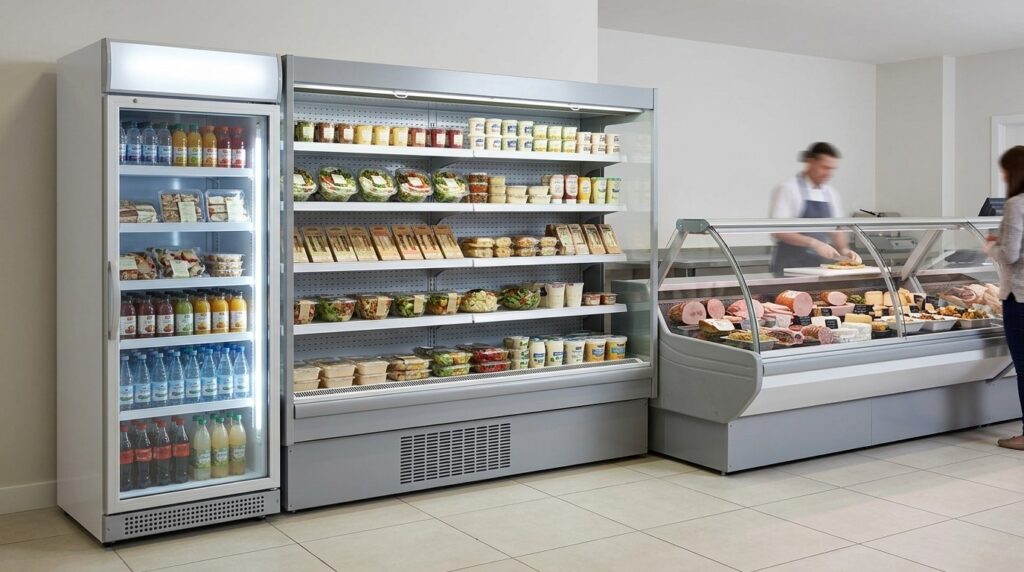
Learn how Unifrost FDR3, GDR1000 fridges, and DCF deli counters fit into Irish café layouts. Explore visibility, layout strategies and energy use.
Unifrost FDR3 vs GDR1000 Display Fridges vs DCF Deli Counters: Front Counter Layout Comparison
You are usually deciding between three different selling styles at the front of house: FDR3 multidecks for high-visibility grab-and-go, GDR1000 glass door uprights for drinks and packaged items on a wall or back bar, and DCF serve-over deli counters for assisted service and made-to-order food. The wrong choice shows up fast in queue build-up, slow service, poor product visibility, and higher day-to-day running effort.
This guide compares where each Unifrost family fits best, then walks you through the practical checks that matter when you are planning an Irish café or deli layout. You will use it to weigh up self-service versus staffed service, how much of your range needs front-facing merchandising, what counter length and customer flow you can realistically support, and the operational tradeoffs around cleaning access, food safety routines, and energy use. By the end, you should be able to map FDR3, GDR1000, and DCF units into one coherent counter run that moves customers from grab-and-go to made-to-order without blocking your team.
Core Differences Between Unifrost Models
FDR3 multidecks, GDR1000 uprights, and DCF deli counters are built for different front-of-house jobs in Irish cafés, delis, and convenience-style foodservice: self-serve grab-and-go, visible chilled drinks and packaged goods, and assisted-service chilled display.
The key difference is customer access. That one choice affects queue flow, how much handling your stock gets, and how hard the cabinet has to work to hold temperature during a busy spell.
FDR3 / FDR3OG: open-front browsing and quick picking.
GDR1000 / GDR1000OG: glass-door display with controlled access.
DCF1300 / DCF1600 (and OG variants): serve-over counter where staff portion and serve.
All three can support safe chilled holding when installed correctly and operated with good routines, but the best fit depends on whether you want self-service speed, a bit more control, or a staffed counter experience.
What “customer access” means in day-to-day trading
With an FDR3, customers can grab product in seconds. That suits high-throughput takeaway coffee sites and commuter trade where queue speed matters. The trade-off is simple: an open front means chilled air is constantly being pulled into the room. Real-world performance depends heavily on placement, especially keeping it away from doors, direct sun, heaters, and heat sources like coffee machines.
A GDR1000 is still visual and customer-facing, but the door adds a natural pause and cuts down on casual handling. In practice, it’s easier to keep drinks and packaged lines tidy, labelled, and rotated because you are not rebuilding the shelf after every rush.
A DCF flips the model. Customers choose with their eyes, but staff control portions, utensils, and pace. That control is useful for higher-risk foods and messy service items, and it usually keeps the display looking presentable for longer because customers are not handling product.
How display style changes what actually sells
An FDR3 tends to favour quick decisions and multi-item picks: sandwich plus drink plus sweet. You are merchandising by range and facings, so consistent packaging and clear pricing matter more than a perfectly styled display.
A GDR1000 suits drinks and packaged goods where stacking and label visibility do the selling. Doors can reduce pure impulse compared to open-front browsing, but you often gain better organisation and less time spent recovering the cabinet after peak periods.
A DCF is for products that sell best when they look fresh and can be described by staff: deli meats, salads, portioned desserts, and anything where the customer benefits from a quick “what’s that?” chat. It can lift spend, but only if you have the staffing and service flow to match.
Food safety and temperature control: same goal, different operational risks
Whatever format you choose, the aim is chilled food held out of the danger zone. The Food Safety Authority of Ireland notes that fridges and chill cabinets should be set so that food is held between 0°C and 5°C (FSAI temperature control guidance).
Where they differ is how that target gets challenged during service:
Open-front (FDR3): more heat gain from the room during browsing. Packaging matters because small, sealed items warm quicker in customers’ hands and are more likely to be put back.
Glass-door (GDR1000): the main pressure is repeated door opening during rushes, plus overstocking that blocks airflow.
Serve-over (DCF): the risk is mostly staff-driven. Leaving access panels open, crowding product too high, or slow portioning can increase exposure time and reduce temperature recovery.
Space planning and counter-run design: where each unit belongs
An FDR3 usually works best early in the customer journey, where people can browse without blocking ordering and payment.
A GDR1000 earns its keep either behind the counter for staff-only drinks, or on the customer side as a clear “add a drink” stop that doesn’t interfere with service.
A DCF is often the anchor of made-to-order service. It needs:
a clean working side behind the glass,
a comfortable reach zone for staff,
and enough queuing space so customers are not pressed up against the display.
If you are combining formats, a practical rule is to separate browsing from ordering. Put self-serve (FDR3 or a customer-facing GDR1000) where customers can step aside, and keep the DCF tight to the service point so staff can portion quickly and keep the queue moving.
Performance and best use-cases for each model
FDR3/FDR3OG, GDR1000/GDR1000OG, and DCF1300/DCF1600 (including OG variants) are all front-of-house options, but they suit different service styles.
FDR3 is an open multideck for high-speed self-serve grab-and-go.
GDR1000 is a glass door upright for controlled self-serve display, especially drinks and packaged lines.
DCF is a serve-over counter for assisted service, portioning, and presentation.
They can all hold chilled food safely when operated correctly, but in practice your decision comes down to customer flow and staff time. For chilled holding, plan around typical retail chilled storage in the 0°C to 5°C band in line with FSAI guidance on chilling and safe storage temperatures.
How do FDR3, GDR1000 and DCF compare overall?
Think in terms of access versus control:
If you sell a lot of pre-packed items at speed, FDR3 suits because customers can browse and take without waiting for staff.
If you mainly sell drinks, desserts in packs, and neat branded lines, GDR1000 gives you strong visibility with a physical barrier that keeps the display orderly.
If your best sellers need portioning, wrapping, allergen control, or staff-led upsell, DCF fits because it’s a service station first and a display second.
The trade-off is straightforward: the more self-serve you allow, the more you rely on tight routines for replenishment, facing-up, and rotation so the cabinet still performs and the display still looks intentional during the rush.
FDR3 / FDR3OG: best for fast grab-and-go
Choose FDR3 when you want the cabinet to drive impulse sales of sandwiches, salads, yoghurts, and packaged “lunch to go” lines. It makes sense where you have steady footfall and you want customers to make their choice quickly, ideally before they hit the till.
Operationally, open-front multidecks reward good habits and punish sloppy ones. You will need:
regular facing-up so it doesn’t look picked over by 12:30pm
strict date rotation
sensible loading so you don’t block airflow by packing it like a storeroom
GDR1000 / GDR1000OG: best for drinks and tidy packaged lines
Choose GDR1000 when you want a clean, easy-to-manage display for drinks and packaged items near the counter. The door adds a small step for the customer, but it also helps with orderliness and reduces casual handling compared with an open deck.
In day-to-day trading, this format is often the easiest to keep looking sharp because stock stays aligned behind the glass and top-ups are quicker and less disruptive than re-facing a full open deck.
DCF1300 / DCF1600 (and OG variants): best for assisted service and portion control
Choose DCF when the counter is part of the production line, not just merchandising. It suits deli meats, salads by weight, premium cakes, and any offer where staff need to portion, wrap, and manage allergens and cross-contact.
A serve-over counter also helps when you have limited frontage but higher-value items. You can keep the range tight, control access, and avoid customers hovering in the same space trying to browse and pay at once. In busy lunchtime trade, that clearer “order point” usually makes queue behaviour more predictable.
Which is best for your front counter?
Match the unit to how people actually buy from you:
If most chilled sales are self-serve, lead with FDR3 for food, and use GDR1000 for drinks so each unit stays focused on its job.
If drinks and packaged items dominate, lead with GDR1000, and only add a DCF where assisted service genuinely earns its space.
If most chilled sales need staff handling, lead with DCF, and treat FDR3 or GDR1000 as secondary add-on display rather than the main event.
Once the primary unit is right, you can plan the counter run around flow so browsing doesn’t collide with ordering and pick-up when you’re under pressure.
Day-to-Day Operational Considerations
Running multidecks (FDR3/FDR3OG), glass-door display fridges (GDR1000/GDR1000OG) and serve-over deli counters (DCF1300/DCF1600) without creating cleaning, food safety or staffing problems comes down to routine. Agree the loading rules, the temperature-check schedule, and who owns close-down cleaning. Then tailor that routine to the cabinet type, because an open-front multideck behaves very differently to a glass-door upright, and both are different again to a serve-over counter.
Build the checks into your HACCP so you catch issues early, not after product has drifted warm. It also needs to survive Irish trading reality: morning delivery drops, lunchtime queues, and doors being opened constantly on wet days.
1. Set food safety controls around how the cabinet is actually used
In chilled display, the biggest risk is usually temperature creep during service, not the controller setpoint. The FSAI guidance is that fridges and chilled display cabinets should be set so food stays between 0°C and 5°C. In practice, a setting around 3°C to 4°C is commonly used to achieve that, depending on conditions and loading (FSAI temperature control guidance for caterers).
That means you operate each format to suit how it holds temperature during trading:
FDR3 (open-front multideck): needs the tightest loading and replenishment discipline because it is exposed to ambient air for the full trading day.
GDR1000 (glass-door upright): gives more stability, but only if doors are closed properly during rush periods and seals are kept clean.
DCF (serve-over counter): is often closest to heat sources and constant interaction, so the “open, serve, close” rhythm matters as much as the refrigeration.
2. Use a temperature-check routine people will actually follow
A display is only as safe as the checks you can evidence. The FSAI recommends using a calibrated probe thermometer to check and monitor food temperatures as part of your HACCP plan, and recording the temperatures measured (FSAI temperature control guidance for caterers).
To make that workable in cafés, delis and forecourt food:
Probe the food, not just the cabinet display, especially slower-selling items and anything sitting in warmer spots.
On multidecks (FDR3): spot-check the top shelf and the front edge where product is most exposed.
On serve-over counters (DCF): check a “worst case” item that gets handled often, but also check a thick, cold product occasionally. It can mask slow recovery if the counter is being opened repeatedly.
Keep the log simple: time, product checked, reading, initials, and what you did if it was out of range. If it is a pain, it will get skipped.
3. Reduce cross-contamination with clear zoning and “hands in cabinet” rules
Most day-to-day trouble comes from mixing self-service and assisted-service without clear boundaries. As a rule, multidecks and glass-door uprights suit sealed, prepacked grab-and-go, while serve-over counters suit open food handled by staff.
Keep it straightforward:
Put ready-to-eat sealed items in self-service (FDR3 or GDR1000).
Keep open food, portioned deli items, and anything needing utensils behind the DCF glass for assisted service.
Don’t let the DCF become “storage at the front counter”. It should be a presentation and service unit, with back-up stock held elsewhere so staff are not digging through trays during a queue.
4. Make cleaning achievable during a busy trading week
If it cannot be cleaned quickly, it will not be cleaned properly. Open-front multidecks generally need more frequent wipe-downs during service because they pull in dust and catch spills. Glass-door uprights and deli counters tend to concentrate mess around door seals, glass, ledges and the staff side.
Use one close-down routine across all cabinet types, with a few format-specific checks:
Wipe high-touch points first: door handles (GDR1000), customer reach points and shelf fronts (FDR3), staff-side ledges and sliding areas (DCF).
Check for blocked airflow paths and spills under shelves or trays. Restricted airflow is a common reason a cabinet “looks cold” while product is not holding temperature.
Quick visual checks that save money and problems:
GDR1000: doors closing properly, seals clean, no product fouling the close.
FDR3: avoid overfilling and keep product within the intended shelf/loading area so air can circulate.
Assign ownership: one person per shift responsible for “front counter refrigeration” so it does not become everyone’s problem and nobody’s job.
5. Staff for service speed, not just presentation
The biggest operational difference is labour. Serve-over deli counters (DCF) rely on assisted service. That is great for portion control and food safety, but it becomes a bottleneck if one person is slicing, portioning, answering questions and taking payment. Multidecks (FDR3) and glass-door displays (GDR1000) reduce labour per sale for packaged items, but they increase replenishment, rotation and “facing up”.
A sensible way to plan it in many Irish cafés is:
Use GDR1000 for quick-grab drinks and packaged items where you want stable temperatures and tidy merchandising.
Use FDR3 where you have the volume to keep it stocked, rotated and faced up through the day.
Use DCF only where you are genuinely serving product that justifies the staffing time.
Once that baseline is clear, it is easier to judge whether a cabinet choice fits your service flow, rather than choosing on looks and then trying to force the operation to match it.
Choosing for Different Venue Types
Venue type and service style matter because they dictate how the cabinet is used minute to minute: how often the cold zone is opened, how long doors sit open, how fast stock turns, and how easily your team can keep to routine checks and safe storage. Your HACCP controls still apply either way, and chilled food needs to be held in the 0°C to 5°C range as per FSAI temperature control guidance. The practical point is that the “right” format depends on frontage, queue behaviour, and how disciplined replenishment is during service, not just how the display looks.
Small café, high takeaway mix, limited frontage
With a tight counter line, separate grab from make.
An open-front multideck (FDR3-style) suits self-service grab-and-go, where customers can pick up prepacked sandwiches, salads and yoghurts without slowing the barista.
A glass door display fridge (GDR1000-style) is often the sensible drinks option when you want visibility, a clear product list, and less time with the chilled space exposed.
A serve-over deli counter (DCF-style) earns its keep when your offer is made-to-order and you need portion control and less customer handling. Staff control what’s opened, what’s rotated, and what’s kept back.
The common mistake in a small unit is trying to make one cabinet do everything. It usually shows up as queues at the worst time and awkward restocking right in the middle of service.
Busy deli, bakery, or forecourt-style operation with queues
At sustained lunchtime pressure, you’re designing for queue speed and clean staff movement behind the counter.
DCF serve-overs work well where one or two staff can keep service moving while controlling what’s on display and what stays in reserve. They also create a natural “order point”, which helps stop customers bunching at the pass.
Use multidecks and glass door displays as queue relief, not as competing focal points.
A layout rule that generally works is: place self-service chilled on the approach to the till (multideck for food, glass door for drinks), and keep the serve-over on the main counter run where you can serve, wrap, and take payment without staff crossing paths. If you cannot give staff a clear working lane behind the serve-over, you lose the speed advantage you bought it for.
Pub, bar food counter, hotel lobby, or mixed dayparts
Where trade swings from quiet to sudden bursts, ease of use and recovery during rushes matter as much as raw capacity.
A glass door display fridge (GDR1000-style) tends to be the most straightforward “always-on” choice for drinks and packaged items. It’s easy for staff to face up and easy for customers to understand, even when the bar is busy.
Add an open-front multideck (FDR3-style) when you want true grab-and-go that doesn’t require a staff member to leave the bar.
Choose a serve-over (DCF-style) when you actually have a staffed counter moment: deli service, carvery-style plating, or a dedicated food point.
The key trade-off is labour. A serve-over can improve control and presentation, but it only pays back if you can staff it properly during your peak windows.
These venue-led choices make it easier to judge what you’ll feel day to day: serving speed, temperature stability during rushes, and which format best matches how your team actually works.
Integrating Unifrost Products into a Coherent Layout
Plan the counter run around behaviour first: what’s genuinely self-serve, and what needs staff control. Then match each zone to the right format: FDR3 multidecks for fast grab-and-go visibility, GDR1000 uprights for drinks and sealed packaged items, and DCF deli counters for assisted service. Sketch the customer route and the staff working route so you are not trying to replenish, slice, wrap, and take payment in the same pinch point.
Before you lock anything in, pressure-test the layout against the boring realities that decide whether it works at lunch: door swings, replenishment access, cleaning space, heat sources, and peak-time temperature recovery. A counter that feels slick at 10am can become a traffic jam at 1pm.
1. Decide what is self-serve versus staff-served (and don’t blur it)
This is a service decision, not a cabinet decision.
If customers should be able to grab and go without interaction, build that zone around FDR3 and GDR1000.
If you need staff control for portioning, allergen separation, freshness cues, or simply keeping hands off product, that belongs in DCF assisted service.
A common mistake in Irish cafés and delis is mixing self-serve browsing with assisted service at the same point in the queue. When customers pause at an open display while staff are serving beside them, you get shoulder-to-shoulder congestion and slower throughput, even if each unit performs well on its own.
2. Zone by product type and replenishment reality, not wishful merchandising
Set zones based on how often you restock and how messy the product is to handle. A practical split for many cafés, forecourts, and bakery counters looks like this:
FDR3: high-turn, prepacked grab-and-go where front-on visibility matters (sandwiches, salads, yoghurt pots, impulse add-ons).
GDR1000: drinks and sealed packaged items where a closed door helps temperature stability and reduces casual handling.
DCF: made-to-order and assisted service (deli meats, filled rolls, salads by weight, desserts you want staff to plate).
This also separates “clean work” from “customer touch”. The DCF becomes controlled service. FDR3 and GDR1000 carry the self-serve sales without dragging staff into constant interruptions.
3. Build a customer path that sells, and protect the staff path so it keeps moving
Put the quick wins on the approach, then feed customers into the service point. In many sites, that means FDR3 and/or GDR1000 on the run-up to the till, with the DCF positioned where the queue naturally forms for assisted service.
On the staff side, protect working space:
Keep a clear lane behind the DCF for serving, wrapping, and passing to the till.
Make sure staff can restock FDR3 and GDR1000 without cutting through the customer queue.
If you cannot keep those routes separate, simplify. Fewer units with clean flow usually outperforms a “hero” line-up that creates bottlenecks.
4. Plan the non-negotiables: access, cleaning, and heat
Front-of-house refrigeration usually fails for practical reasons: blocked vents, doors that cannot open properly, shelves that never get cleaned properly, and stock that cannot be rotated.
When placing units, think through the daily jobs:
Replenishment and date rotation: Can you reach in, rotate stock, and pull out-of-date items quickly during service?
Cleaning: Can you clean around and under the unit without having to move it every week?
Heat and sun: Avoid placing display refrigeration where it will take direct sun through glazing or heat wash from coffee machines, dishwashers, or hot holding.
If you are fitting out an older Irish unit with narrow passages or tight turns, confirm the delivery route early. Plenty of good layouts fall apart when the cabinet cannot be brought through the door.
5. Make food safety checks easy, and set routines around what you actually sell
Your layout should support HACCP checks, not make them harder. The usual pressure points in a mixed counter run are frequent door opening on drink fridges, long dwell time at the deli counter, and overfilling displays so air cannot circulate.
Build simple habits into the layout: clear product limits, tidy loading, and easy temperature checking during service. For chilled food, keep controls aligned with FSAI guidance on chilled food being held at 5°C or below: https://www.fsai.ie/business-advice/running-a-food-business/food-safety-controls/temperature-control
Once the flow and routines are right, you can judge each format on what matters in real trading: visibility, serving speed, temperature stability under pressure, and how forgiving it is when the lunch rush gets messy.
Zoning Layouts and Future-Proofing Considerations
Zone your front counter based on how customers actually buy, not on “what fits where”. In most cafés and delis, that means separating quick self-service from assisted service. Done well, you reduce queue friction and make temperature control easier, because doors are opened less often and staff are not constantly reaching into display refrigeration during peak periods.
Cold holding still has to do the basics: chilled food should be kept between 0°C and 5°C. Many operators set fridges around 3°C to 4°C to stay comfortably inside that window, but the real test is how the unit performs during Irish breakfast and lunch peaks when doors open repeatedly and warm air is dragged in. See the FSAI temperature control guidance.
Self-service zone vs assisted-service zone (and why mixing them slows you down)
Treat FDR3 and GDR1000 as your self-service zone. They work best when customers can browse without blocking the till, and staff are not opening the unit every few minutes to help.
Treat the DCF deli counter as assisted service. It belongs where a queue can form without trapping customers who only want a drink, and where staff have a clean workflow for wrapping, labelling and handover.
When you blur these zones, you create pinch points: one customer waiting on a made-to-order sandwich can end up blocking several people who just want to grab a bottled drink. The practical aim is:
Quick grab peels off early
Made-to-order flows towards staff and payment
Practical zoning for one coherent counter run (cakes, sandwiches, salads, drinks)
A workable approach in Irish cafés and delis is to start the customer journey with the fastest decisions and finish with the highest labour items:
Drinks and prepacked impulse in a GDR1000 upright (easy browse, quick restock).
Grab-and-go in an FDR3 multideck (sandwiches, salads, yoghurts where visibility drives sales).
Assisted service at the DCF deli counter, where customers already expect to wait while you slice, portion and serve.
If you also run a cake display (for example, Unifrost HGP/CDV families), place it either:
Near the till for the last-minute add-on, or
Beside coffee pick-up, where it sells while customers wait.
The key is keeping the flow consistent. Customers should not have to cross back through a queue to add an item, and staff should not have to leave the serving position to open a drinks fridge mid-rush.
Front counter layout mistakes that cost you money (and how to avoid them)
A few layout errors show up again and again in day-to-day service:
Putting an open-front display (like an FDR3) beside draughts or in the path of the entrance. Temperature stability becomes harder, and stock rotation pressure increases.
Placing an open display beside a frequently opened door unit. You end up fighting warm air loads from two directions during peak trading.
Forgetting replenishment space. If there is no clear restock lane behind the merchandising line, staff restock from the customer side. Service slows, and breakages and spills go up.
Designing the whole run for today’s menu only. Many Irish cafés shift seasonally towards more takeaway, delivery aggregation, or prepacked lines. A layout built around plated brunch can feel clumsy when you move to higher-volume grab-and-go.
Future-proofing: choose formats that can flex with menu and service changes
If you expect more prepacked items, longer opening hours, or higher staff turnover, keep the system simple: a clear self-service offer (FDR3 and GDR1000) and a DCF reserved for true assisted-service lines.
If you expect more specials, custom builds and higher-touch service, the DCF becomes the “theatre” piece. In that case, use the FDR3 and GDR1000 to take pressure off the queue, rather than trying to do everything through the counter.
Before you commit to a layout, sanity-check it against your own operation:
If takeaway jumps by 30% on a wet Tuesday, can customers grab drinks (GDR1000) without joining the made-to-order queue (DCF)?
If you add more prepacked lines, do you have enough high-visibility self-service frontage (FDR3) without cramming too many categories into one unit?
If staffing gets tighter, can one person run the DCF while the rest of the chilled offer sells itself from FDR3/GDR1000?
If the menu shifts, can you re-zone categories (cakes vs deli vs drinks) without moving power points and tearing up the counter run?
Can you keep chilled food reliably within 0°C to 5°C during peaks, in line with the FSAI temperature control guidance?
Once the zoning is right, the decision becomes less about what looks neat on day one and more about which unit type will hold temperature, handle service pressure, and fit your workflow week after week.
FAQs: Choosing Between FDR3, GDR1000 and DCF for a Café Front Counter
What is the difference between a serve-over deli counter and a glass door/multideck fridge?
A serve-over deli counter (like the Unifrost DCF range) is built for assisted service: staff stand behind it, present fresh items through the front glass, and serve to order. It is ideal for made-to-order deli, bakery, and “talk to the customer” selling.
A multideck-style display merchandiser (like FDR3 / FDR3OG) is designed for self-service grab-and-go with a high-visibility open merchandising face. A glass door upright display cooler (like GDR1000 / GDR1000OG) is typically used for drinks and packaged items on a wall or back-bar where customers can see the range through the doors but products remain enclosed.
How do I choose the correct size and capacity for my café’s display units?
Start with what you need to sell, where, and how often you can restock:
Menu and pack format: Use DCF when you need space for trays and an assisted-service presentation (deli meats, pastries behind the counter, plated items). Use FDR3 for pre-packed grab-and-go lines (sandwiches, salads, desserts in pots). Use GDR1000 for bottles/cans and packaged items.
Frontage vs depth: In tight counter areas, prioritise the unit that gives the most sellable frontage for your hero category (for many cafés that is grab-and-go, so an FDR3 can act as a “feature” unit). If you have queueing space and staff-led service, a DCF1300/DCF1600 style length is often chosen based on how many products you want visible at once.
Restock rhythm: If you can restock little and often, you can run a smaller display and keep it looking full. If restocking is infrequent (busy service, limited staff), size up so the display stays presentable through peak periods.
Layout reality check: Tape the footprint on the floor and confirm you can still achieve a clean flow: order point, payment, pick-up, and staff access behind the counter without bottlenecks.
Which offers better visibility for maximizing impulse sales?
For pure impulse visibility, an ultra high-vision multideck-style unit like Unifrost FDR3 is usually the strongest choice because customers can scan products quickly as they approach, without waiting for service.
That said, visibility depends on what you’re selling:
FDR3: Best for fast browsing and “add one more item” moments in grab-and-go.
DCF serve-over: Best when the product benefits from staff recommendation and premium presentation (fresh pastry selection, deli specials). The visibility works with the theatre of service.
GDR1000 glass door: Great for drinks and packaged lines where customers want certainty and range, and the doors help keep stock protected and organised.
A common high-performing café setup is FDR3 near the entrance/queue to drive add-ons, with DCF at the order point for made-to-order items, and GDR1000 on the wall/back-bar for drinks.
Next step: Map your layout to the right Unifrost range
If you’re planning a new counter run or upgrading your display, it helps to shortlist the unit type first (self-service grab-and-go vs assisted deli service vs drinks wall), then work backwards from your available frontage and service flow.
Browse the options in Explore Unifrost Fridges to compare display styles and pick a range that suits your café layout.
Related Unifrost guides
Compare models, maintenance advice and support information related to this topic.
Finding and Using Unifrost Display Fridge, Freezer & Bottle Cooler Manuals
Learn how to access Unifrost display fridge and cooler manuals. Ensure your business refrigeration runs smoothly.
Read guideView Unifrost fridges at Caterboss
For current product options, pricing and availability, continue to Caterboss.